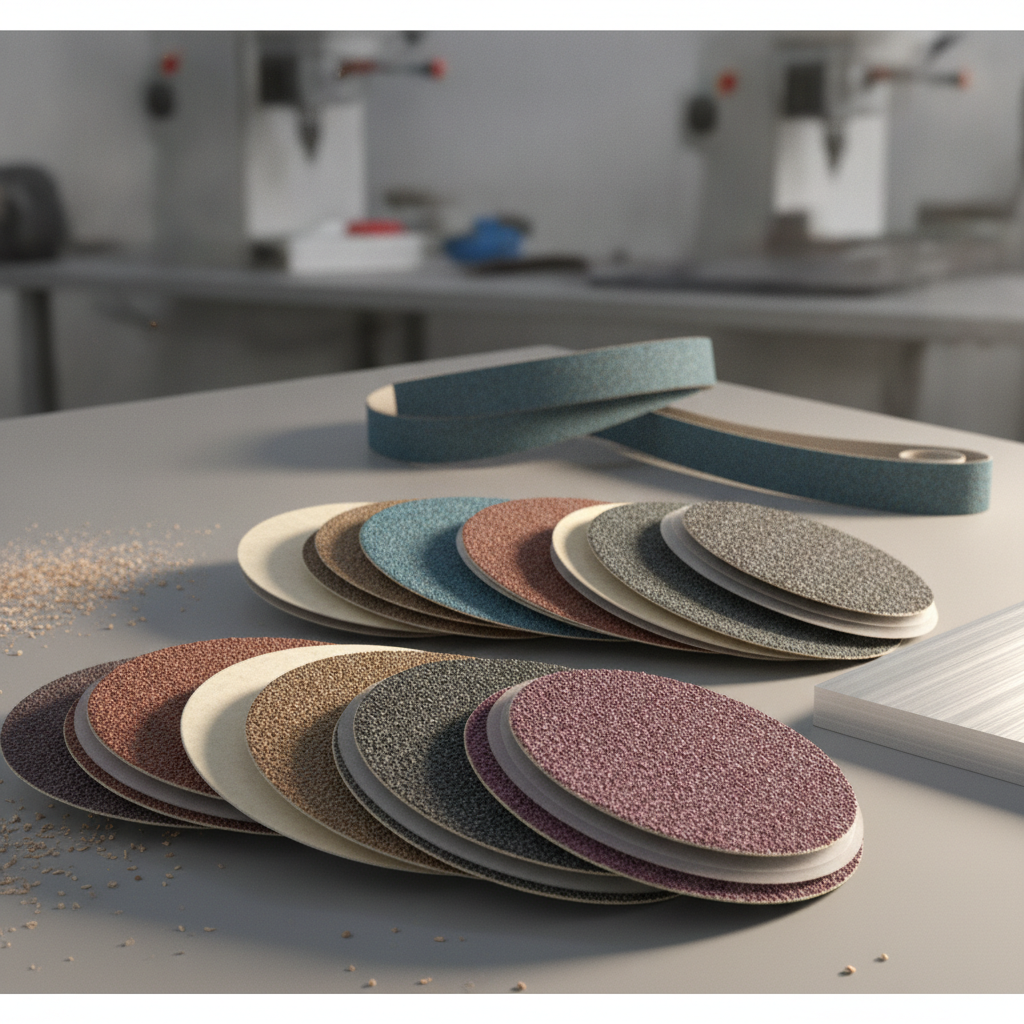
What Materials Are Sanding Discs Made Of? Expert Guide
A metal fabrication buyer in Suzhou once sent me two sanding discs that looked almost identical on paper. One burned edges on stainless welds in minutes. The other ran clean and lasted far longer. The difference was not magic. It was materials.
Sanding discs are built from multiple material layers, and each layer affects cutting behavior. Abrasive grains commonly include aluminum oxide, zirconia alumina1, ceramic alumina, and silicon carbide2, each with different hardness, toughness, and fracture characteristics. Backing materials such as paper, cloth, film, fiber, foam, or mesh determine flexibility, tear resistance, and finish consistency. Resin bond systems, coatings, and grit grading further influence heat generation, loading resistance, disc life, stock removal rate, and scratch pattern control across wood, metal,
What Abrasive Grains Are Sanding Discs Made Of?
Sanding discs are commonly made with synthetic abrasive grains including aluminum oxide, zirconia alumina, ceramic alumina, and silicon carbide. Aluminum oxide serves general-purpose sanding, zirconia and ceramic support heavier metal removal, and silicon carbide suits hard, brittle, or heat-sensitive surfaces. Specialty discs may also use garnet, diamond, or CBN for niche applications requiring specific cutting behavior or material compatibility.
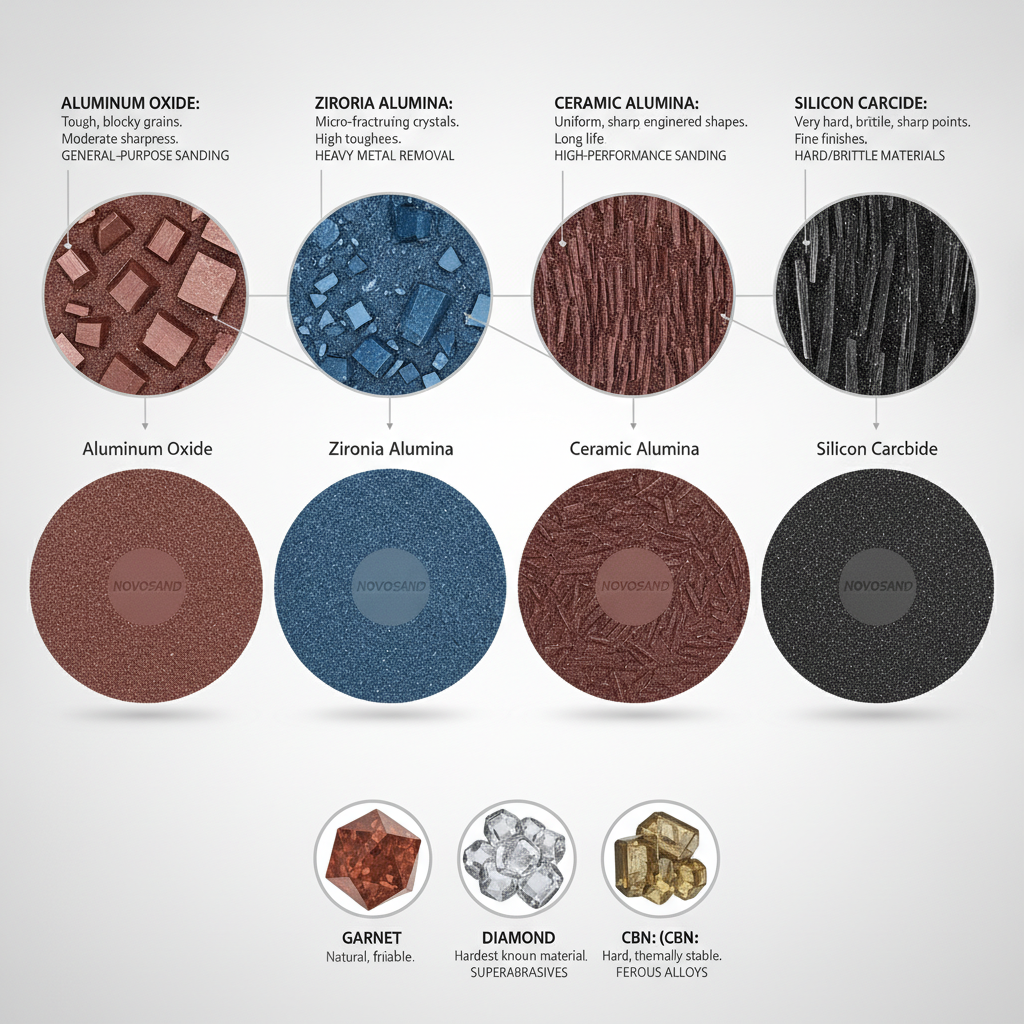
Grain type decides how a sanding disc actually behaves on the machine. The same P80 disc can cut fast, run cool, or die early depending on whether the grain is aluminum oxide, zirconia, ceramic, or silicon carbide.
| Grain Type | Best For | Typical Grit Range | Common Backing | Performance Note |
|---|---|---|---|---|
| Aluminum oxide | Wood, fillers, general metal prep | P40–P400 | Paper or cloth | Balanced cost and life |
| Zirconia alumina | Weld blending, heavy stock removal | P24–P120 | Vulcanized fiber3 or polyester | Needs pressure to self-sharpen |
| Ceramic alumina | High-pressure metal grinding | P24–P120 | Heavy fiber or Y-weight cloth | Very high cut rate, long life |
| Silicon carbide | Clear coat, glass, stone, composites | P80–P2000 | Film, paper, or mesh | Sharp finish, but more friable |
In one metal fabrication project, a customer switched from P60 aluminum oxide fiber discs to P60 zirconia on carbon steel brackets.
Disc life improved by around 30%, and weld blending time dropped roughly 15% per part.
This is a common pattern when operators apply enough pressure for zirconia to fracture and expose fresh cutting edges.
For furniture sanding, aluminum oxide still makes the most sense in many lines.
I supplied 5-inch hook & loop paper discs (P120 to P240) to a cabinet factory, and they preferred aluminum oxide because it gave stable finish quality on MDF and solid wood at a lower disc cost.
"AFalse
"Grit
Silicon carbide is the standard grain for most general-purpose wood sanding discs because its rounded grain shape resists loading better than aluminum oxide from P40 through P400.False
Silicon carbide is usually sharper but more brittle than aluminum oxide, making it better suited to hard, brittle materials, finishes, glass, stone, and some nonferrous applications rather than mainstream general-purpose wood sanding. Aluminum oxide is more commonly used on wood because it offers a better balance of cost, durability, and versatility across a wide grit range.
How Do Abrasive Grains Affect Performance?
Abrasive grain properties determine cutting speed, disc life, heat generation, and scratch consistency. Silicon carbide is hard, sharp, and friable for brittle or non-ferrous materials; aluminum oxide is tougher for general sanding; zirconia and ceramic grains suit high-pressure metal removal. Matching hardness, toughness, fracture behavior, and heat response to the workpiece improves efficiency and prevents premature dulling or unnecessary abrasive cost.
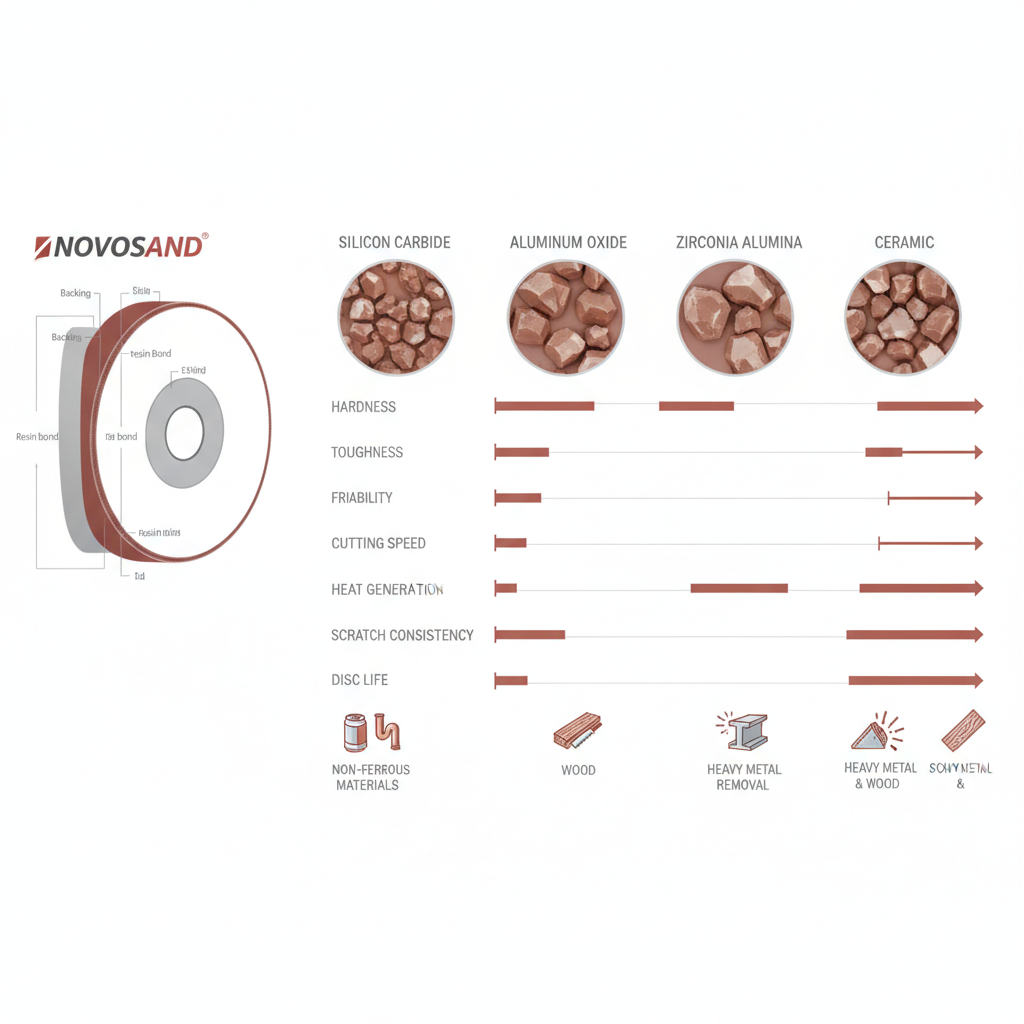
Cutting speed changes fast when the grain and workpiece fight each other. A disc can feel sharp in the first minute, then glaze, heat up, and leave an uneven scratch if the grain’s hardness and fracture pattern do not match the job.
Silicon carbide cuts with a very sharp point, but it is more friable, so it breaks down faster under pressure. That helps on glass, stone, solid surface, and plastics because fresh edges keep appearing. In one furniture components project, a P180 silicon carbide paper disc on melamine panels gave cleaner edge sanding than aluminum oxide, with roughly 15-20% less chipping around cutouts.
Aluminum oxide is tougher and more stable. I usually suggest it for wood, primers, fillers, and general metal sanding where operators need predictable life, not maximum aggression. A woodworking customer in Jiangsu switched from silicon carbide to P150 aluminum oxide on 5-inch hook & loop discs with C-weight paper, and disc use dropped from about 14 discs per shift to 10.
For heavy metal removal, zirconia and ceramic make more sense. Zirconia handles high pressure well on carbon steel and weld blending, while ceramic micro-fractures in a controlled way, so the cut rate stays high longer. I have seen a metal fabrication shop move from conventional aluminum oxide to a P36 ceramic fiber disc and get around 25-30% longer life on stainless weld cleanup, with less blue heat marking.
Here’s what matters most: buy grain for the actual sanding pressure, material hardness, and heat sensitivity. I suggest running a small production trial first, because the cheapest grain often becomes the most expensive per workpiece.
Silicon carbide sanding discs often maintain a more uniform scratch pattern on glass, solid surface, and plastics because their friable grains micro-fracture under load, exposing new sharp points even though the disc may wear out faster than aluminum oxide.True
This is true because silicon carbide is both very hard and relatively friable. Instead of rounding over and rubbing, the grain tends to break and reveal fresh cutting edges, which helps it keep cutting cleanly on brittle or low-melting materials. That fresh-edge renewal can reduce glazing and heat buildup, but the tradeoff is shorter abrasive life under heavy pressure compared with tougher grains like aluminum oxide or ceramic.
Silicon carbide is the best choice for high-pressure steel grinding because its grains resist fracture and become smoother as they wear, which increases disc life and lowers heat.False
This is false because silicon carbide does not resist fracture well under heavy pressure; it is intentionally more friable. On steel and other high-pressure metal applications, that brittleness can cause rapid breakdown rather than long life. As the grain fractures or dulls in the wrong application, the disc can lose efficiency, generate more heat, and wear faster than tougher grain types designed for metalworking.
How Do Backing Materials Affect Sanding Discs?
Backing materials control sanding disc flexibility, tear resistance, edge durability, finish consistency, and suitability for wet or dry use. Paper suits light to moderate finishing, cloth handles higher loads and edge work, polyester film5 supports precise fine finishing, and vulcanized fiber provides rigidity for coarse grinding. Selection depends on tool speed, pressure, part geometry, finish requirements, and downtime cost rather than fixed claims about life or price.
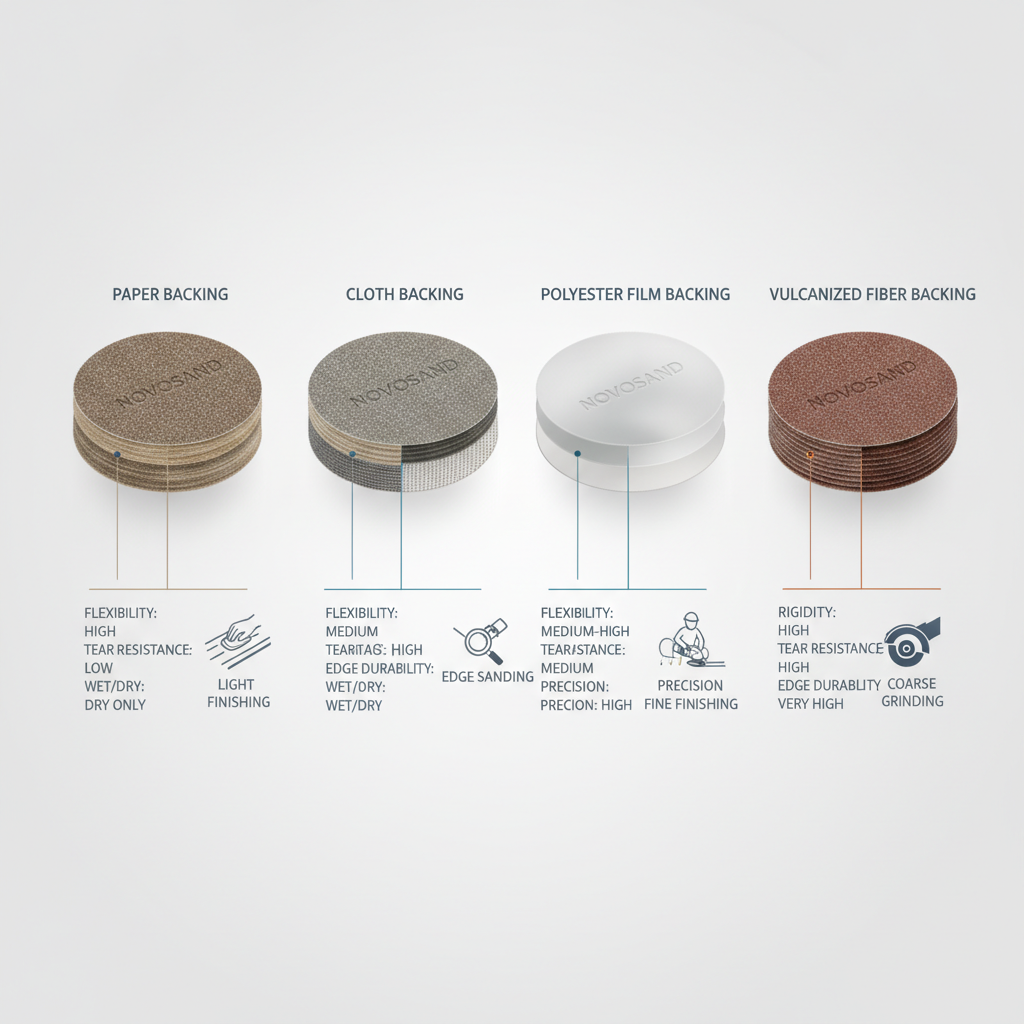
Backing material decides whether a disc bends with the part, holds its edge, or fails early at the rim. In practice, the backing often explains finish variation faster than the grain type does.
Paper works well for light to moderate sanding because it stays economical and flexible, especially in P120 to P400 finishing. A furniture factory I supported used 5-inch, C-weight paper discs on sealer sanding, and they gave stable results on flat panels. But once operators pushed harder on profile edges, the disc edge frayed and disc changes increased. That is a common limit.
Cloth handles that abuse better. In metal shops, I usually suggest X-weight or Y-weight cloth when the job includes edges, corners, or higher contact pressure. One customer making stainless cabinets switched from heavy paper to X-weight cloth in P80 and P120, both with zirconia grain and resin bond. Disc consumption dropped by around 20% per shift because tearing stopped near sharp edges.
For finer finishing, polyester film gives better dimensional stability. That means the backing stays flatter, so the scratch pattern stays more uniform. I have seen this clearly in automotive refinishing, especially with P800 to P2000 wet sanding. A refinishing line in South China changed to film-backed hook & loop discs for primer denibbing, and rework fell by roughly 15% because the finish stayed more consistent.
Vulcanized fiber is different again—rigid, strong, and built for coarse grinding on angle grinders, usually P24 to P60. I always suggest choosing backing by process conditions: speed, pressure, geometry, and finish target. Test it on the actual line first.
In P120-P400 finishing, C-weight paper-backed sanding discs often produce more uniform scratch patterns on flat panels than stiffer fiber discs because the backing can conform slightly to minor panel waviness instead of riding only on high spotsTrue
Backing stiffness directly affects how pressure is distributed across the work surface. In light to moderate finishing, a C-weight paper disc has enough flexibility to stay in contact with subtle surface variation, which helps reduce isolated deep scratches and uneven cut zones. That is why paper-backed discs are commonly chosen for sealer sanding and similar finishing steps on furniture panels.
A heavier paper backing always improves edge life, so D-weight paper discs are universally better than C-weight discs for profile edges and rim durabilityFalse
Heavier paper can improve stiffness and tear resistance in some uses, but edge life is not determined by weight alone. On profile edges, a stiffer backing may crack, curl, or cut unevenly if it cannot flex with the contour. Rim failure also depends on operator pressure, pad support, disc diameter, coating, and whether the application needs conformability more than stiffness.
How Do Resin Bonds Affect Discs?
Resin bonds control how securely abrasive grain stays attached and how well a sanding disc withstands heat, pressure, and speed. The make coat anchors grain to the backing, while the size coat reinforces retention and durability. Phenolic and resin-over-resin systems are widely used for consistent cutting, while top coatings such as stearate or grinding aids can reduce loading, friction, and heat buildup in demanding applications.
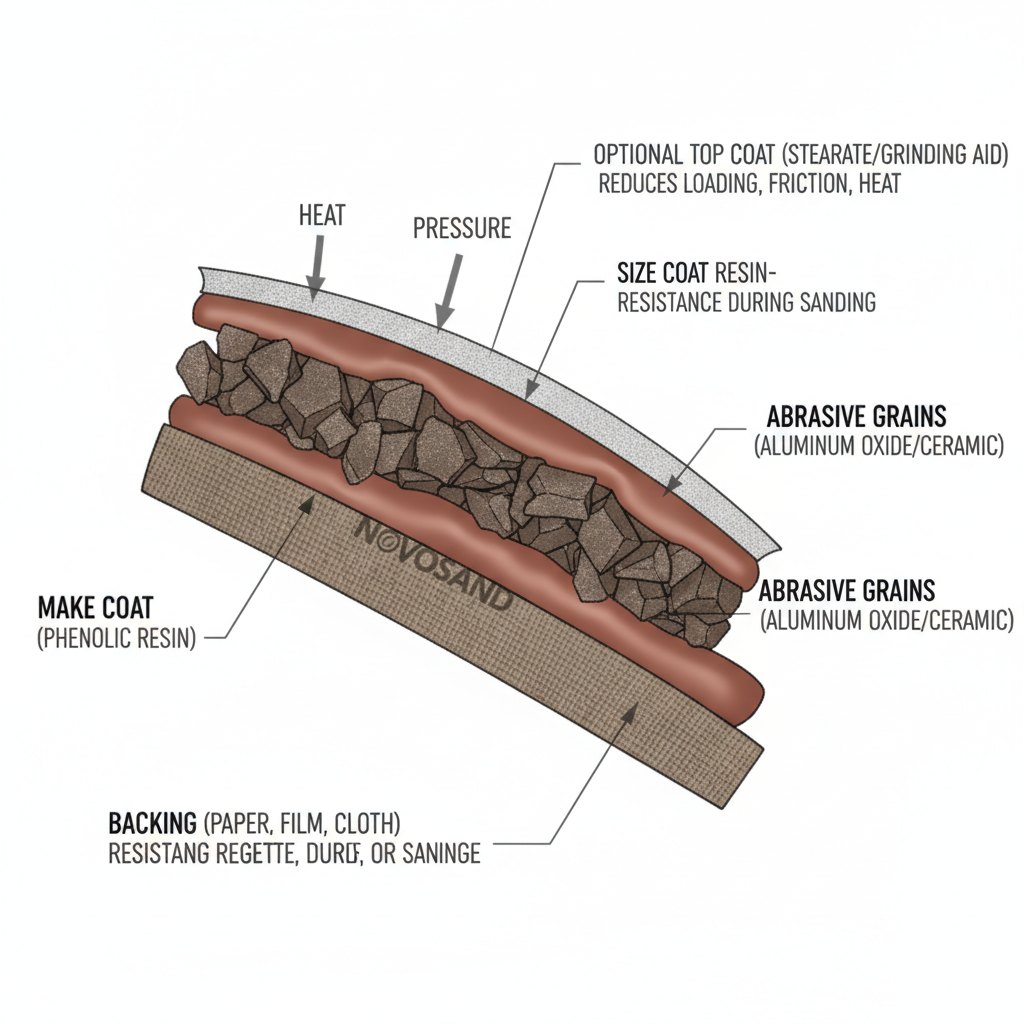
When a disc starts shedding grain early, the problem often sits in the bond system, not the grit itself. Resin bonds decide whether the disc keeps cutting under heat or turns dull, glazed, and unstable after a short run.
The make coat fixes the abrasive grain to the backing first. Then the size coat locks that grain in place and adds strength under pressure. In most industrial discs, phenolic resin or resin-over-resin construction gives better heat resistance and more stable cutting, especially on high-speed orbital sanding and edge work. A top coat also matters. Stearate helps reduce loading on wood filler and primer, while grinding aids lower friction on stainless steel.
I saw this clearly with a furniture parts supplier in Guangdong using 125 mm P180 aluminum oxide hook & loop discs on MDF sealer sanding. Their lower-cost paper-backed discs started loading after around 20 to 25 panels, and edge wear became obvious before one hour. After they tested a better resin-over-resin disc with stearate coating6, usable life increased to roughly 35 to 40 panels per disc, and the scratch pattern stayed more even.
From my experience, low-quality bonds usually show up as grain shedding, delamination, or random deep scratches. That is the spec sheet gap many buyers miss. A disc may look similar on paper, but weak resin can fail fast under real shop pressure.
I always suggest comparing bond system, backing weight, top coating, and maximum speed rating together. Then run a production trial and measure cost per finished part, not just price per disc.
In a resin-over-resin sanding disc, the make coat anchors the grain and the size coat adds a second cured resin layer that improves grain retention at elevated interface temperatures, which is why phenolic-bonded discs usually resist early shelling better than glue-bonded systems in metal grinding.True
This is true because the bond system, not just the abrasive mineral, controls whether grains stay attached under heat and pressure. The make coat secures the abrasive to the backing first, while the size coat reinforces that anchor and helps support the grain during cutting. Phenolic resin systems cure into a thermoset network with much better heat resistance than traditional glue-based bonds, so they hold abrasive grains more reliably during demanding operations such as metal grinding. That improved retention delays shelling, glazing, and unstable cut behavior.
The size coat on a sanding disc is mainly a lubricating top layer, so reducing it by about 50% generally improves cutting speed without affecting grain retention or heat resistance.False
This is false because the size coat is not primarily a lubricant; it is a structural bonding layer that helps lock the abrasive grains in place and strengthen the disc under load. If the size coat is reduced too much, grains are more likely to shed early, especially at high pressure or temperature. While some discs may include grinding aids or supersize additives near the surface, that does not change the core role of the size coat in bond integrity, grain support, and thermal stability.
How Do Grit Ranges Affect Applications?
Grit range determines how aggressively a sanding disc cuts and the scratch pattern it leaves. Coarse grits 24-60 suit stock removal, weld blending, and paint stripping; medium grits 80-180 fit surface preparation and shaping; fine grits 220-400 support finishing and primer sanding; ultra-fine grits above 600 are used for clear coat leveling, plastics finishing, and precision defect correction.
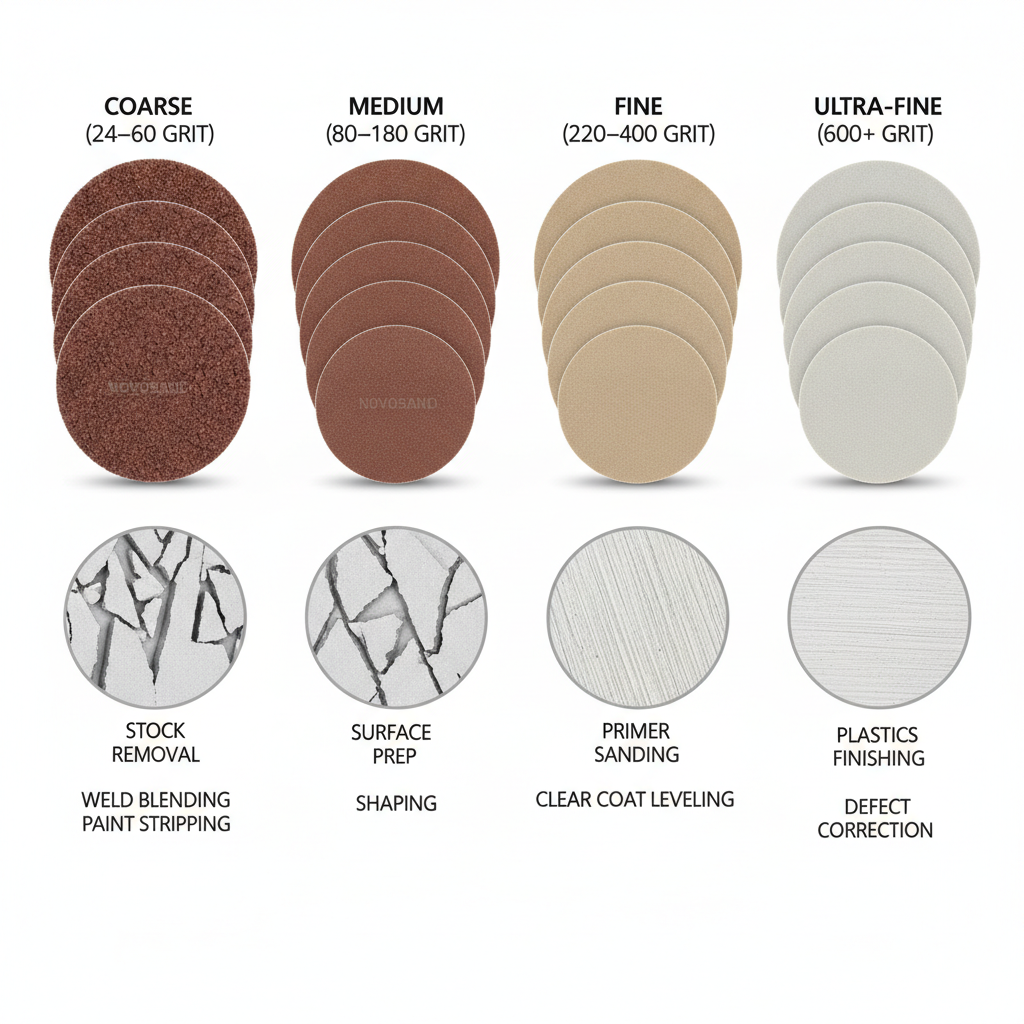
A P36 disc and a P320 disc may use the same machine, but they solve completely different problems. Grit range sets both cut rate and scratch depth, so application fit starts there.
In production, I usually break grit choice into four working zones:
- P24–P60 — heavy stock removal, weld blending, rust or paint stripping, edge deburring
- P80–P180 — general surface prep, filler shaping, sealer sanding, profile blending
- P220–P400 — finishing wood, primer sanding, scratch refinement, pre-coating preparation
- P600 and above — clear coat leveling, plastics finishing, defect correction, pre-polishing
I saw this clearly with a metal fabrication customer using 125 mm fiber discs on stainless welds.
They tried P120 aluminum oxide first, hoping for a cleaner finish, but removal was too slow and heat built up fast.
After switching to P36 ceramic on vulcanized fiber, cycle time dropped by around 30%, and disc use per shift fell noticeably.
The opposite problem happens in finishing shops.
A furniture factory in Southeast Asia used P80 paper discs for primer sanding on flat panels, then spent extra labor removing deep scratches before topcoat.
I suggested a P180 to P240 progression on stearated paper backing, which resists loading from soft coatings.
Rework dropped by roughly 20%.
Grit range never works alone.
Coarse zirconia or ceramic fits heavy metal work best, usually on cloth or fiber backing.
Fine silicon carbide or film-backed discs give a tighter, more even scratch for coatings and plastics.
A jump from P36 to P80 does more than slow stock removal—it also leaves a much shallower scratch pattern, which is why coarse-grit weld blending is typically followed by one or more intermediate steps before primer or topcoat prep.True
Grit range controls both aggressiveness and scratch depth. P24-P60 abrasives are designed for rapid material removal, but they leave deep grooves that telegraph through coatings if not refined. Moving into the P80-P180 range reduces scratch severity enough for shaping and general surface prep, making staged progression more important than simply using the same machine with a finer disc.
Because FEPA 'P' grading is standardized, a P320 sanding disc will always remove material faster than a P36 disc when both use ceramic grain on the same sander.False
FEPA 'P' grading standardizes particle size range, not cut speed superiority. In practice, a P36 disc is far more aggressive than a P320 disc because its larger abrasive particles take deeper bites and clear stock faster. Grain type such as ceramic can improve efficiency within a grit class, but it does not reverse the basic relationship between coarse and fine grit ranges.
Why Do Disc Holes and Attachments Matter?
Disc hole patterns and attachment systems influence dust extraction, disc loading, heat buildup, finish consistency, and changeover speed. Multi-hole, 6-hole, 8-hole, and universal patterns can improve extraction when aligned with the sander pad and vacuum system. PSA discs suit stable long-run sanding, while hook-and-loop discs7 support faster grit changes, inspection steps, and variable finishing processes across different substrates and part geometries.
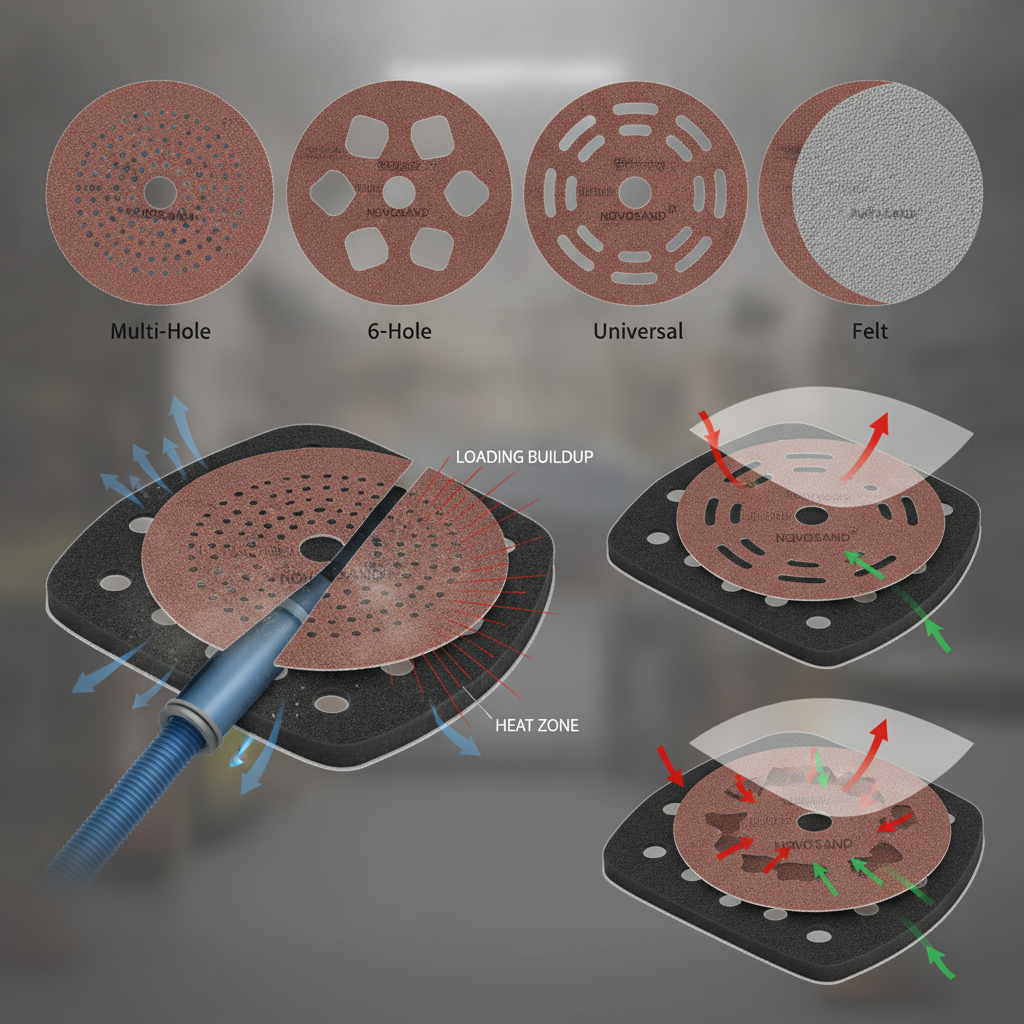
A sanding disc can cut well and still fail the process if dust has nowhere to go or if operators waste time changing discs. Hole pattern and attachment style directly affect extraction, heat, loading, finish consistency, and line speed.
In a furniture plant I supported, the team used 150 mm P180 aluminum oxide discs on random orbital sanders for sealer sanding. They switched from a mismatched 8-hole disc to a multi-hole film-backed disc that matched the pad and central vacuum. Dust stayed lower, visibility improved, and average disc life increased from about 35 minutes to around 45 minutes. I’ve seen this often—the spec sheet gap is not the abrasive grain, but the fit between disc, pad, and airflow.
What matters most in practice:
- Hole alignment — if the disc holes do not match the backup pad, extraction drops quickly.
- Dust type — wood dust, primer dust, and metal fines behave differently and load discs at different rates.
- Attachment system — PSA holds firmly on flat, stable sanding jobs with fewer disc changes.
- Changeover frequency — hook-and-loop saves time when operators move from P80 to P120 to P180 often.
- Part geometry — curved edges and mixed substrates usually favor faster disc removal and reattachment.
To be honest, I suggest standardizing by process, not by habit. Use PSA on flat panels where one grit stays on the machine for long runs, and use hook-and-loop or quick-change formats where inspection steps, rework, or frequent grit swaps are part of the job. A short production trial usually shows the right choice fast.
On 150 mm random-orbit discs, a multi-hole pattern only improves extraction if the abrasive backing can support airflow; film-backed discs generally hold hole geometry better than latex paper under vacuum, so matched multi-hole film discs often run cooler and load less during P180 sealer sanding.True
Hole pattern performance is not just about how many holes are present. Extraction depends on alignment with the pad, the vacuum path, and whether the backing resists edge collapse around the holes. Film backing is dimensionally stable and tear-resistant, so the holes stay open more consistently than many paper backings, helping remove fine sealer dust before it packs the grain. Better dust evacuation lowers frictional heat, reduces loading, and improves finish consistency.
Because dust is pulled through the holes instead of across the abrasive face, disc hole pattern has no meaningful effect on finish quality; any 8-hole, 15-hole, or multi-hole disc will leave the same scratch pattern as long as the grit is P180 aluminum oxide.False
Hole pattern can materially affect finish quality because dust that is not captured efficiently stays between the disc and the workpiece. Those trapped fines can cause pigtails, random deeper scratches, and uneven sanding, especially in sealer sanding on random orbital machines. A mismatched 8-hole disc on a different pad may cut acceptably at first but still run hotter, load faster, and leave a less consistent surface than a pad-matched multi-hole disc with better extraction.
Which Backings Handle Heavy Grinding Best?
Heavy grinding requires rigid, durable backings that resist tearing, heat, and edge wear under high pressure. Resin fiber discs use stiff vulcanized fiber for aggressive stock removal on metal, while flap discs use abrasive cloth flaps on backing plates to combine cutting and blending. In demanding stainless or alloy work, ceramic or zirconia grains paired with strong cloth, fiber, or engineered backings can reduce disc failure and rework.
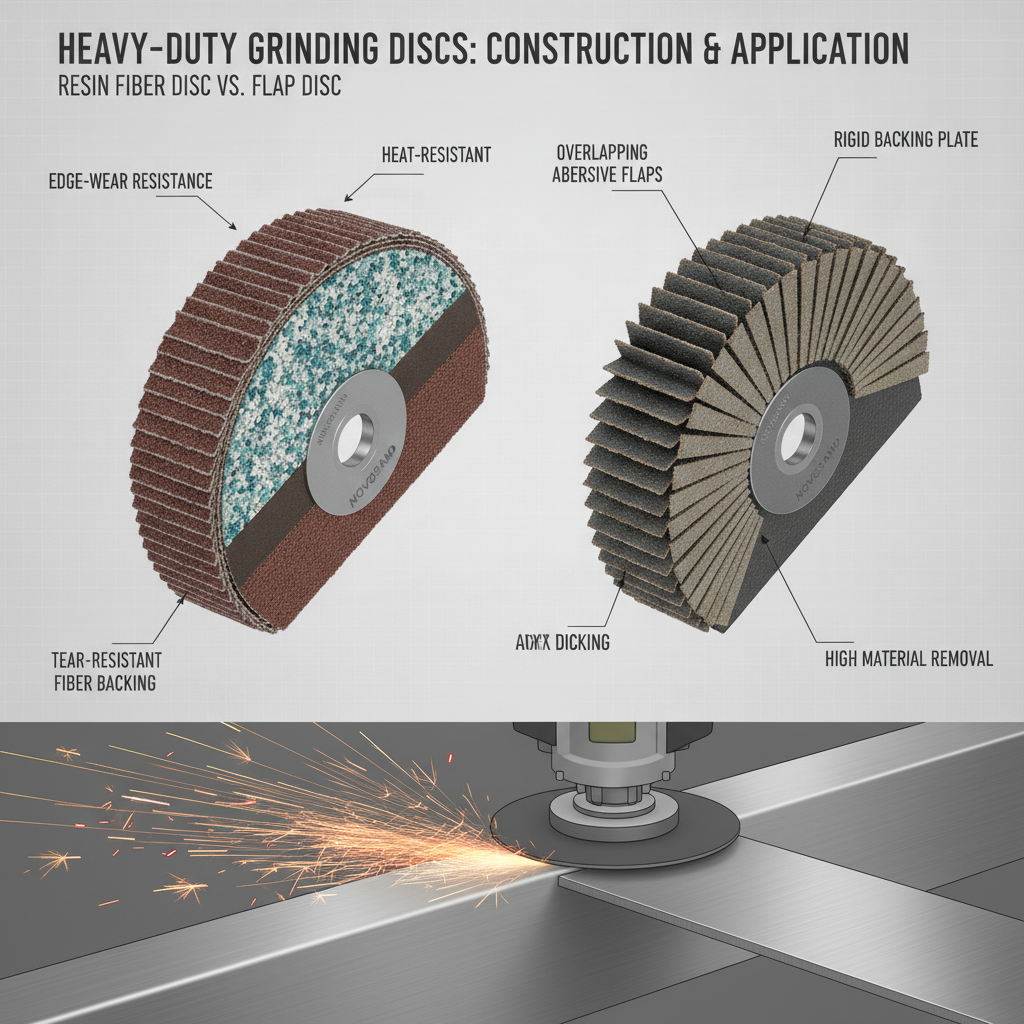
Under heavy grinding, failure usually starts at the backing—edge fray, heat curl, or center tear.
That is why rigid constructions outperform paper or film when operators lean hard on welds, castings, or sharp corners.
| Backing type | Best for | Common grit range | Construction | Typical result |
|---|---|---|---|---|
| Vulcanized fiber | Weld grinding, beveling, scale removal | P24–P60 | Stiff resin fiber disc on backup pad | Fast stock removal, strong edge support |
| Abrasive cloth flap | Weld blending, contour work, edge smoothing | P40–P120 | Cloth flaps on fiberglass or plastic plate | Good cut plus smoother blend |
| Engineered heavy-duty cloth/fiber | Stainless, alloys, sharp-edge grinding | P36–P80 | Ceramic or zirconia grain with reinforced backing | Better heat control and fewer disc failures |
From my experience, resin fiber discs still make the most sense for aggressive metal removal on flat surfaces.
A 125 mm fiber disc in P36 or P40, used with the correct ribbed backing pad, can remove weld reinforcement quickly—but only if the grinder speed stays within rating.
I saw this clearly with a metal fabrication customer in Jiangsu.
They switched a stainless weld cell from aluminum oxide fiber discs to ceramic flap discs (60 grit) and got around 25–30% longer life per disc.
More important, they reduced edge burn and disc breakage on corners.
That saved rework.
To be honest, this is where the spec sheet gap shows up.
For heavy grinding in the P24-P60 range, vulcanized fiber discs resist edge fray and center tear better than paper or film because the backing is a dense, cross-linked cellulose fiber sheet that stays rigid only when supported by a backup pad.True
Vulcanized fiber is made by chemically densifying cellulose into a hard, stiff sheet, which gives the disc much better resistance to folding, curling, and tearing under high side loads. In coarse grits such as P24-P60, that rigidity helps maintain aggressive stock removal on welds, bevels, and scale. The backup pad is important because fiber discs are engineered as a system; without firm support, the disc can lose control and durability.
Film-backed sanding discs are the best choice for heavy weld grinding because polyester film dissipates heat better than vulcanized fiber and is less likely to curl at the edge under high pressure.False
Film backing is valued for smoothness, dimensional consistency, and finer finishing applications, not for the highest-pressure heavy grinding. Under aggressive weld grinding, failure often begins in the backing from edge damage, heat distortion, or tearing, and rigid fiber constructions generally outperform film. Vulcanized fiber discs are specifically favored for coarse, high-load grinding because they provide stronger edge holding and better structural support for fast stock removal.
How do sanding disc materials affect cost?
Sanding disc material choices shape total process cost by influencing cut rate, usable disc life, finish consistency, dust control, and failure risk. Premium grains, stronger backings, better bonds, engineered coatings, hole patterns, and attachment systems often raise unit price but can lower cost per finished part when they reduce changeovers, rework, cleanup, and unplanned downtime in demanding applications.
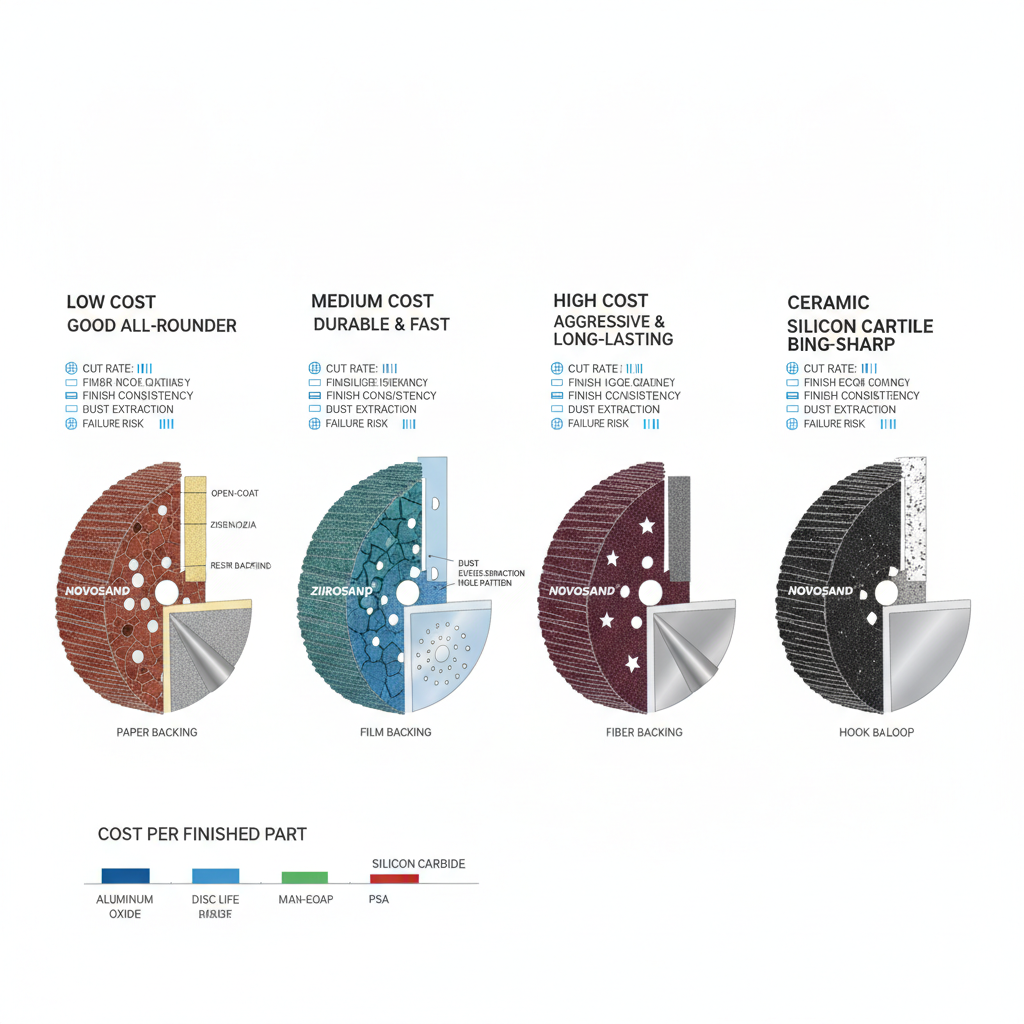
Unit price rarely tells the real story. Material choice changes how fast the disc cuts, how long it stays usable, and how much trouble it creates between parts.
A low-cost paper-backed aluminum oxide disc may work well for light hand sanding on wood. Put that same disc on a high-speed orbital sander, on primer or stainless edges, and costs rise fast. I’ve seen buyers focus on carton price, then lose time on disc changes, dust cleanup, and rework from uneven scratch patterns.
One furniture customer in East China compared 125 mm P180 paper discs with film-backed stearated discs on MDF sealer sanding. The film disc cost more per piece, around 30-40% higher, but average usage dropped from about 14 discs to 9 discs per shift. Surface consistency improved too, so the repaint rate fell by roughly 10%. In that case, higher disc price lowered cost per finished panel.
In metal fabrication, the trade-off often shifts to grain and backing strength. A ceramic or zirconia disc8 with a tougher resin bond and vulcanized fiber or polyester film backing usually handles heat and pressure better than a basic aluminum oxide paper disc. From my experience, that matters most on weld blending and deburring, where edge wear and grain shedding can stop production.
Attachment and dust extraction also affect cost. Hook & loop saves changeover time, while mesh or multi-hole patterns improve dust control and finish stability. I always suggest evaluating cost per finished part—include cut rate, disc life, operator time, rework, and downtime. Also check rated speed, pad compatibility, and applicable safety rules such as EN 13743 where relevant.
A vulcanized fiber disc with ceramic grain can cost 30-80% more per disc than a paper-backed aluminum oxide disc, yet lower total sanding cost on stainless or edge work because it maintains cut under heat and pressure, reducing disc changeovers and inconsistent scratch patterns.True
Disc cost is driven by more than unit price. Ceramic grain micro-fractures to expose new sharp edges, so it keeps cutting aggressively on tough metals where aluminum oxide dulls quickly. Fiber backing also tolerates higher pressure and edge loading better than light paper backings. In applications like stainless blending or primer removal, fewer disc swaps, less downtime, and less rework often outweigh the higher purchase price.
Polyester film-backed sanding discs are always the lowest-cost option for orbital sanding because the backing is thinner than paper, so they automatically generate less heat and extend abrasive life on every substrate.False
Film-backed discs are often chosen for dimensional stability and more consistent scratch patterns, not because they are automatically cheapest or coolest running. Heat generation depends on many factors including abrasive mineral, coating density, stearate or grinding aid, hole pattern, machine speed, pressure, and substrate. Film can improve durability, but on some jobs it costs more upfront and does not guarantee longer life across wood, primer, soft metals, and stainless.
How to choose best-fit sanding discs?
Best-fit sanding discs are selected through clear labeling, controlled storage, and structured production testing. Color-coded backprints and marked grit, grain, and backing reduce line-selection errors. Storage at about 18–22°C and 45–65% relative humidity helps protect paper backings, PSA adhesives, laminates, and resin bonds. Supplier samples should be tested on actual workpieces using KPIs such as removal rate, disc life, surface roughness9, and rework rate.
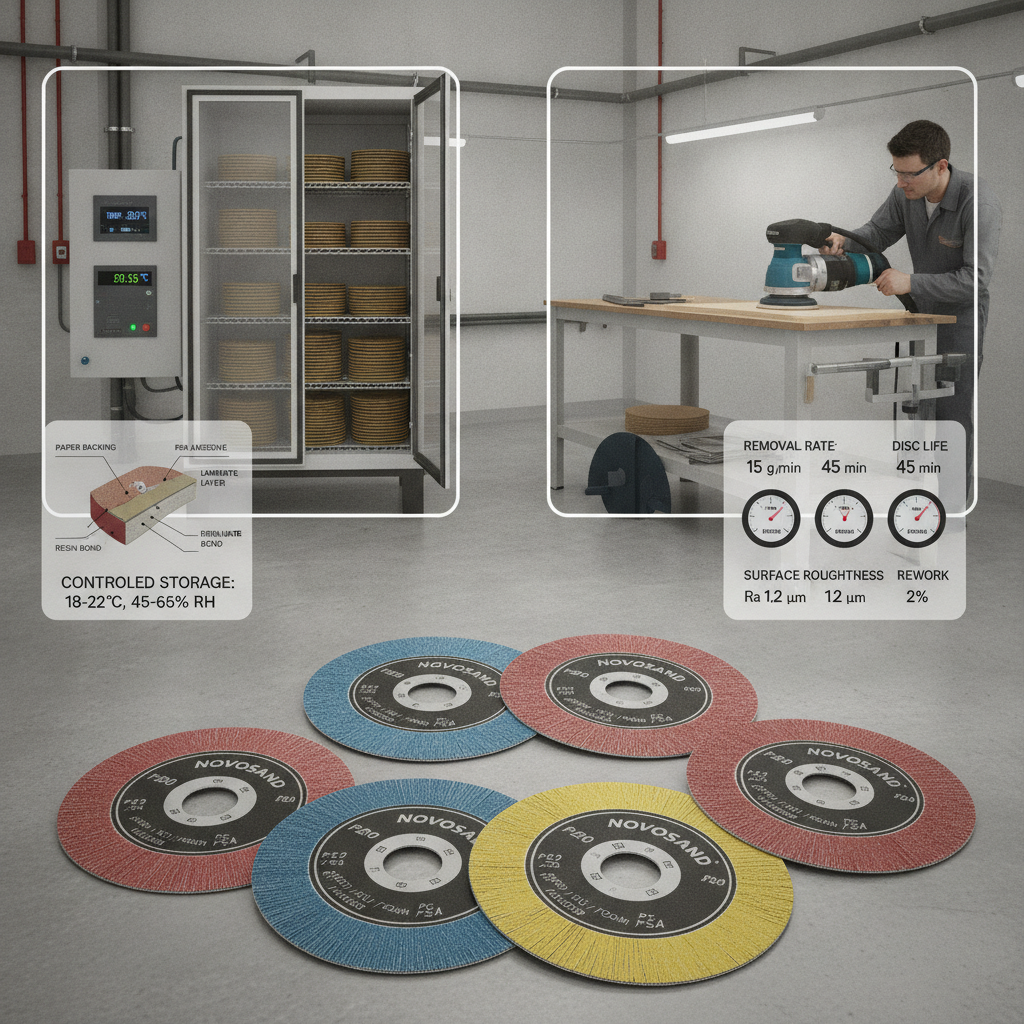
Choosing the right disc often fails before sanding even starts. When operators cannot identify grit, grain, or backing at a glance, line errors increase fast—especially when P80, P120, and P180 run side by side.
Clear backprint matters more than many buyers expect. I suggest using color-coded markings plus printed grit, grain type, backing weight, and attachment style. In one furniture plant, the team mixed a paper-backed P180 aluminum oxide disc with a film-backed P180 product for sealer sanding. Same nominal grit. Different behavior. Their rework rate rose by around 12% in one week because the finish became less consistent.
Storage also affects disc performance. Paper backings absorb moisture, then curl or soften. PSA adhesive10 can lose tack, and hook-and-loop laminates can weaken if cartons sit near heat or solvent vapor. From my experience, a stable room at about 18–22°C and 45–65% relative humidity gives much better consistency, especially for paper and laminated discs. Date every batch and rotate FIFO. Simple, but effective.
Before a large order, test supplier samples on real parts, not only on a showroom panel. I worked with a metal fabrication customer who compared 125 mm ceramic P60 discs and zirconia P60 discs on mild steel weld leveling. They tracked cut rate, discs per shift, and surface roughness Ra. The ceramic option removed about 20% more material, but the zirconia disc gave lower cost per workpiece on lighter stock.
That is the spec sheet gap. I always suggest a short production trial with KPIs before locking in annual volume.
Two sanding discs with the same printed grit, such as P180, can behave very differently because the disc material stack also includes abrasive grain type and backing substrate; for example, a film-backed aluminum oxide P180 typically gives a more uniform scratch pattern in sealer sanding than a paper-backed P180 because the film backing is more dimensionally stable.True
Sanding discs are not made from abrasive grain alone. They combine grain, resin bond, backing, and attachment layer, and each material affects performance. Film backings resist stretch and edge fray better than paper, so the abrasive surface stays flatter under light finishing pressure. That stability can reduce scratch variation even when the nominal grit size is identical.
If two sanding discs are both labeled P120, they must be made from the same abrasive material because FEPA grit standards control not only particle size but also grain chemistry and backing composition.False
FEPA P-grit standards define the abrasive particle size range, not the mineral type or disc construction. A P120 disc may be made with aluminum oxide, ceramic, silicon carbide, zirconia alumina, or blends, and it may use paper, film, cloth, or fiber backing. Matching grit numbers do not guarantee the same cutting behavior, finish quality, or durability.
We’ve covered the main materials used in sanding discs and how grain type, backing, and coating affect cut rate, heat, life, and finish quality. The best choice depends on your workpiece, machine, pressure, and finish target.
From my experience, buyers get better results when they look past disc price and focus on actual process fit. I’ve seen the spec sheet gap many times—good-looking products on paper that perform poorly on the line.
If you’re comparing aluminum oxide, zirconia, ceramic, or silicon carbide for a specific job, feel free to reach out. I’m happy to help you sort through the options based on real production needs. Every application is different—choose what works in practice.
References
-
Explains self-sharpening behavior, pressure requirements, and real-world metalworking advantages, helping buyers choose longer-lasting abrasive discs. ↩
-
Covers cutting action, friability, surface finish quality, and best-fit materials such as glass, stone, and composites for more accurate disc selection. ↩
-
Provides an in-depth analysis of vulcanized fiber backing, including rigidity, impact resistance, and heavy-duty grinding suitability, helping users evaluate its value in high-pressure stock removal and edge work. ↩
-
Explains the performance characteristics of aluminum oxide abrasive discs, including material compatibility, cutting life, and cost efficiency, helping buyers decide when low-cost options are most economical. ↩
-
Systematically explains the flatness, dimensional stability, and fine-finishing consistency advantages of polyester film backing, and compares it with paper and cloth backings in precision surface finishing applications. ↩
-
Details the mechanism by which stearate coatings reduce clogging, friction, and heat buildup, and explains their applications in primer, filler, and woodworking sanding. ↩
-
Systematically explains hook-and-loop fastening principles, disc change efficiency, and suitable applications, helping users determine when it is more appropriate than PSA in multi-step, frequent-grit-change workflows. ↩
-
Compares ceramic and zirconia abrasives in metalworking in terms of cutting speed, heat resistance, and service life, enabling better evaluation of total cost per part. ↩
-
Explains surface roughness parameters, measurement methods, and evaluation standards, helping compare sanding results and reduce rework and coating defects. ↩
-
Explains how PSA adhesive layers are affected by temperature, humidity, and solvent vapors, and provides storage and failure indicators to reduce disc slippage and adhesion failure. ↩