Abrasive Structure
Stable structure is what makes sanding discs reliable — batch after batch.
Performance variation and unstable lifetime usually come from what you don't see: the backing, bonding system, and abrasive structure underneath. We focus on controlling these core layers — the foundation of long-term consistency for private labels, OEM programs, and jumbo roll conversion.
Less Batch Variation
Predictable performance across long-term supply, not just one shipment
Lower Complaint Risk
No sudden change in cutting behavior, lifetime, or finish quality
Safer Import Replacement & Private Label Scaling
What you test today is what you can keep selling tomorrow
The Three Layers That Actually Matter
Not every layer in a sanding disc affects your result in the same way. From a production and procurement perspective, long-term consistency comes down to three core layers — the ones that most often cause performance variation when they are not properly controlled.
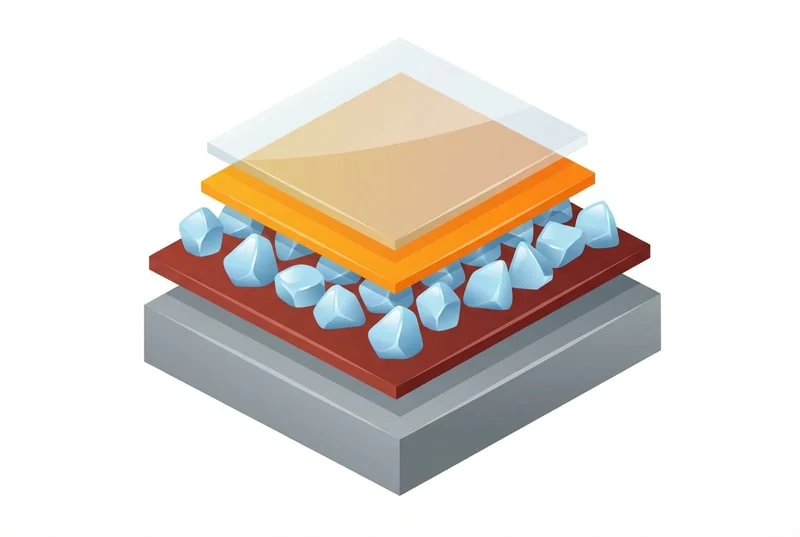
Simplified structure for consistency-focused evaluation, not a full material breakdown.
Backing (Base Material)
This layer defines how stable the disc feels in real use.
The backing is responsible for flatness, strength, and dimensional stability during sanding.
When backing quality varies, operators often notice vibration, edge lifting, or an inconsistent sanding feel — even when grit and size remain the same.
Bonding System (Resin Control)
This layer determines how long the disc performs as expected.
The bonding system controls how firmly abrasive grains are held during use. If bonding characteristics change, cutting performance may look fine at the beginning, but drop suddenly halfway through.
In practice, bonding inconsistency is one of the most common reasons for lifetime-related complaints.
Abrasive Grain (Type & Distribution)
This layer defines how the disc cuts — and how predictably it wears.
Grain quality and, more importantly, grain distribution affect initial cutting speed and wear behavior over time.
Poor distribution often results in aggressive early cutting followed by rapid performance decline.


Layer 1
Backing (Base Material)

Backing (Base Material)
This layer defines how stable the disc feels in real use.
The backing is responsible for flatness, strength, and dimensional stability during sanding.
When backing quality varies, operators often notice vibration, edge lifting, or an inconsistent sanding feel.

Bonding System (Resin Control)
This layer determines how long the disc performs as expected.
The bonding system controls how firmly abrasive grains are held during use.
Bonding inconsistency is one of the most common reasons for lifetime-related complaints.

Abrasive Grain (Type & Distribution)
This layer defines how the disc cuts — and how predictably it wears.
Grain quality and distribution affect initial cutting speed and wear behavior over time.
Poor distribution often results in aggressive early cutting followed by rapid performance decline.
When these three layers are controlled as a system, performance becomes predictable — not only for one shipment, but across long-term supply.
What This Means for You
Consistency You Can Rely On
Performance That Doesn't Drop Unexpectedly
Lower Risk When You Scale or Replace a Brand
Key Variables Are Fixed, Not Redefined
When backing, bonding behavior, and grain distribution are treated as fixed reference points, performance remains repeatable.
You don't have to re-evaluate a product every time you reorder it, because the underlying structure has not shifted. For you, this means fewer surprises when a familiar specification comes back months later.
Products Designed for Continuity, Not One-Off Orders
Some products are optimized to perform well in a single batch. Others are designed to stay within a controlled range over repeated production runs.
When continuity is part of the design logic, performance does not depend on short-term adjustments or temporary tuning. That makes long-term supply more predictable, even when volumes increase.
Test Results Remain Relevant as Volumes Grow
If structure stays consistent, what you see during testing is what you get later in regular supply. There is no gap between sample performance and follow-up orders.
This reduces the risk of approving a product that works well in trials but changes once it becomes part of daily use or scaled programs.
What Keeps Performance Stable Over Time
Consistency is not something you check once. If you rely on sanding discs for long-term supply, what matters is whether performance stays the same after repeat orders, volume increases, or time gaps between shipments.
This stability depends on how key variables are controlled — and whether they are allowed to change.
