What Is a PSA Sanding Disc? Expert Guide for Buyers
A buyer from a cabinet factory in Foshan told me something I hear all the time: “PSA discs are just the cheap version of hook-and-loop1, right?” Not exactly. In flat panel sanding, automotive filler prep, and sheet metal finishing, that assumption can lead to the wrong setup fast.
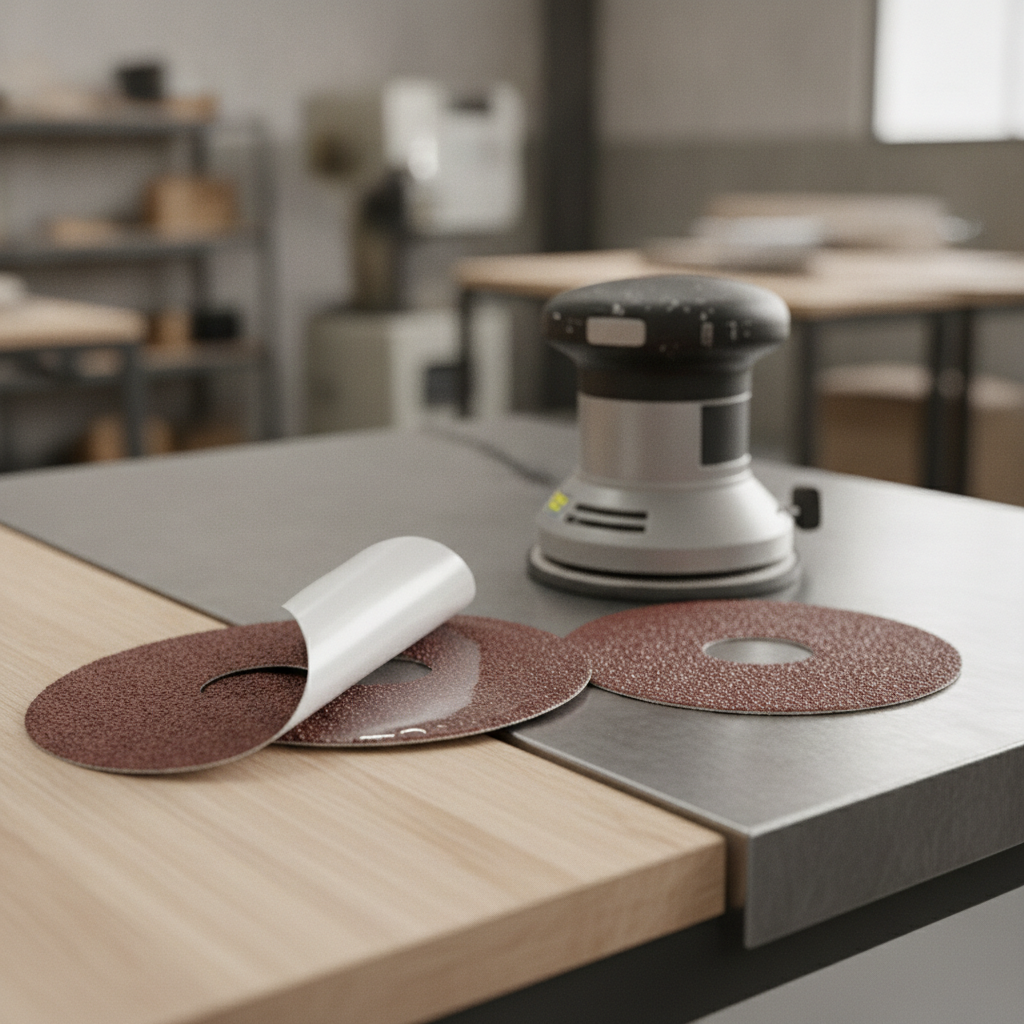
A PSA sanding disc is an abrasive disc with a pressure-sensitive adhesive2 backing protected by a peel-off liner, allowing direct attachment to a smooth compatible backup pad3. This adhesive-mounted structure creates a firmer interface than hook-and-loop, which can improve contact stability in flat sanding and repeatable production work. PSA discs are commonly used on random orbital sanders, stationary disc machines, and automated sanding heads in woodworking, metalworking, and automotive refinishing.
What Is a PSA Sanding Disc?
A PSA sanding disc is a coated abrasive disc with a pressure sensitive adhesive backing4 that bonds directly to a smooth compatible backup pad after the release liner is removed. This adhesive-mounted design creates a firm, stable sanding interface that supports flatness, controlled cutting, and consistent contact pressure in woodworking, metalworking, and automotive refinishing applications.
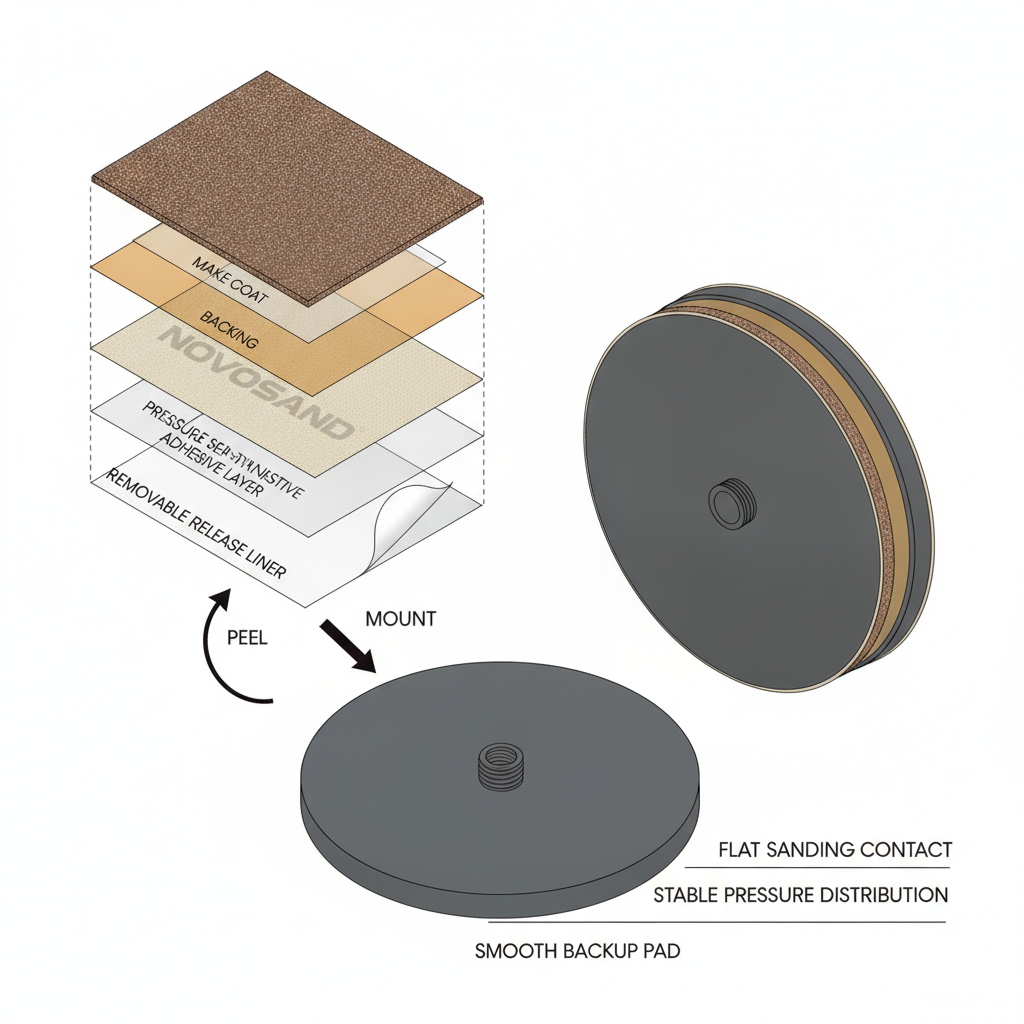
A PSA sanding disc answers a simple process question: do you want fast disc changes, or do you want a firmer sanding interface? PSA uses a peel-off pressure sensitive adhesive backing, so the disc bonds directly to a smooth backup pad instead of gripping through hooks.
That direct bond matters on flat panels and repeat jobs. The abrasive layer can sit on paper, film, or cloth backing, with grains like aluminum oxide5, ceramic alumina, zirconia alumina, or silicon carbide. Once you remove the liner and press the disc in place, the pad-to-disc contact stays tight. Less flex. More control.
I saw this clearly with a furniture components factory running 6-inch P180 and P240 PSA paper discs on random orbital sanders. They sanded lacquered MDF drawer fronts in long batches, around 800 to 1,000 pieces per shift. After changing from hook-and-loop to PSA for the finish-sanding step, their operators got more uniform scratch patterns and fewer edge ripples. Disc life did not jump dramatically—maybe 10-15%—but finish consistency improved enough to cut rework noticeably.
In automotive refinishing, I usually see PSA selected for fixed steps like P320 primer sanding or P600 sealer denibbing on flatter panels. In metalworking, a film-backed PSA disc can also help when the customer wants controlled cutting and cleaner flatness on stainless covers or aluminum parts. The key is compatibility: the backup pad must be smooth, clean, and dimensionally stable.
To be honest, PSA is not about convenience first. It is about repeatable contact pressure. If your process runs the same grit for long batches on flatter surfaces, I suggest testing PSA discs on one machine before switching the whole line.
Because a PSA disc bonds across its full face rather than only at hook contact points, it typically produces a firmer interface that can improve edge definition and reduce tiny disc-to-pad movement on flat-panel sanding compared with hook-and-loop systems.True
PSA stands for pressure sensitive adhesive, and the peel-off backing lets the disc adhere directly to a smooth backup pad. That full-surface bond minimizes the micro-flex and slight slippage that can occur in hook-and-loop attachments, which is why PSA discs are often preferred for flat surfaces, repeat jobs, and applications where a stable sanding face matters more than rapid abrasive swaps.
A PSA sanding disc can be removed and reattached dozens of times without losing holding power because pressure sensitive adhesive is designed for repeated peel-and-stick cycles like hook-and-loop fastening.False
PSA discs are generally intended for more permanent attachment during a sanding cycle, not repeated on-off reuse. Each removal can contaminate or weaken the adhesive layer, reducing bond strength and increasing the chance of edge lift or disc failure. Hook-and-loop systems are the style specifically designed for frequent disc changes and repeated reattachment.
How Do PSA and Hook-and-Loop Compare?
PSA sanding discs bond directly to a smooth backup pad with pressure-sensitive adhesive, creating a firmer, flatter sanding interface. Hook-and-loop discs6 attach through a textile layer, allowing faster removal and reattachment but adding compliance. PSA discs often cost less per unit, while hook-and-loop discs are usually more practical for frequent grit changes. Surface finish depends on abrasive quality, pad hardness, machine orbit, dust extraction7, and technique.
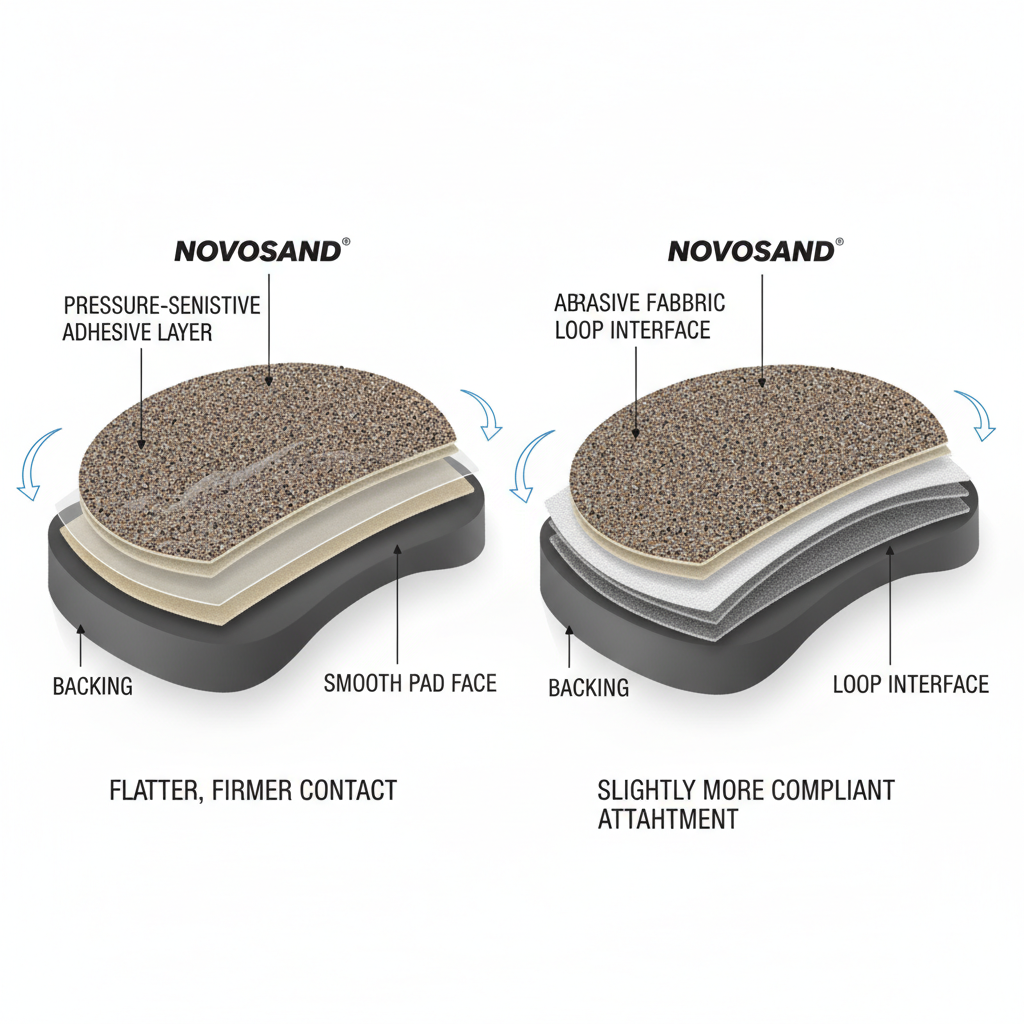
The real difference starts at the sanding interface. PSA bonds directly to a smooth backup pad, while hook-and-loop adds a textile layer that makes the disc easier to remove but slightly more compliant.
| Attachment Type | Main Strength | Main Limitation | Typical Use Case | Cost Pattern |
|---|---|---|---|---|
| PSA | Flatter, firmer contact | Poor reattachment after removal | Panels, tabletops, filler sanding | Lower unit cost |
| Hook-and-loop | Fast grit changes and reuse | Slightly softer interface | Contours, mixed jobs, repair work | Higher unit cost |
That extra layer matters most on flat work. In a furniture plant I supported in East China, a 5-inch P180 aluminum oxide PSA disc on a medium-hard pad gave more even contact on MDF panels than the hook-and-loop version, especially over long runs of 200-300 parts. The operators changed discs less often, and disc cost dropped by around 10-15% per finished panel. On curved chair components, though, hook-and-loop followed the profile better.
I’ve seen buyers blame swirl marks on the attachment type alone. To be honest, that is usually the spec sheet gap. Surface finish depends just as much on grain quality, backing stiffness, orbit size, dust extraction, pad hardness, and sanding pressure. A poor P240 disc can leave a worse finish than a good P180, no matter how it attaches.
Hook-and-loop makes more sense when operators jump from P80 to P120 to P180 several times per shift. I always suggest PSA for stable, repeat jobs, and hook-and-loop for flexible workflows. If possible, test both on the same machine, same pad hardness, and same grit sequence before deciding.
On a rigid backup pad, a PSA disc usually produces a slightly flatter sanding interface than a hook-and-loop disc because it eliminates the textile loop layer, which can reduce edge washout on body filler and tabletops during fine grit work such as P180-P320.True
PSA discs adhere directly to a smooth pad, so there is no hook-and-loop fabric stack between the abrasive and the machine. That lower interface thickness makes the system firmer and less compliant, which helps maintain a flatter contact patch. In practical finishing work, this can improve panel flatness and reduce the tendency to round edges compared with hook-and-loop systems, which trade some rigidity for fast disc changes and reuse.
Hook-and-loop sanding discs generally run cooler than PSA discs because the textile attachment layer acts as a heat sink and conducts frictional heat away from the abrasive face more effectively.False
The hook-and-loop layer is added primarily for attachment convenience, not thermal management. In fact, adding that textile interface increases compliance and can slightly reduce firmness at the sanding surface, but it does not function as a meaningful heat sink. Disc temperature is influenced far more by abrasive type, loading, pressure, speed, dust extraction, and hole pattern than by the hook-and-loop attachment layer itself.
Where Do PSA Sanding Discs Excel?
PSA sanding discs excel in high-volume, repetitive, relatively flat sanding operations where stable disc attachment and process consistency are more important than frequent grit changes. Common applications include wood panel calibration, tabletop flattening, automotive filler and panel preparation, and sheet metal deburring. Performance depends on the full sanding system, including abrasive type, backing, pad hardness, machine condition, pressure, heat, and dust extraction.
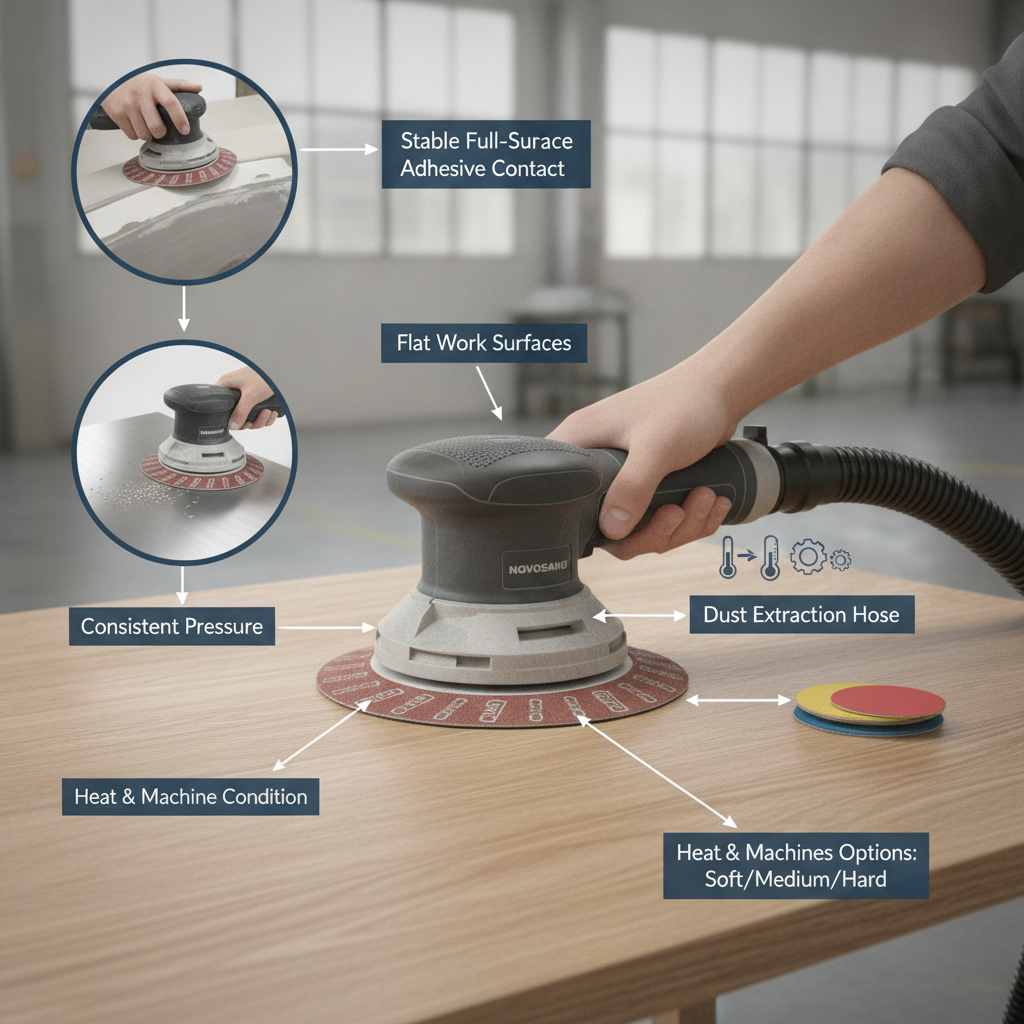
PSA discs show their real strength when the job stays repetitive, flat, and stable for hours. In these conditions, firm adhesive contact helps the disc track consistently, especially on stationary disc sanders and automated heads.
A furniture factory I supported in Guangdong used 6-inch PSA paper discs, P120 and P180, for tabletop flattening on rubberwood panels. They ran batches of around 800 to 1,000 pieces per grit change. After switching from hook & loop8 to PSA on a hard backup pad, they reduced edge flutter and improved finish consistency across the panel width. Disc life only improved around 10-15%, but rework dropped more noticeably. That mattered more.
I’ve seen the same pattern in automotive refinishing. For filler leveling and panel preparation, especially with P80 to P180 aluminum oxide or ceramic grain discs, PSA gives very stable contact on relatively flat repair zones. The cut feels more predictable. Operators often notice less chatter, which helps before primer. But PSA alone does not create a better finish — backing weight, grain type, pad hardness, machine balance, and dust extraction all change the result.
In sheet metal deburring, some production lines use fiber-reinforced or heavy paper-backed PSA discs on fixed-speed machines because they do not need constant grit changes. I always remind buyers to check heat buildup during long runs. If pressure is too high or dust extraction is weak, adhesive softening can shorten disc life fast. That is where the spec sheet gap usually appears.
If your process runs long batches with one grit, PSA is a strong option. I suggest validating it on your actual machine, with your pad, pressure, and cycle time before scaling up.
On stationary disc sanders and automated sanding heads, a 6-inch PSA disc mounted to a hard backup pad typically holds flatter contact than a hook & loop disc, which can improve thickness consistency in long tabletop runs such as P120 to P180 sanding on rubberwood panels.True
PSA discs bond directly to the pad with a continuous adhesive layer, so there is no compressible hook interface between the abrasive and the machine. On repetitive flat-panel work, this reduces pad squirm and helps the disc track more consistently across the surface. That stability is especially useful in high-volume operations where hundreds of similar parts are processed per grit.
PSA sanding discs excel on highly contoured hand-sanding jobs because the pressure-sensitive adhesive allows the disc to flex and reposition repeatedly without losing holding power.False
PSA discs are generally strongest in repetitive, flat, stable sanding, not in highly contoured hand work. Their adhesive mounting is less convenient to remove and reapply than hook & loop, and repeated repositioning usually weakens the bond or damages the disc. For curved surfaces and frequent disc changes, hook & loop systems are typically preferred because they conform better and are easier to swap.
How Are Grit, Backing, and Size Selected?
PSA sanding disc selection depends on the operation, substrate, and machine setup. Coarse grits P36-P80 are used for heavy stock removal, P100-P240 for intermediate smoothing, and P320 or finer for finishing preparation. Cloth backing suits higher-pressure metal work, paper supports controlled general sanding, and film improves fine-finish consistency. Disc diameter must match the pad correctly to prevent vibration, edge wear, adhesive failure, and finish defects.
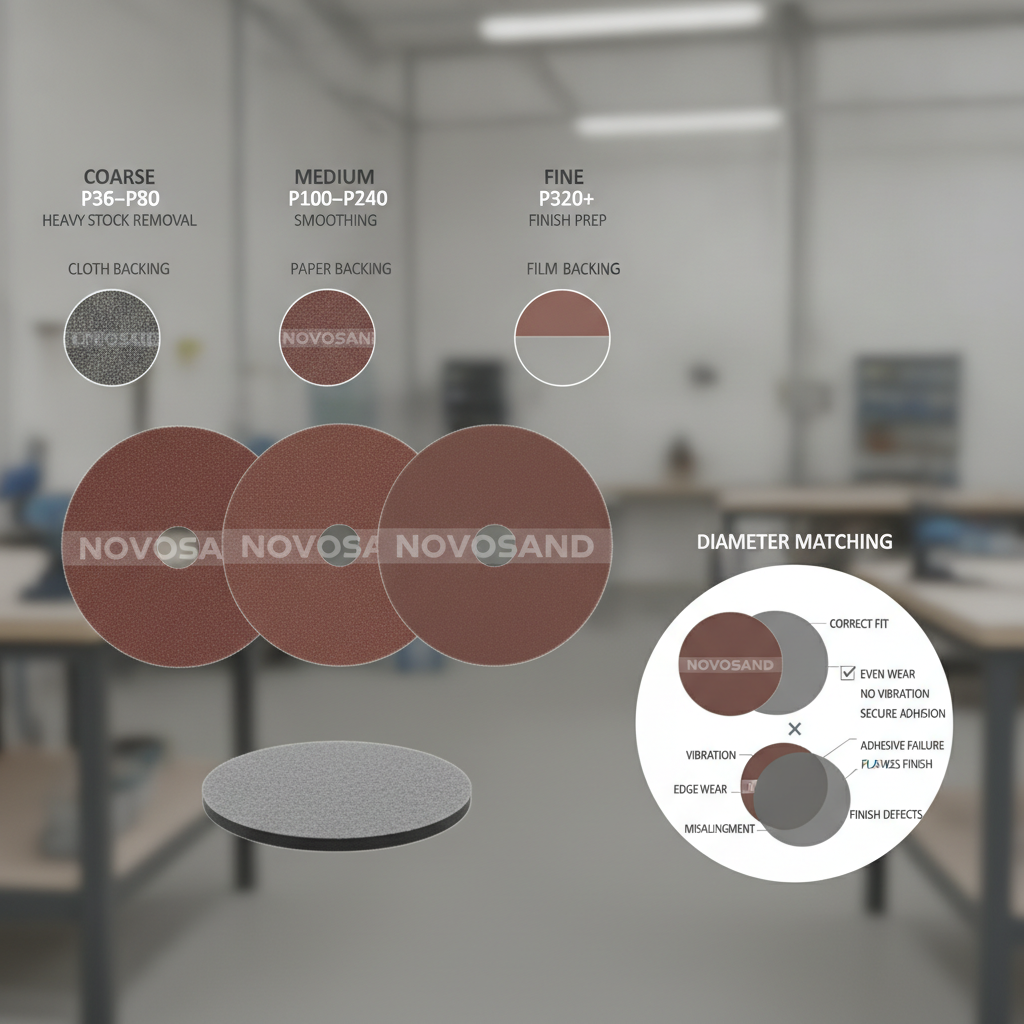
Selection usually fails at the interface between the disc and the job, not on the label. Grit, backing, and diameter have to match the actual operation—stock removal, blending, finish prep—and the machine doing the work.
For aggressive removal, P36 to P80 works well on welds, mill scale, or hard wood leveling. For smoothing, most shops move into P100 to P240. Then P320 or finer handles paint prep or pre-polishing. From my experience, skipping too many grit steps saves minutes at first, then costs rework later. The scratch pattern stays too deep.
Backing changes how the disc behaves under pressure. Cloth-backed PSA discs9, often X-weight cotton or polyester, resist tearing and heat better in metal fabrication and larger stationary disc sanders. Paper backing gives a more controlled cut in woodworking and general sanding. Film backing10 stays dimensionally stable, so fine grits leave a more even finish. I’ve seen automotive refinishing lines switch from paper P600 to film P800 and reduce edge wear by around 20-30%.
Size matters more than many buyers expect. A 6-inch disc on a 5-inch pad creates vibration, weak edge support, and adhesive lift. In one furniture plant in Jiangsu, the operator used 8-inch paper PSA discs on worn pads for panel sanding. Disc use increased from about 90 pieces to 120 pieces per shift, and swirl defects became common. We corrected pad size, kept a P120-P180-P240 sequence, and disc life improved by roughly 25%.
I always suggest standardizing by substrate, machine type, pad hardness, and dust control first. Then test one grit progression in production before locking the spec.
On a PSA sanding disc, selecting a stiffer vulcanized fiber or heavy C-/D-weight paper backing for P36-P80 grit helps maintain flat contact under high pressure, while finer grits like P180-P320 often perform better on more flexible backing that can conform to slight surface variation without cutting deep edge tracksTrue
Grit alone does not control the finish; the backing changes how force is delivered into the work. Coarse grits used for weld removal or leveling need support so the abrasive can bite aggressively instead of folding over or rounding the workpiece. As shops move into finer grits for blending and finish prep, a backing with more flexibility reduces localized pressure points and lowers the risk of deep scratch tails that are difficult to remove in later steps.
Because PSA sanding discs bond across the full face, a smaller 4-inch disc will always cut cooler and leave a finer finish than a 6-inch disc when both use the same grit on the same machineFalse
Disc diameter by itself does not guarantee a cooler cut or a finer finish. Heat and scratch quality depend on several interacting variables: machine speed, surface feet per minute, applied pressure, dust extraction, backing pad hardness, and whether the abrasive is open- or closed-coat. A smaller PSA disc can actually run hotter if the tool speed is high or if the contact area concentrates pressure, and the finish is still primarily governed by grit progression and how stable the disc stays in the cut.
What Pad Conditions Do PSA Discs Need?
PSA sanding discs require a clean, flat, smooth backup pad specifically designed for adhesive-backed abrasives, such as a plain PSA-compatible pad or vinyl-face PSA pad. Hook-and-loop faces, worn surfaces, dust, adhesive residue11, moisture, or pad low spots can reduce bond strength, cause disc slippage, create uneven sanding patterns, and shorten abrasive life. Routine pad cleaning, drying, and inspection are essential for consistent performance.
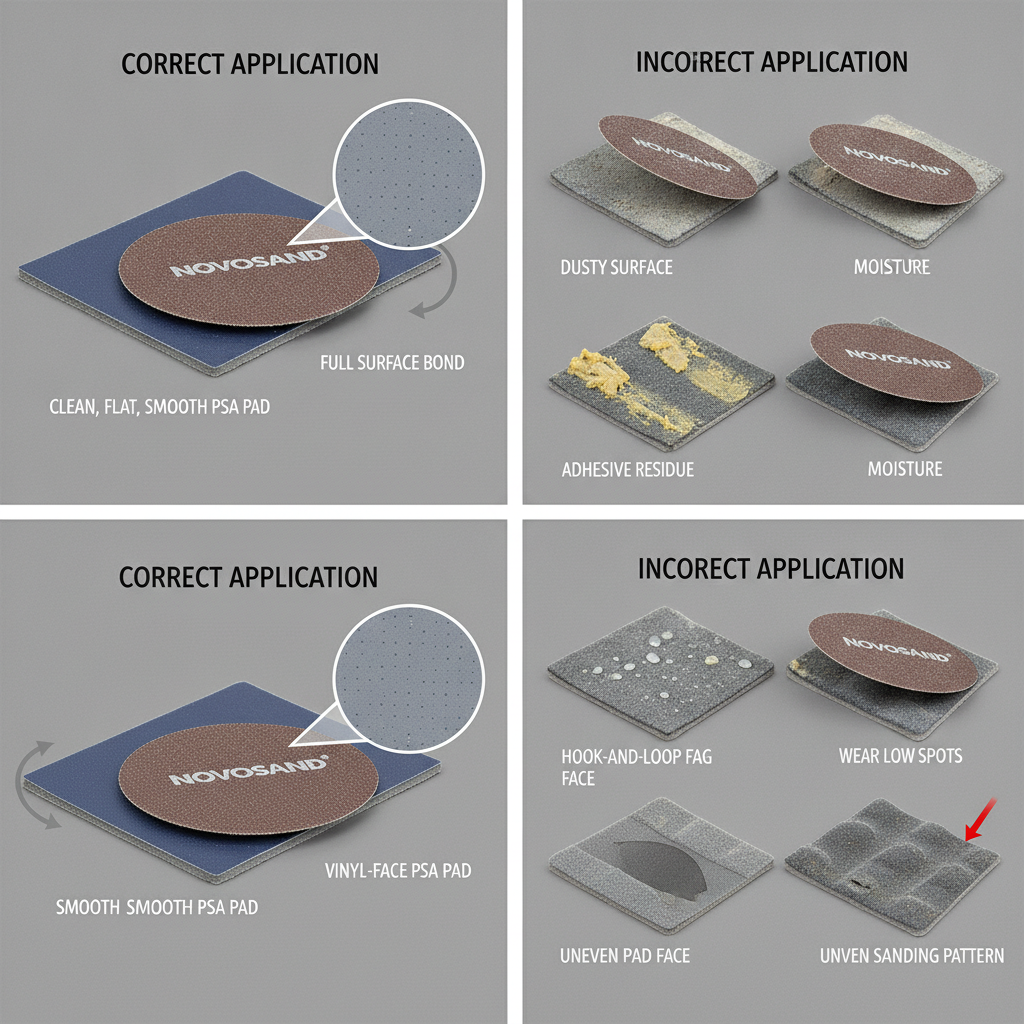
PSA discs only hold properly when the backup pad gives them a flat, smooth, adhesive-friendly surface. If the pad has hook-and-loop hooks, dust buildup, adhesive residue, or low spots, the disc can shift under load and print defects into the workpiece.
I’ve seen this issue in a furniture plant running 5-inch P180 aluminum oxide PSA discs on orbital sanders. They changed discs onto worn pads with light glazing and old adhesive left behind. Disc life dropped from around 80 panels to roughly 50, and the finish showed uneven scratch lines near the panel edges. The abrasive was not the main problem. The pad was.
A proper PSA setup usually means a plain PSA-compatible pad or a vinyl-face pad made for pressure-sensitive adhesive discs. I always suggest checking pad flatness by hand and by sight before blaming grit, grain type, or bond system. If the pad surface feels hard, rippled, or slightly hollow in the center, sanding pressure stops distributing evenly. Then cut rate falls, heat rises, and the disc can slip.
Cleaning matters too. In my experience, dry compressed air removes loose dust, but adhesive residue often needs a mild wipe with isopropyl alcohol if the pad material allows it. Let the pad dry completely first. Aggressive solvent is a risk because it can soften foam, vinyl, or rubber layers.
Over time, every pad ages — even in clean production. I suggest treating pad inspection as preventive maintenance, especially in automotive refinishing and high-volume woodworking lines. A good disc on a bad pad usually becomes expensive very quickly.
For 5-inch PSA discs on orbital sanders, even light adhesive residue or pad glazing can create localized high spots that reduce real contact area enough to shorten disc life by roughly 25-40% and increase defect printing on flat panels.True
PSA discs depend on uniform adhesive contact across the full backup pad. Old adhesive, embedded dust, or glazing interrupts that bond and creates uneven support, so the disc can micro-shift under load instead of cutting evenly. That movement generates heat, edge stress, and pressure variations that show up as swirl patterns or pressure marks, especially on furniture panels where surface consistency matters. In production, this can cut usable disc life significantly compared with a clean, flat pad.
PSA discs bond most securely when applied over a hook-and-loop backup pad because the pressure-sensitive adhesive flows around the hooks and creates a stronger mechanical lock than on a smooth face pad.False
PSA discs are designed for smooth, flat, non-textured backup pads. A hook-and-loop face prevents full adhesive wet-out because the hooks reduce contact area and create voids under the disc. Instead of improving retention, this uneven interface promotes shifting, wrinkling, and imprinting of pad texture into the workpiece. Mechanical hook engagement and PSA adhesion are different attachment systems and are not interchangeable.
What Cost Trade-Offs Do PSA Discs Present?
PSA sanding discs often cost less per unit than comparable hook-and-loop discs because they use a simpler construction without a loop backing. However, savings depend on backing, abrasive grain, coating, size, hole pattern, brand, and order volume. PSA also delivers a firm mounting interface, but removed discs usually cannot be remounted reliably, which can raise disc consumption, changeover time, and total process cost in frequent grit-change applications.
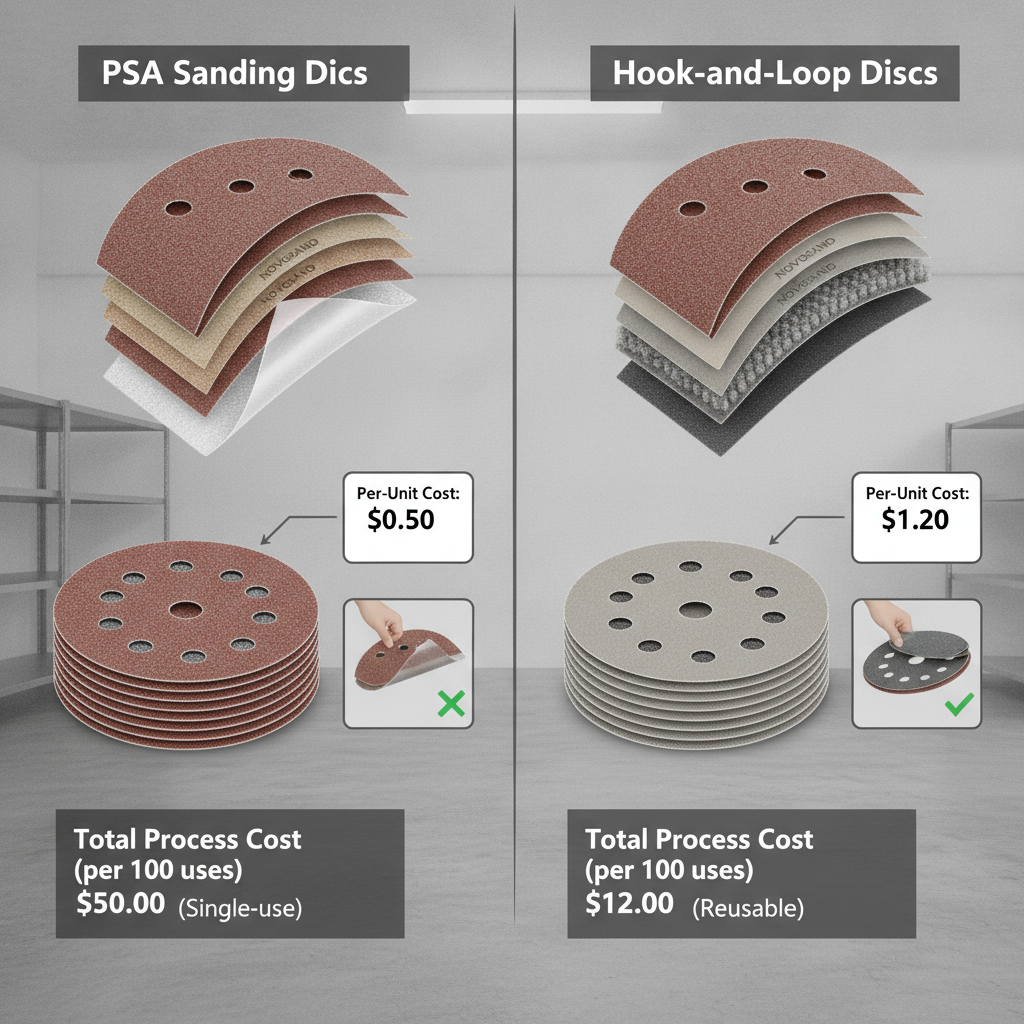
Unit price is where PSA usually looks attractive first. A 5-inch PSA disc often runs around 10-20% lower than a similar hook-and-loop disc because it skips the laminated loop layer.
That saving is real, but it is not fixed. Backing weight, aluminum oxide versus ceramic grain, stearated coating, hole pattern, and order volume can shift the gap quickly. I have seen a paper-backed P180 PSA disc for wood sanding cost less per piece, yet a film-backed dust-extraction version narrow the difference to only a few percent.
The bigger trade-off appears on the shop floor. PSA gives a firm mounting interface, so the disc sits flatter on the pad and can support more consistent scratch patterns in finish sanding. In a furniture plant in Guangdong, one customer used 125 mm P240 PSA discs on sealer sanding and cut disc cost per panel by around 12% because operators ran one grit until full wear.
The same logic failed in an automotive refinishing workshop. Their technicians changed from P320 to P500 to P800 constantly, and once they peeled off a PSA disc for inspection, it rarely re-mounted well. Disc consumption rose by roughly 15%, and changeover time increased enough to cancel the lower unit price.
To be honest, this is the spec sheet gap I see most often. Buyers compare piece price, but the real metric is cost per finished part. I always suggest testing PSA in long-run, single-grit work first, then tracking disc life, labor time, pad replacement, and rework before making a full switch.
A 5-inch paper-backed PSA disc can be roughly 10-20% cheaper per unit than a comparable hook-and-loop disc because it eliminates the laminated loop fabric layer, but that spread often shrinks once you move to film backing, multi-hole dust-extraction patterns, or premium grains like ceramic.True
PSA discs often enter at a lower piece price because their construction is simpler: abrasive, backing, resin, and pressure-sensitive adhesive, without the added loop material used on hook-and-loop products. However, the cost gap is not constant. Film backings, stearated topcoats, engineered hole patterns, and higher-grade grains add cost to both formats and can reduce the PSA price advantage significantly.
PSA sanding discs maintain the same cost advantage in every grit and construction, since backing weight, abrasive mineral, and hole pattern have almost no effect on the price gap versus hook-and-loop discs.False
The price difference between PSA and hook-and-loop discs is highly dependent on construction details. Heavier paper or film backings, aluminum oxide versus ceramic grain, stearated coatings, and dust-extraction hole configurations all change manufacturing cost. As a result, PSA may be clearly cheaper in a basic paper-backed wood-sanding disc, yet only marginally cheaper in a premium film-backed configuration.
How Should PSA Sanding Discs Be Stored?
PSA sanding discs should be stored in original packaging in a clean, dry, moderate-temperature area, typically around 18–22°C and 45–65% relative humidity12, away from sunlight, heat, humidity, dust, and solvent vapors13. During handling, discs should be touched only at the edges to prevent adhesive contamination. When changing discs, careful removal and pad-safe cleaning help preserve backup pad condition and adhesive performance.
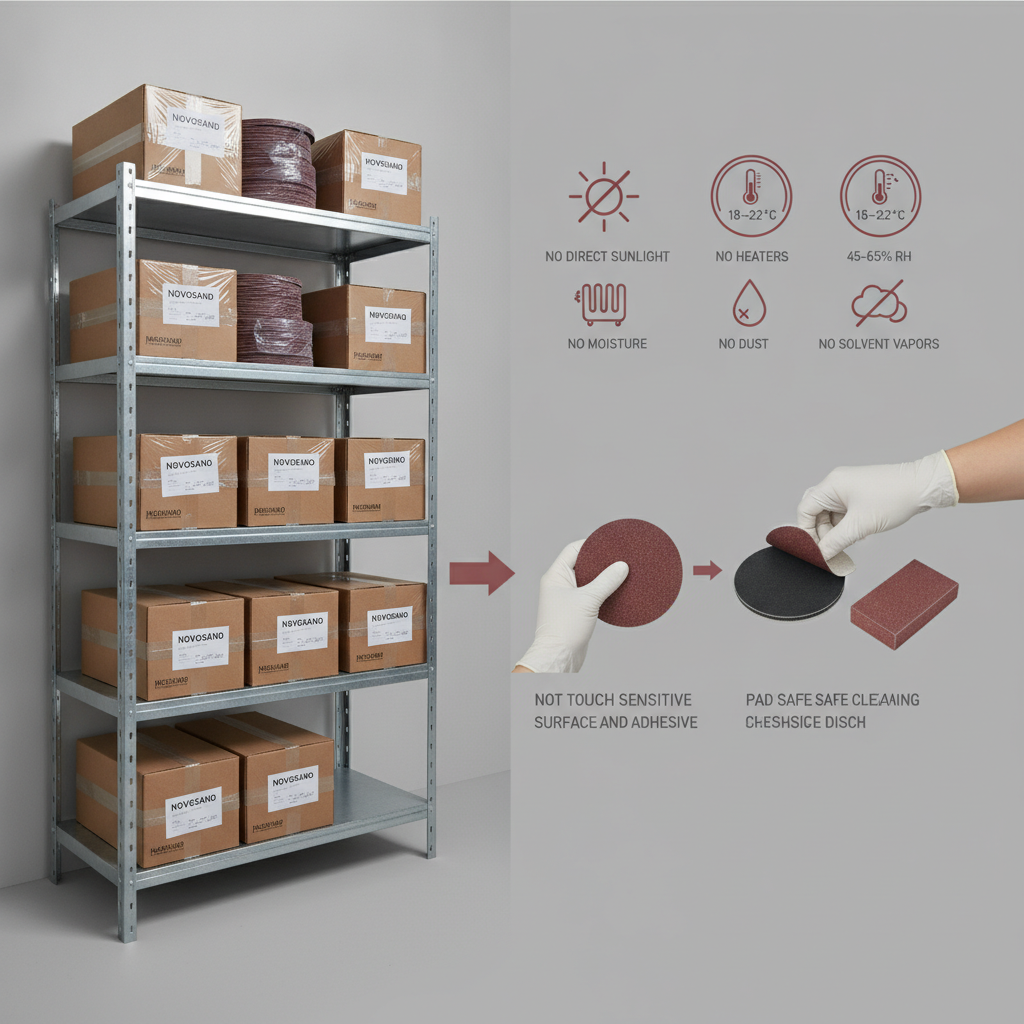
PSA disc storage looks simple, but adhesive failure often starts on the shelf, not on the sander. A disc kept beside a hot compressor or in damp open cartons can lose tack long before the abrasive grain wears out.
A clean room is not necessary, but controlled conditions matter. I suggest keeping discs in original sleeves or boxes at around 18–22°C and 45–65% relative humidity. Keep them away from sunlight, heaters, dust, and especially solvent vapors. PSA adhesive is sensitive to all of that. In one furniture plant, open packs of 125 mm P180 aluminum oxide paper-backed discs sat near a spray booth for two weeks. Edge lifting increased, and operators lost roughly 15–20% more discs during changeover.
Handling also affects bond quality. Touch the discs by the edges only. Bare fingers leave oil and dust on the adhesive face, and that weakens contact with the backup pad. I’ve seen this issue in automotive refinishing lines where technicians change P400 and P800 discs quickly between primer sanding steps. The problem is small, but repeat it all day and consistency drops.
Disc removal deserves the same attention. Peel the disc off carefully instead of ripping it at one point, which can damage the pad surface. If adhesive stays behind, I always suggest a lint-free cloth with isopropyl alcohol, or another pad-approved mild cleaner. Use a plastic scraper if needed. Avoid aggressive solvent blends unless the pad manufacturer approves them.
Good storage and careful changeover protect both the adhesive and the backup pad. If your shop runs high volume, test pull-tab or roll-format PSA discs at one workstation first.
PSA sanding discs stored at roughly 18–22°C and 45–65% relative humidity tend to retain peel strength and lay-flat behavior better than discs left in hot or damp areas, because both the pressure-sensitive adhesive and the paper/film backing can change properties during storage.True
PSA disc performance depends on more than abrasive grain condition. Elevated heat can soften or age the adhesive, while excess humidity can affect paper-backed products and promote edge curl or dimensional change. Moderate temperature and humidity help preserve adhesive tack, backing stability, and reliable disc-to-pad contact when the disc is finally used.
PSA sanding discs should be stored in open racks near shop airflow so the adhesive can 'breathe'; keeping them sealed in original sleeves at 18–22°C actually reduces tack over time.False
Pressure-sensitive adhesives do not need to 'breathe' in storage. In fact, original sleeves or cartons help protect discs from dust, UV exposure, and contamination that can reduce adhesion. Controlled indoor conditions around 18–22°C are commonly recommended because they slow adhesive degradation and help maintain consistent performance.
How Can PSA Disc Life Be Extended?
PSA sanding disc and pad life can be extended by cleaning pads to remove adhesive build-up14, matching disc and pad diameters, scheduling disc changes during micro-downtime, and controlling heat at the sanding interface. Production teams should monitor edge wear, vibration, adhesive lift, finish defects, disc life, and rework data to optimize grit, backing, pad hardness, pressure, speed, and dust extraction.
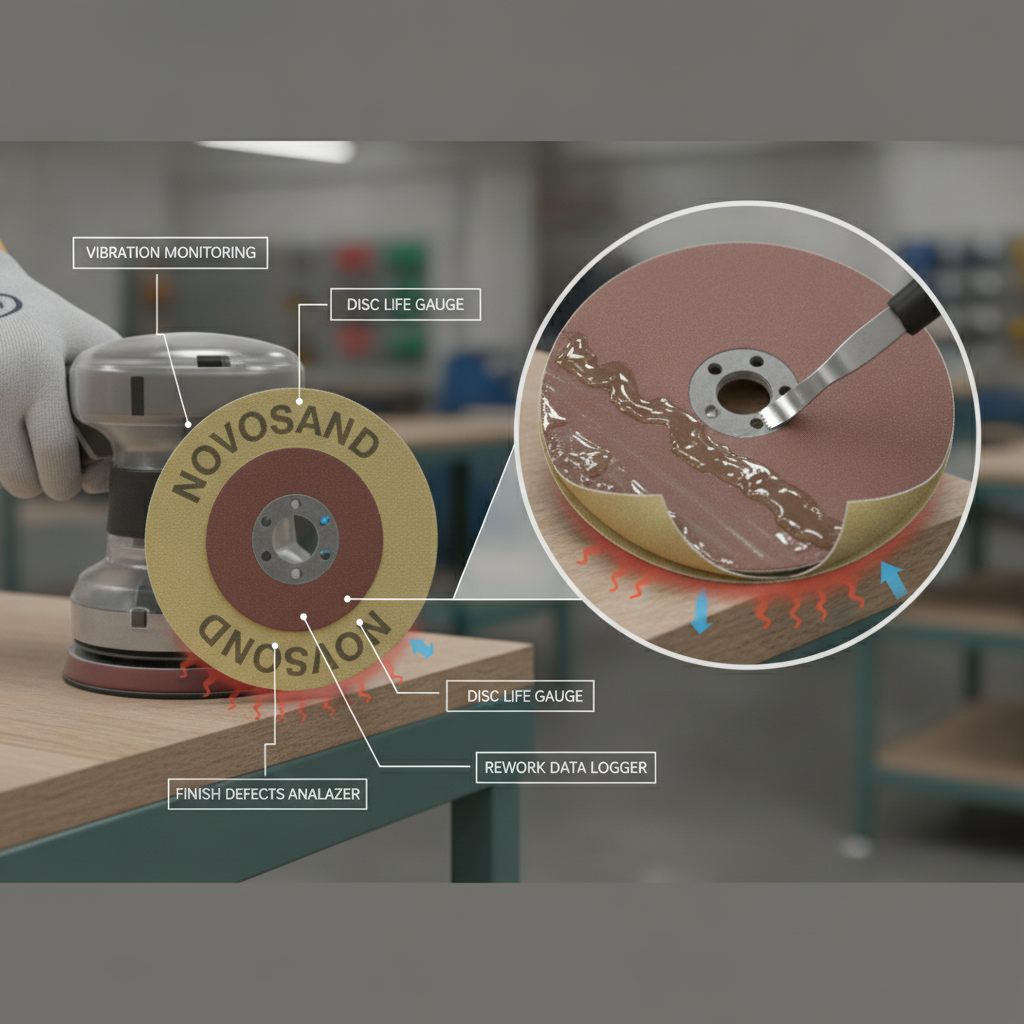
PSA disc life usually drops first at the edge, not in the center. When the disc overhangs the pad by even 1-2 mm, heat and vibration rise fast.
A furniture components plant I supported cut this problem quickly on 150 mm P180 aluminum oxide PSA discs. Their operators had been mounting slightly oversized discs on a medium-density foam pad, and edge lift started after roughly 35-40 cabinet panels. After they matched disc and pad diameter, cleaned adhesive residue every shift, and improved dust extraction, disc life climbed to around 50-55 panels. Rework also fell by about 15%. That is practical gain.
I’ve seen the same pattern in automotive refinishing. A worn pad with adhesive build-up creates high spots, so the disc does not sit flat. Then the sanding interface overheats, the PSA bond softens, and the disc can slip during primer sanding. I always suggest cleaning pads with a suitable pad eraser or approved solvent method, then checking pad flatness before the next disc goes on.
Heat control matters more than many teams expect. Excess pressure, high RPM, dull grain, or poor extraction can glaze the abrasive and weaken the adhesive bond system. From my experience, a film-backed PSA disc in P320-P600 often lasts longer on fine finishing because the backing stays flatter and resists edge curl better than light paper.
Disc changes also should happen during micro-downtime—part swaps, air-line checks, quick inspections. Track parts per disc, finish defects, vibration, and pad cleaning frequency. I suggest a one-week trial with two grit and pad setups before you standardize.
A PSA disc that overhangs its backup pad by just 1-2 mm can fail first at the perimeter because the unsupported edge runs hotter and vibrates more, which weakens both the abrasive bond and the pressure-sensitive adhesive before the center is fully wornTrue
PSA disc life often drops at the edge first because the outer circumference sees the highest surface speed and, if it extends past the pad, loses backing support. That combination increases flutter, localized heat, and shear stress on the adhesive layer. In practice, matching pad and disc diameter closely, removing adhesive residue, and maintaining dust extraction can noticeably delay edge lift and improve usable disc life.
Using a PSA sanding disc that is 2-3 mm larger than the pad is recommended because the extra edge acts like a wear margin and typically extends disc life by protecting the pad from contactFalse
An oversized PSA disc does not function as a beneficial wear margin. Instead, the unsupported overhang flexes excessively, creating more heat, vibration, and edge loading at the fastest-moving part of the disc. This commonly leads to premature edge lift, tearing, or adhesive failure, so PSA discs should be matched to the pad diameter rather than intentionally oversized.
We’ve covered what PSA sanding discs are, how they attach, and where they make the most sense in day-to-day production. In most cases, they’re a practical choice for flat-surface sanding, fixed-grit steps, and jobs where consistency matters more than quick disc changes.
From my experience, buyers get better results when they look beyond attachment style and check the full sanding setup—pad hardness, surface shape, and changeover frequency. That’s where the spec sheet gap often shows up.
If you’re comparing PSA with hook-and-loop for a real application, feel free to reach out. I’m happy to share what tends to work best in woodworking, metal, or finishing lines. Every sanding process is a little different.
References
-
Systematically compares hook-and-loop and PSA sanding discs in terms of changeover efficiency, fit stability, surface consistency, and rework rates, supporting better process selection. ↩
-
Explains PSA bonding mechanisms, heat resistance, and removal limitations, and why PSA can deliver flatter contact and lower per-disc cost in certain workflows. ↩
-
Explains pad material, flatness, and surface requirements that affect adhesion strength, sanding consistency, disc lifespan, and final finish quality. ↩
-
Provides an in-depth explanation of PSA adhesive bonding principles, compatible backing pad requirements, and usage considerations, helping readers determine when to choose a more stable sanding interface. ↩
-
Explains the cutting characteristics, durability, material compatibility, and grit selection of aluminum oxide abrasives, helping evaluate performance in automotive refinishing applications. ↩
-
Systematically compares unit price, reuse potential, changeover efficiency, and total processing cost between two disc systems, helping procurement and process engineers make more accurate selections. ↩
-
Details how dust extraction efficiency affects cutting consistency, surface quality, disc life, and heat buildup, useful for optimizing sanding processes and cost control. ↩
-
Systematically compares the stability, changeover efficiency, cost, and application scenarios of two attachment systems, helping select the best option for batch flat sanding. ↩
-
Explains the tear resistance, heat resistance, and service life advantages of cloth-backed PSA discs in high-pressure metal sanding, helping users select appropriate backing materials. ↩
-
Explains how film-backed discs improve dimensional stability, fine finishing uniformity, and edge wear resistance, suitable for high surface quality repair and finishing applications. ↩
-
Shows how residual adhesive weakens bond strength, causes slippage and scratch defects, and outlines proper cleaning methods to prevent these issues. ↩
-
Explains how humidity affects PSA adhesive tack, edge lifting, and service life, and provides practical storage ranges and on-site control recommendations. ↩
-
Explains how solvent vapors degrade PSA adhesive performance, with workshop examples showing how to avoid loss of adhesion, disc detachment, and replacement waste. ↩
-
Explains how adhesive residue causes pad high spots, uneven contact, and slippage, and provides cleaning methods and inspection practices to prevent failure. ↩