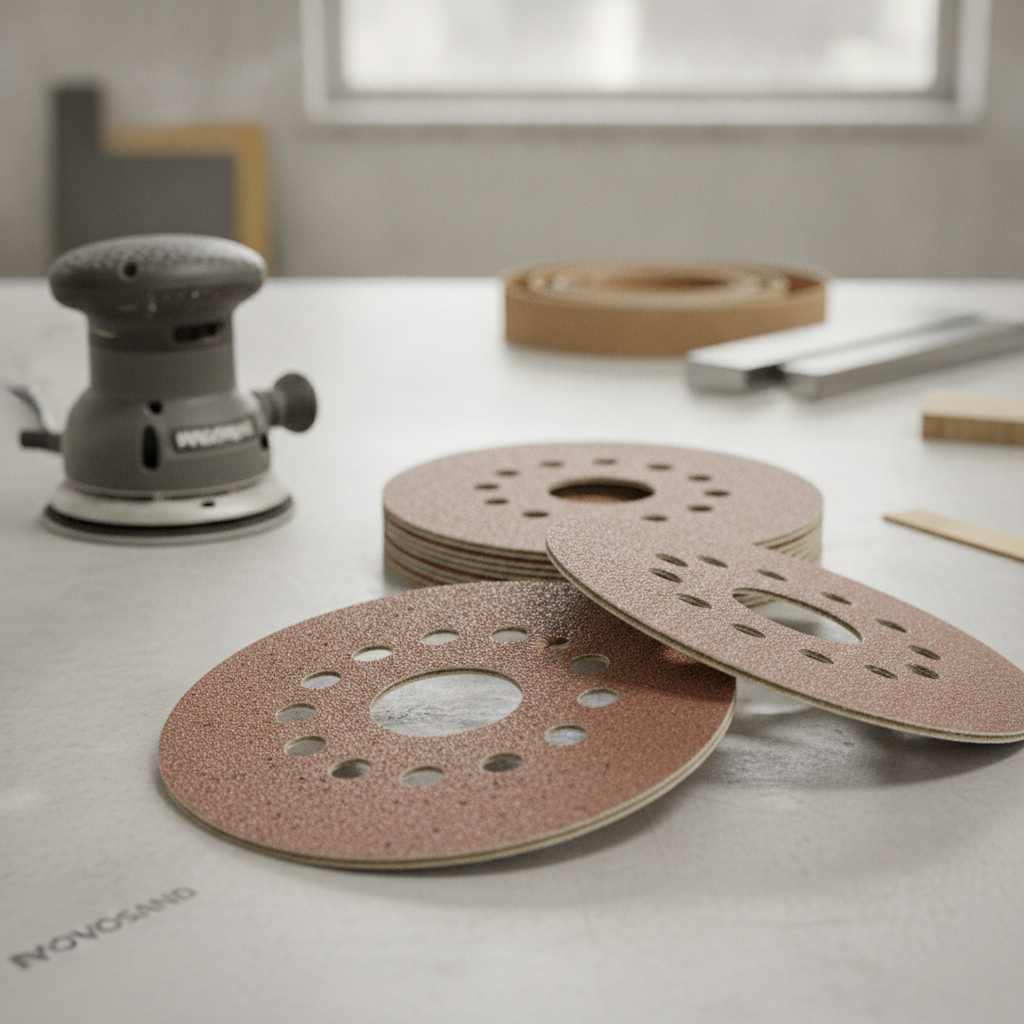
What Is a Paper Sanding Disc? Expert Guide to Key Specs
A buyer from a cabinet factory in Foshan once told me, “It’s just a paper disc, right?” That small sentence explains why so many sanding problems start at purchasing. A paper sanding disc looks simple, but the wrong backing, grit, or hole pattern can change the whole sanding result.
A paper sanding disc is a circular coated abrasive built with abrasive grains bonded to a paper backing through a resin system for sanding, surface preparation, and finishing. Performance varies significantly by grain type, grit size, backing weight, attachment system, and dust-extraction hole pattern. Lighter paper grades provide more flexibility for contours, while heavier grades offer better tear resistance and stability on flat surfaces.
What Is a Paper Sanding Disc?
A paper sanding disc is a circular coated abrasive designed for orbital, random-orbital, disc, and other compatible sanding machines. It combines abrasive grains such as aluminum oxide1, silicon carbide2, zirconia alumina, or ceramic alumina with a paper backing and resin bond system. Performance varies by backing grade, grit size, coating structure, attachment method, diameter, and dust-extraction hole pattern.
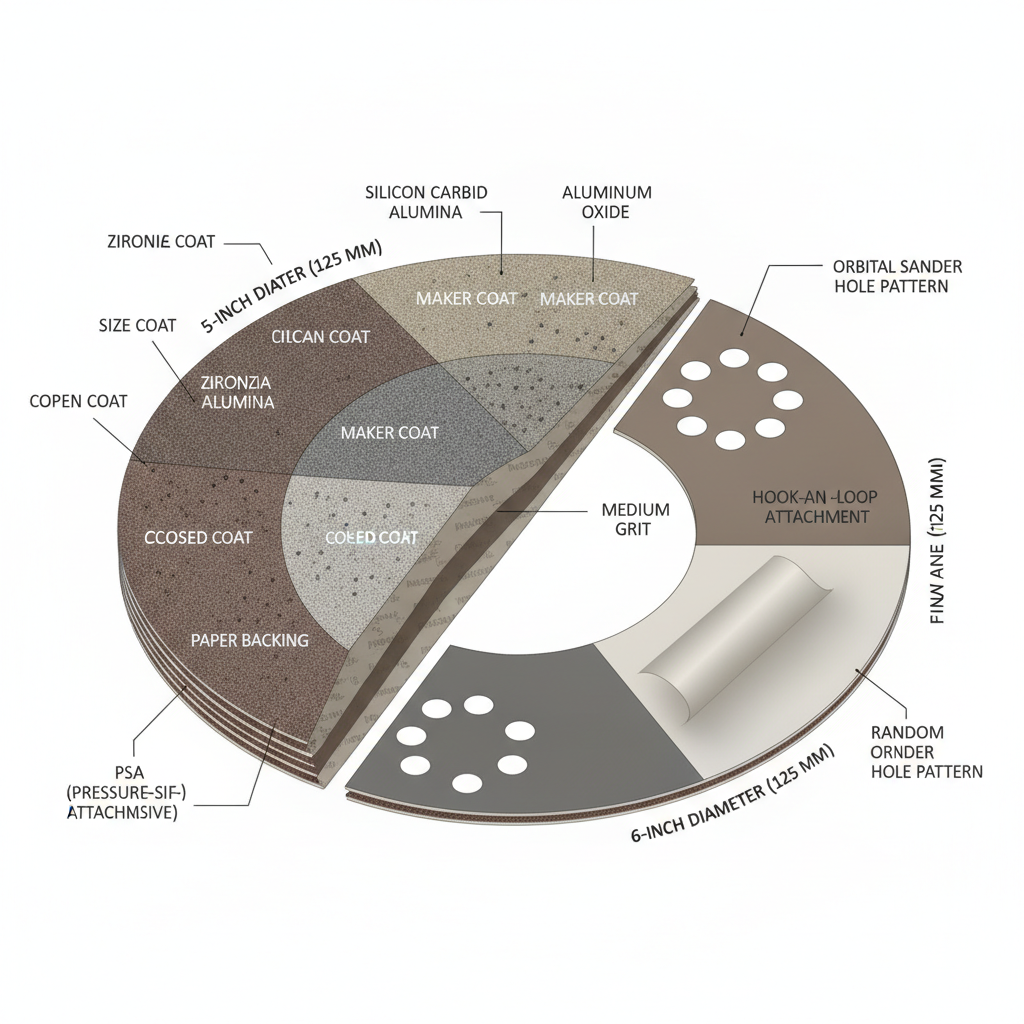
A paper sanding disc looks simple, but its performance comes from several engineered layers working together. The disc combines abrasive grain, paper backing, and a resin bond system to cut, support pressure, and hold the grain during sanding.
Common grains include aluminum oxide for general wood and metal work, silicon carbide for finer finishing, and zirconia or ceramic alumina for heavier stock removal. The paper backing also matters more than many buyers expect. A lighter A- or C-weight paper bends easily for contour sanding, while D- to F-weight paper gives better stability on flatter surfaces and higher pressure jobs.
I saw this clearly with a furniture manufacturer running 6-inch random-orbital discs on MDF panels. They started with a P180 aluminum oxide disc on C-weight paper, but edge wear came too fast—often after only 35 to 40 cabinet doors. We switched to a stronger paper grade with the same grit and hole pattern, and disc life improved by around 20-25%. Same machine. Better match.
Attachment style is another key part of the definition. Hook & loop discs suit fast disc changes in production, while PSA discs give a firmer hold on some disc sanders. I always remind buyers to check the dust-extraction hole pattern too, because a 6-inch disc with 15 holes will not perform well on a pad drilled for 8 holes.
So, a paper sanding disc is not just a round piece of sandpaper. From my experience, it should be specified like a cutting tool—grain, backing, grit, diameter, and attachment all need to fit the job.
In a paper sanding disc, the backing weight and resin bond are engineered as a system: lighter A- or C-weight papers conform better to contours, while heavier D- to F-weight papers resist edge wear and grain shedding under higher pressure on flat sanding.True
Paper sanding disc performance depends on more than abrasive type. Lighter paper backings flex more easily, which helps the abrasive stay in contact on curved or profiled surfaces. Heavier backings are stiffer and stronger, so they better support coarse grits and aggressive sanding where heat, pressure, and edge loading can tear lighter papers or prematurely strip abrasive grain from the bond.
Paper sanding discs use a single adhesive layer, so the abrasive grain is bonded directly to bare paper without a separate make coat and size coat resin system.False
Most coated abrasive paper discs use multiple engineered layers, not a single adhesive film. Typically, a make coat first anchors the grain to the backing, and a size coat is then applied over the grain to lock it in place and improve durability. Many products also include supersize or grinding-aid layers for heat reduction and loading resistance, especially in stearated wood sanding discs.
How Do Paper Weights Affect Performance?
Paper backing weight determines flexibility, strength, and sanding stability. Lighter A- or C-weight paper conforms better to curves and fine finishing, while heavier D-, E-, or F-weight paper resists tearing and stays flatter under higher pressure. Actual performance also depends on resin treatment, latex impregnation3, fiber quality, coating structure, and conversion quality, not backing weight or gsm alone.
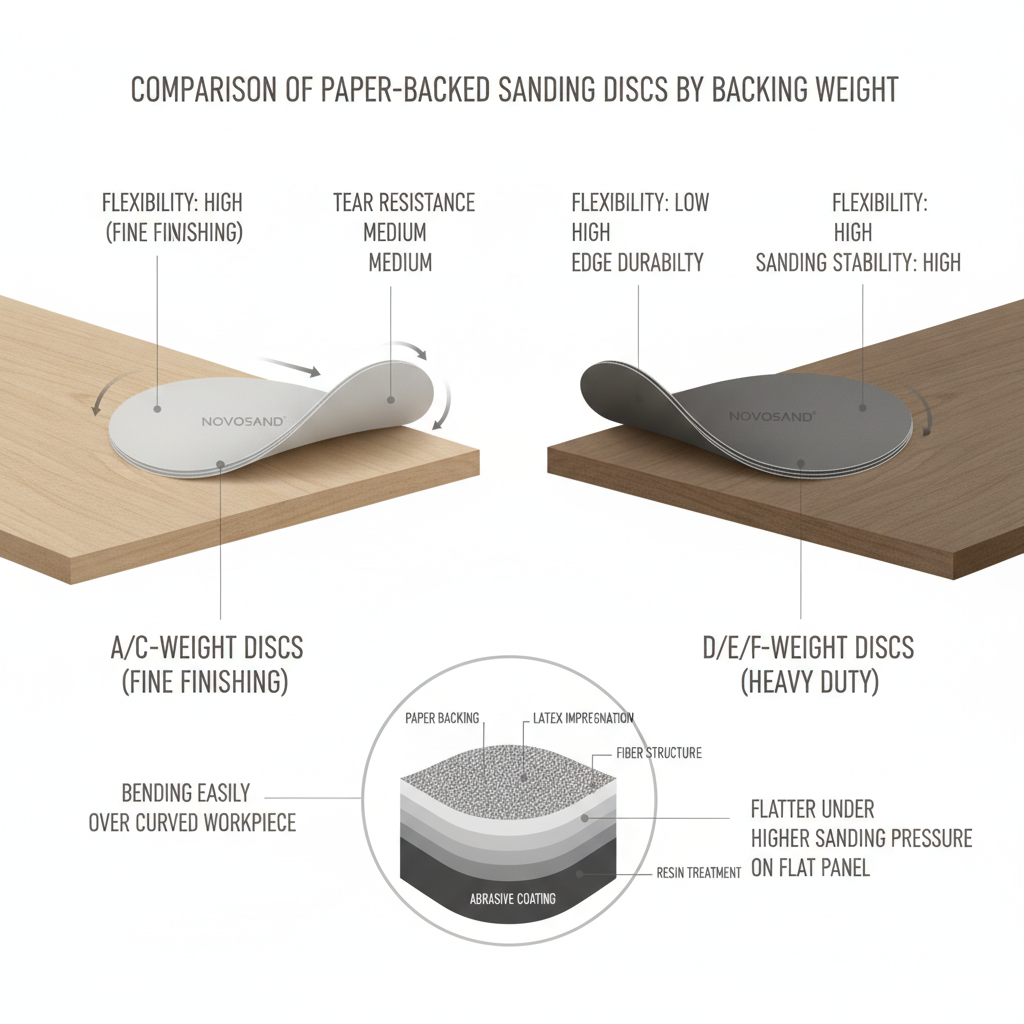
Paper weight changes how a disc behaves the moment pressure goes on. A- and C-weight paper bend easily over curves, while D-, E-, and F-weight paper stay flatter and resist tearing on edges and broad panels.
In a cabinet door line, that difference shows up fast. A furniture factory in Vietnam tested 125 mm hook-and-loop discs in P180 and P240 aluminum oxide. Their C-weight discs finished routed profiles cleanly, but edge wear increased after around 35 to 45 doors per disc when operators pushed too hard. When they switched those same contour jobs to E-weight, the disc lasted longer on paper, but it bridged over the profile and left uneven scratch patterns. Wrong match.
I’ve seen the opposite in flat sanding. One panel shop running wide flat components used D-weight paper with a resin-over-resin bond system4 and latex impregnation. Disc life improved by around 20-30% compared with a lighter C-weight version, especially on MDF edges where heat and sharp corners usually break the rim first. The heavier backing held shape better under machine pressure. That gave them a more stable cut rate.
But gsm alone does not tell the whole story. To be honest, this is a common spec sheet gap. Fiber quality, latex treatment, grain coating, and conversion quality all affect curling, edge cracking, and disc retention. A poorly converted heavy paper disc can still fail early.
I always suggest choosing lighter paper for contour sanding and final finishing, then heavier grades for flat panels, edges, or higher-pressure sanding. Before standardizing, test with your actual pad hardness, substrate, and dust extraction setup.
At the same grit, switching from C-weight to D- or E-weight paper usually improves edge-life on cabinet parts because the heavier backing deflects less under pressure, so the abrasive stays flatter on door edges and broad panels instead of folding into the corner and tearing earlyTrue
Paper weight affects stiffness before grit or mineral changes anything. Lighter A- and C-weight backings conform better to routed profiles, but under sustained hand pressure they flex more and can concentrate stress at edges, which accelerates backing fatigue and edge wear. Heavier D-, E-, and F-weight papers resist that deformation, so they are typically chosen where tear resistance and shape retention matter more than tight conformability.
For 125 mm hook-and-loop paper discs in P180-P240, F-weight paper is generally the best choice for routed cabinet door profiles because its extra stiffness lets it conform more closely to curves while also reducing scratch depthFalse
This reverses the normal behavior of paper backings. Heavier papers like F-weight are stiffer, so they conform less effectively to tight curves and routed details than C-weight papers. They can improve durability on flat panels and edges, but they do not increase flexibility, and scratch depth is driven mainly by grit size, abrasive type, and loading pressure rather than paper weight alone.
Which Is Better: Hook-and-Loop or PSA?
Hook-and-loop paper sanding discs are generally preferred for frequent grit changes because they attach mechanically to hook pads and remove quickly. PSA paper sanding discs bond to smooth backup pads with pressure-sensitive adhesive5, offering a thin, firm interface that can be cost-effective for long single-grit runs. The better choice depends on pad compatibility, changeover frequency, sanding pattern, machine speed, and maintenance conditions.
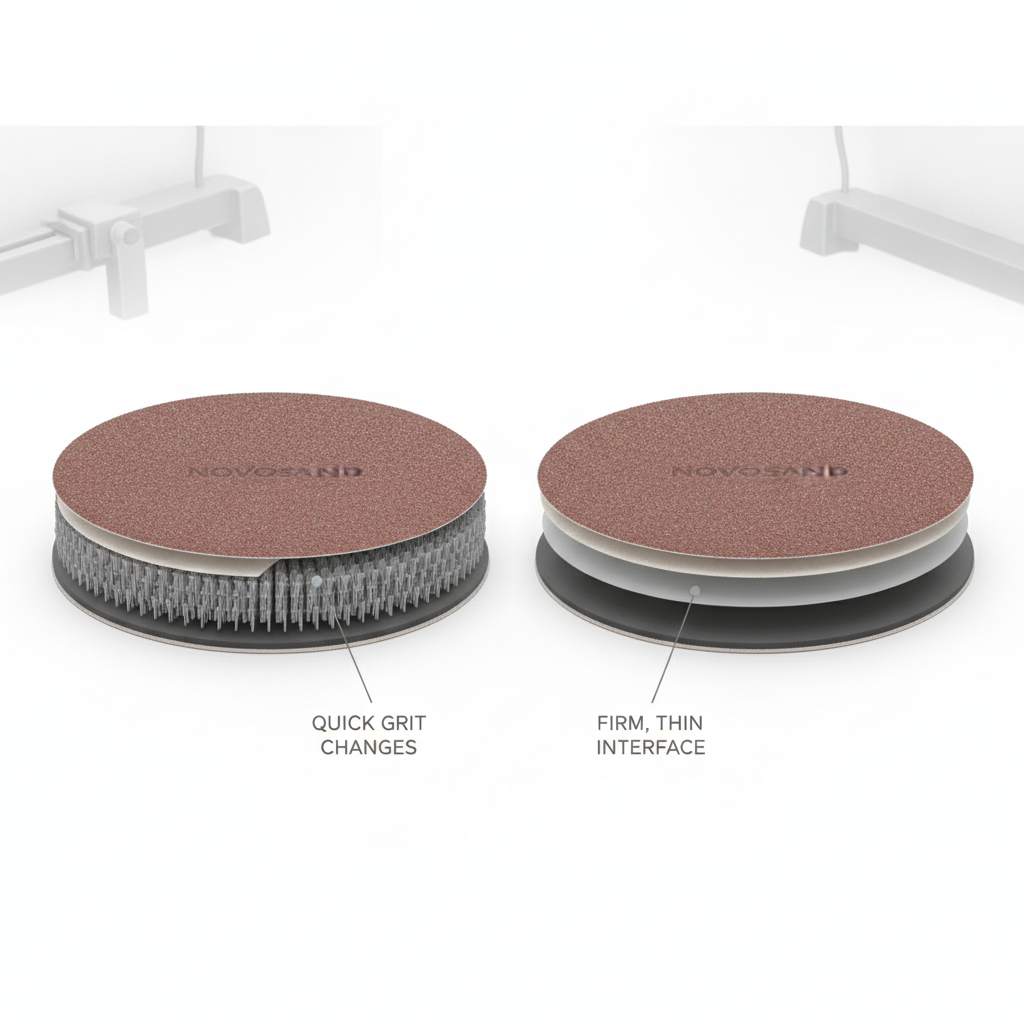
The real difference starts at the pad. Hook-and-loop changes faster, while PSA gives a thinner, firmer contact between disc and backup pad.
| Attachment | Best For | Pad Type | Changeover Speed | Common Risk |
|---|---|---|---|---|
| Hook-and-loop | Multi-grit sanding, inspections, repair work | Hook pad | Very fast | Hook wear or disc movement |
| PSA | Long single-grit runs, flat sanding | Smooth PSA pad | Slower | Adhesive residue or pad contamination |
In a furniture plant I supported, operators ran 5-inch P120, P180, and P240 aluminum oxide paper discs6 on orbital sanders during whitewood preparation. They changed grits every 8-12 minutes. Hook-and-loop cut downtime significantly because each swap took only a few seconds. Over one shift, that saved roughly 20-30 minutes per operator. That matters.
PSA works differently. I’ve seen metalworking customers use PSA paper discs in long runs with one grit, often P80 or P120, on flat steel panels where they wanted a stable sanding pattern and low disc cost. The adhesive layer keeps the interface thin, so the disc feels firm and direct at speed. But heat changes the story.
To be honest, pad condition decides more than many buyers expect. If the hook field is flattened, holding power drops. If a PSA pad gets dusty or hot, discs can peel badly and leave residue—that’s part of the spec sheet gap I see often. I always suggest checking machine speed, pad face, and how often the team changes grit before choosing. Test both systems on your actual line, not just on a sample bench.
For paper sanding discs, PSA mounting usually gives a slightly lower stack height than hook-and-loop, which can improve flat-panel sanding by reducing interface compliance and helping the abrasive track more rigidly across the surfaceTrue
PSA discs bond directly to a smooth backup pad with a pressure-sensitive adhesive layer, while hook-and-loop systems add the thickness and compressibility of the loop backing and hook face. That thinner, firmer interface can improve contact uniformity on flat work, which is why PSA is often preferred for long single-grit runs and flatter sanding applications.
Hook-and-loop paper sanding discs should only be used for one grit size per pad because changing between grits quickly wears out the hooks and causes immediate loss of holding powerFalse
Hook-and-loop systems are specifically favored for multi-grit sanding, inspections, and repair work because they allow very fast disc changes on the same hook pad. Hook wear can occur over time, especially with heavy pressure, heat, or contamination, but normal grit changes do not make a pad single-grit-only. Their main advantage is repeated changeover efficiency.
How Do Grit and Grain Guide Selection?
Grit size controls cut rate and finish quality, while abrasive grain affects sharpness, durability, and substrate suitability. Coarse P40-P80 grits remove stock and coatings, P100-P180 support smoothing and primer sanding, P220-P400 refine surfaces, and P600+ handle intercoat or delicate finishing. Aluminum oxide suits general-purpose sanding, silicon carbide fits paint and plastics, and zirconia or ceramic support aggressive, long-life metalworking applications.
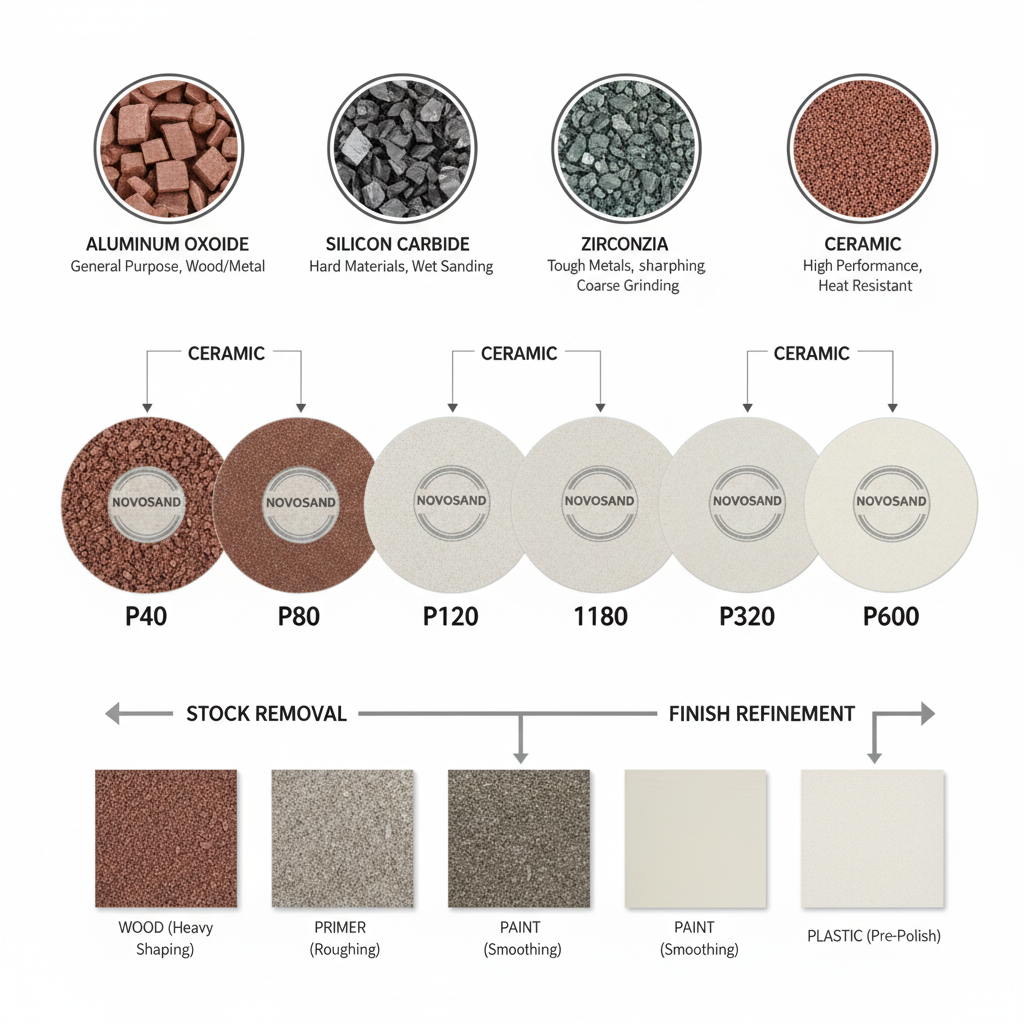
Selection usually fails when buyers choose grit by finish target alone and ignore grain behavior under pressure. P80 and P150 can both look acceptable on a sample panel, but the wrong grain will change cut rate, loading, and disc life fast.
Coarse P40-P80 grits remove stock, old coatings, and heavy filler. P100-P180 handle smoothing, primer sanding, and general surface prep. P220-P400 refine the scratch pattern before sealer, while P600 and above suit intercoat sanding, clear coat correction, or delicate plastics. From my experience, this grit progression matters most when cycle time is tight and rework is expensive.
Grain type decides how that grit actually works. Aluminum oxide is the general-purpose option for wood, primer, filler, and many routine metal prep jobs. Silicon carbide cuts sharper but breaks down faster, so I often suggest it for paint, clear coat, solid surface, and plastic parts where a clean, fine scratch matters. Zirconia and ceramic grains hold up better under high pressure—especially on stainless steel, weld blending, or aggressive edge work.
I saw this clearly with an automotive refinishing customer in Malaysia. They used a 6-inch P320 aluminum oxide paper disc for primer sanding and complained about loading after roughly 12 to 15 panels. We switched them to P320 silicon carbide on a stearated C-weight paper, and disc life improved by around 25% with a more even finish.
To be honest, the spec sheet gap often starts with incomplete callouts. I always suggest specifying the full combination: 6 in hook-and-loop, P150 aluminum oxide, C-weight paper, 6-hole or 15-hole pattern. That makes sourcing clearer and production results more consistent.
A P150 paper sanding disc made with stearated aluminum oxide can load faster and cut slower on polyester body filler than a non-stearated ceramic P150 disc, even though both leave a similar initial scratch depth on a test panel.True
Grit number mainly indicates particle size, not how the abrasive behaves under pressure or with specific materials. Stearates help reduce loading in paint and primer, but on heavy filler a ceramic grain often fractures to expose fresh edges and maintains cut better. Two discs with the same P150 grade can therefore produce a similar-looking sample scratch pattern at first, yet differ significantly in stock removal rate, loading resistance, and usable life.
"ForFalse
"FEPA
Why Do Sanding Disc Holes Matter?
Hole patterns on paper sanding discs are critical for dust extraction performance8 because they must align with the sander pad and vacuum ports. Proper matching improves dust capture, reduces loading, lowers heat buildup, supports a more consistent cut rate, and can extend disc life. Extraction results also depend on pad design, airflow, hose and filter condition, operator pressure, and full system compatibility.
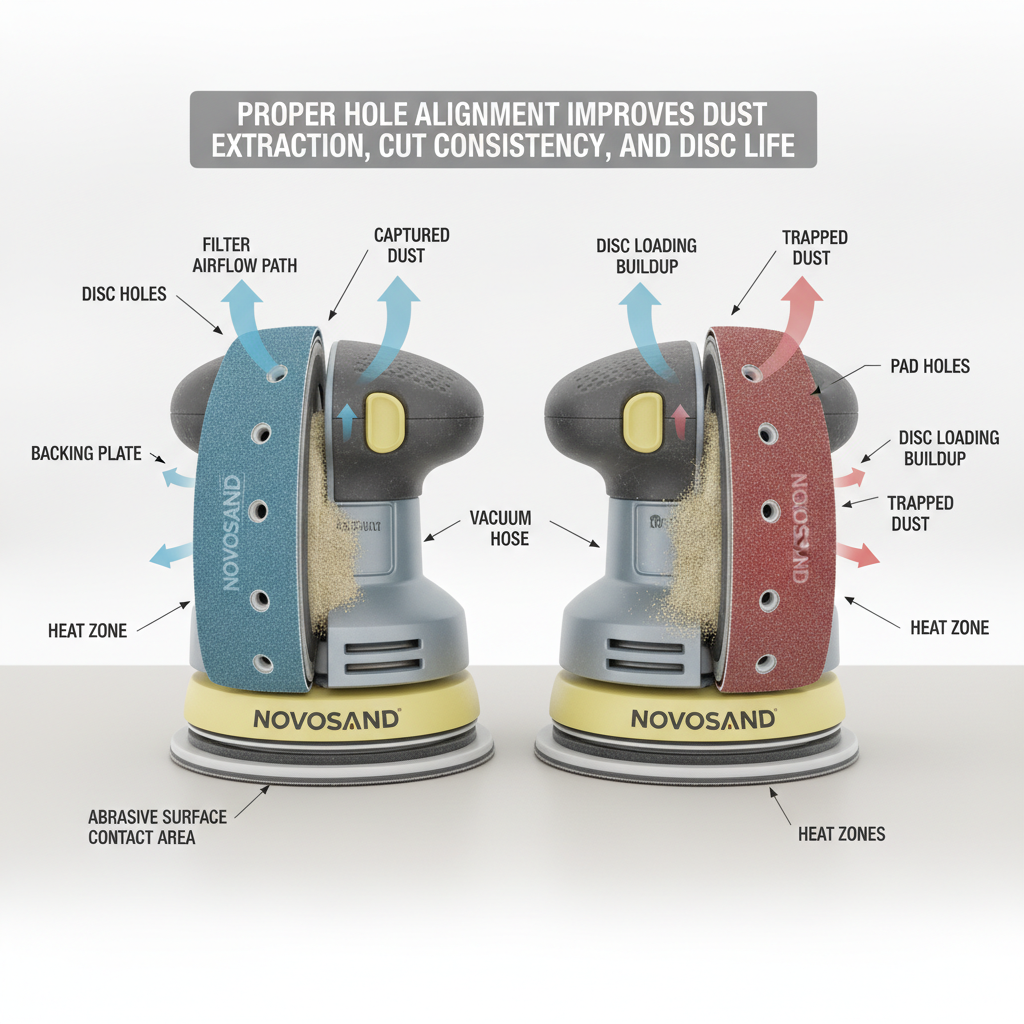
Hole patterns matter when dust has somewhere to go. If the disc holes do not line up with the pad ports, extraction drops fast, even when the abrasive grain and grit are correct.
On a 150 mm paper disc, I commonly see 6-hole, 8-hole, 9-hole, and multi-hole layouts. Match them correctly, and the vacuum pulls dust from the sanding zone instead of letting it pack between the grain and the workpiece. That reduces loading, lowers heat, and keeps the cut rate more stable through the disc’s life.
I saw this clearly with a furniture manufacturer running P180 aluminum oxide paper discs on sealer sanding. Their old 8-hole disc sat on a mismatched multi-port pad, and operators complained that discs glazed after 20-25 doors. We switched to the exact pad pattern, kept the same grit and resin bond system, and disc life improved by around 25-30%. Dust on the panel also dropped noticeably. The finish stayed more even.
Still, the disc is only one part of the system. From my experience, weak airflow, a cracked hose, or a clogged filter can cancel out the benefit of a good hole pattern. Paper discs also have less open area than mesh discs, so alignment matters even more on high-volume sanding lines.
I always suggest checking the full setup—disc pattern, pad design, extractor airflow, and operator pressure—before blaming the abrasive. To be honest, there is no universally superior hole pattern. Test it on the actual machine and material first.
On a 150 mm paper sanding disc, switching from a mismatched 6-hole disc/pad combination to a correctly aligned 8-hole or multi-hole setup can improve dust extraction enough to noticeably reduce loading and keep the abrasive cutting more consistently, even when grit and grain type stay the sameTrue
Dust extraction efficiency depends heavily on whether the disc holes actually align with the backing pad ports. When they do, the vacuum can remove debris directly from the sanding interface instead of letting fines accumulate between the abrasive grain and the workpiece. This reduces loading, lowers interface temperature, and helps maintain a steadier cut rate over the life of the disc without changing the abrasive mineral or grit size.
If a paper sanding disc has more holes, such as a multi-hole pattern instead of 6-hole or 8-hole, it will always sand faster because the extra holes increase airflow and make the abrasive more aggressiveFalse
More holes do not automatically make a disc cut faster. Hole patterns primarily affect dust evacuation, and only when they match the pad's extraction ports. A multi-hole disc on an incompatible pad may extract poorly, and additional holes also slightly reduce abrasive surface area. Sanding speed is governed more by abrasive type, grit, coating, pressure, and actual extraction efficiency than by hole count alone.
How Do Paper, Film, and Cloth Compare?
Paper-backed sanding discs are the economical standard for general dry sanding on wood, body filler, primer, drywall, and light metal preparation. Film backing offers better tear resistance, dimensional stability9, and finer scratch consistency, especially in wet sanding and finishing. Cloth backing delivers the highest durability and flexibility for metal sanding, edge work, and higher-pressure applications where paper discs may tear, curl, or lose flatness.
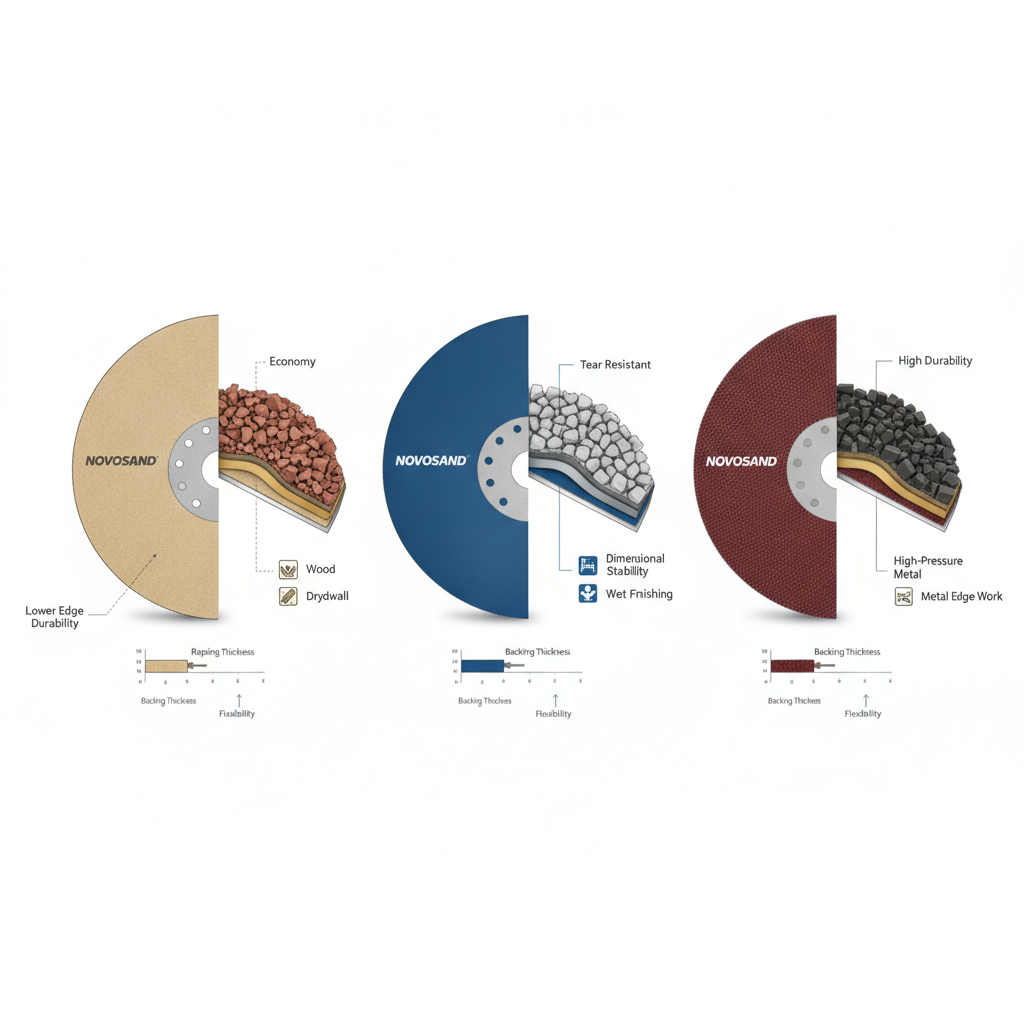
Backing choice decides whether the disc fails at the edge, stays flat, or keeps a uniform scratch. That is why paper, film, and cloth behave very differently even at the same grit, say P180 aluminum oxide on a 125 mm hook & loop disc.
| Backing | Best For | Typical Grit Range | Main Strength | Main Limitation |
|---|---|---|---|---|
| Paper | Wood, filler, primer, drywall, light metal prep | P40–P600 | Low cost, easy conversion, good finish | Tears more easily, sensitive to moisture |
| Film | Wet sanding, paint, clearcoat, plastics, fine finishing | P240–P2000 | Tear resistance, flatness, scratch consistency | Higher cost |
| Cloth | Metal sanding, edges, high pressure work | P24–P240 | Durability, flexibility, edge strength | Heavier, usually less suited to very fine finish work |
In a furniture plant, paper still makes the most sense for broad dry sanding.
I have seen B-weight and C-weight paper discs run well on MDF sealer sanding from P180 to P320, especially with stearate topcoat for loading resistance.
Cost per disc stayed about 20–30% lower than comparable film.
The limit shows up fast on sharper profiles or wet processes.
One automotive refinishing customer in Guangdong switched from paper P600 to polyester film P800 for primer and clearcoat prep.
Disc life improved by around 25%, and scratch uniformity was visibly better under inspection lights.
Less rework. That matters.
For stainless steel edge sanding, cloth wins.
At the same grit and abrasive mineral, a film-backed 125 mm hook & loop disc usually holds a more uniform scratch pattern than paper because the polyester film backing has more consistent thickness and less fiber variation, so the abrasive layer stays flatter under load.True
Film backing is manufactured as a uniform plastic sheet, unlike paper which has fiber structure and can vary more in local stiffness. On fine to mid grits such as P180 aluminum oxide, that dimensional consistency helps the disc track flatter and produce a more even scratch, especially on primers, fillers, and painted surfaces where scratch uniformity is easy to see.
For 125 mm hook & loop discs, paper backing is generally the best choice above P600 because its porous fiber structure resists edge tearing better than film or cloth during contour sanding.False
Paper is typically valued for cost, ease of conversion, and good finish in common ranges like roughly P40-P600, but it is more prone to edge tearing than film or cloth. Film usually offers better tear resistance and flatter backing behavior, while cloth is stronger still but less common for fine-finish random orbital discs. A porous fiber structure does not make paper more tear-resistant at the disc edge.
Why Use Paper Sanding Discs Woodworking?
Paper sanding discs are favored in woodworking because they combine low cost, good flexibility, reliable cut rate, and consistent finish quality. Paper backing conforms to minor grain variation and surface irregularities while remaining stable enough for machine sanding. They are widely used on random-orbital sanders for MDF, hardwood, softwood, veneers, and panels, especially in multi-step grit sequences where predictable coating absorption and economical disc replacement matter.
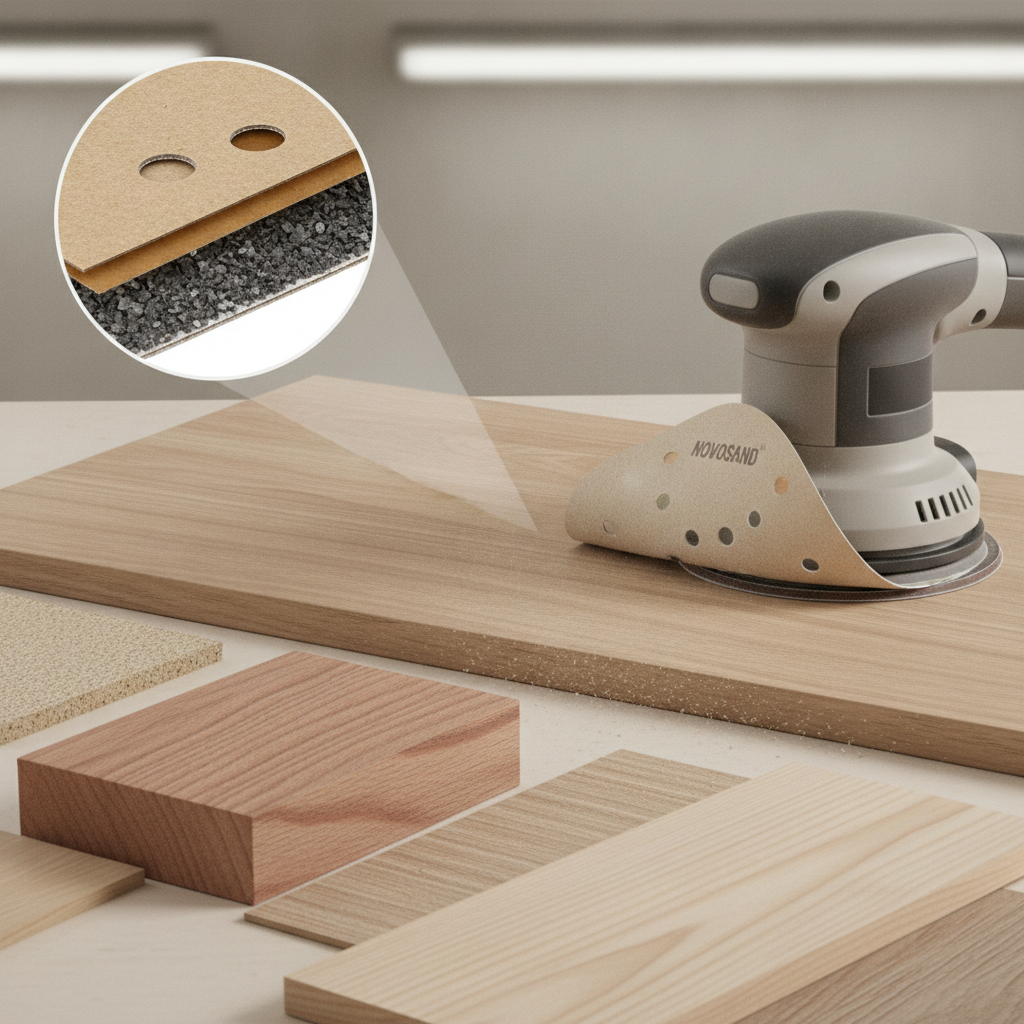
Wood shops choose paper discs for one simple reason: they give a clean, predictable finish without pushing sanding cost too high. That balance matters on random-orbital sanding, where finish quality and disc consumption move together.
In furniture and cabinet lines, paper backing flexes enough to follow small grain changes, especially on oak, pine, MDF, and veneered panels. At the same time, a C-weight or D-weight paper still stays stable on 125 mm and 150 mm hook & loop discs. I’ve seen this clearly in a cabinet factory in Guangdong. They ran a P120-P180-P240 sequence on MDF doors and cut disc cost by around 15% after switching from over-specified film discs to good aluminum oxide paper discs.
Why do paper discs work so well in woodworking?
- Lower disc cost — important in multi-step sanding systems
- Good flexibility — helps the disc track minor surface variation
- Reliable cut rate — especially with aluminum oxide on wood
- Wide grit range — easy to build sequences from P80 to P320
- Consistent finish — important for stain absorption and topcoat appearance
- Many anti-loading options — open coat and stearate help on resinous wood and MDF
To be honest, the spec sheet gap often appears here. Buyers compare only price per disc, but wood sanding depends heavily on backing weight, coat structure, and grit consistency. A heavy paper may sand flat panels better, while a lighter paper handles profiles more smoothly. If dust loading is a problem, I always suggest open-coat aluminum oxide with dust extraction holes matched to the pad. Test a sample batch on your real grit sequence before scaling up.
On 125 mm and 150 mm random-orbital sanders, C- and D-weight paper discs are commonly preferred for woodworking because they balance enough flex to track subtle grain and veneer transitions with enough stiffness to resist edge curl and uneven scratch patterns during flat-panel sandingTrue
Paper backing weight directly affects how a disc behaves under orbital motion. In woodworking, lighter paper can conform well but may wrinkle or wear too quickly, while overly stiff backings can reduce surface compliance. C- and D-weight papers are widely used because they give a controlled compromise: they stay stable on common 5-inch and 6-inch discs yet still flex enough for oak, pine, MDF, and veneered panels, helping produce a more predictable finish.
Paper sanding discs cut cooler than film-backed discs because the paper backing absorbs heat into the fibers, which is why paper is the standard choice for aggressive stock removal on heat-sensitive hardwoodsFalse
Paper backing does not function as a meaningful heat sink in sanding. Heat generation is driven much more by abrasive type, coating density, loading, pressure, and dust extraction than by the backing absorbing heat. In aggressive sanding, paper is often chosen for cost and finish balance, not because it runs cooler; in fact, film-backed discs are frequently valued for tear resistance and edge durability rather than being inherently hotter or cooler.
What Determines Paper Disc Total Cost?
Paper sanding disc total cost depends on more than unit price. Backing quality, resin bond strength10, grain grading, and coating density affect cut consistency, loading resistance, edge retention, and disc life. A higher-priced disc can lower cost per finished part by reducing changeovers, defects, rework, and downtime. Supplier comparisons should use production trials, technical datasheets, and measured indicators such as parts per disc and cut rate over time.
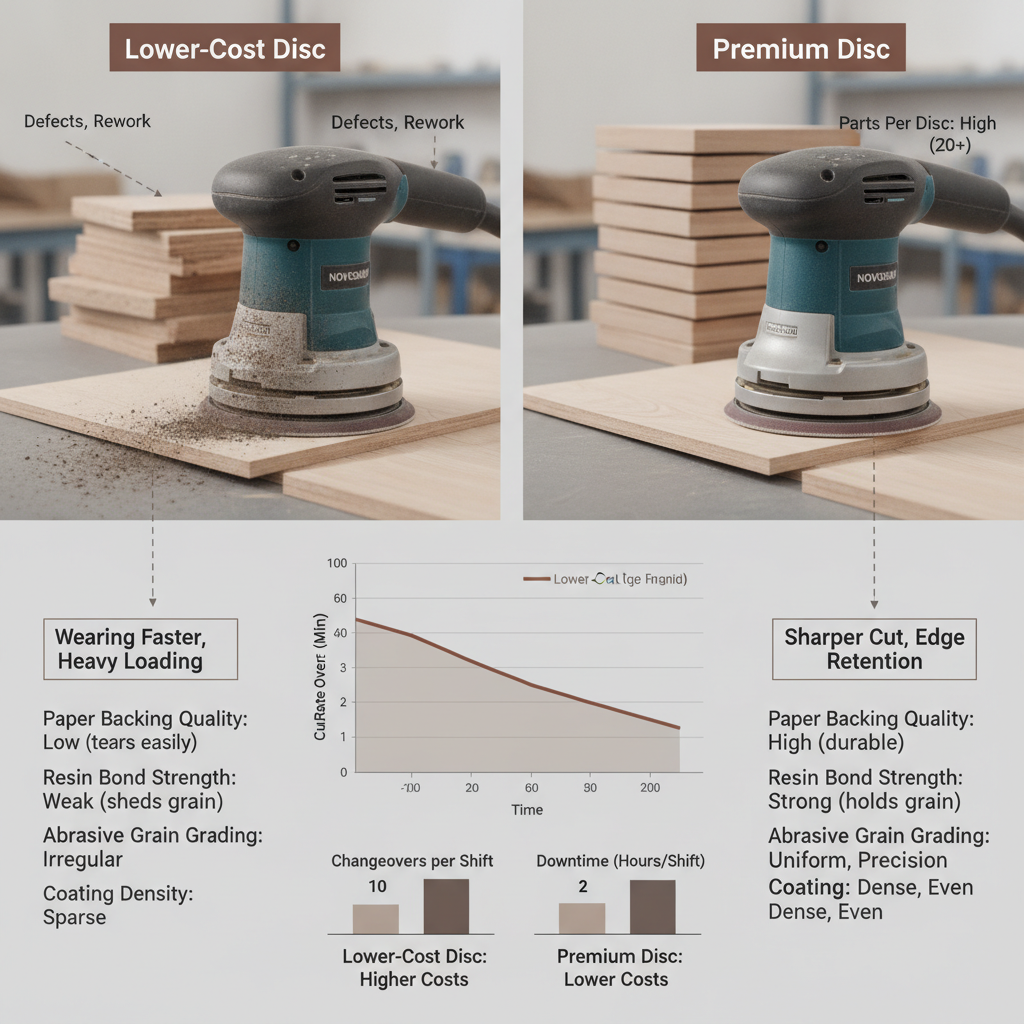
Piece price is only the visible cost. The bigger cost comes later—when a disc dulls early, loads with dust, or loses its edge halfway through a production run.
I saw this with a furniture factory in Dongguan using 6-inch P180 paper discs on sealer sanding. Their purchasing team switched to a disc that was about 12% cheaper per piece. On paper, it looked fine. In production, the lighter C-weight backing curled sooner, the resin bond softened faster under heat, and operators changed discs every 35-40 cabinet panels instead of around 55. That saved a little on purchase price, but disc use per shift jumped by roughly 25-30%.
The hidden cost was labor, not abrasives. Changeovers increased, finish consistency dropped, and rework on edge zones went up because the grain grading was less uniform. From my experience, this is the spec sheet gap buyers miss most often. A disc with better aluminum oxide or ceramic-aluminum oxide blend, stronger phenolic resin bond, and more suitable coating density can keep a steadier cut rate over time.
I always suggest measuring cost per finished part, not cost per disc. Track parts per disc, loading behavior, cut rate after 10, 20, and 30 minutes, and defect rate. If one disc costs $0.18 instead of $0.15 but lasts 40% longer, the math usually changes fast.
To be honest, bulk pricing alone can mislead good buyers. Test small batches under real conditions, lock in clear specs, and compare performance before signing an annual supply contract.
For 6-inch P180 paper discs used on sealer sanding, a disc that is 10-15% cheaper per piece can still raise total sanding cost if its C-weight backing curls under heat and forces 25-40% more changeovers, because labor stoppage and lost cut consistency usually outweigh the purchase-price savings.True
Total cost of a paper sanding disc includes much more than unit price. In sealer sanding, heat buildup and loading can soften lower-grade resin bonds and deform lighter paper backings, especially on thinner C-weight constructions. That leads to earlier edge wear, more frequent disc changes, more downtime, and inconsistent scratch patterns. In many production settings, the extra operator time and reduced throughput cost more than the initial per-disc savings.
The lowest-total-cost paper disc is usually the one with the softest resin bond, because faster bond breakdown exposes fresh abrasive grains and extends disc life on dusty wood sanding applications.False
A soft or weak resin bond generally reduces disc life in paper-backed wood sanding applications. While controlled grain release can be beneficial in some abrasive systems, premature bond breakdown on paper discs usually causes rapid grain loss, edge wear, and heat-related failure before the abrasive has been fully used. For dusty operations like sealer sanding, anti-loading treatment, backing stability, and heat-resistant resin are more important for lowering total cost than having a softer bond.
What Safety Practices Matter for Paper Discs?
Critical practices include matching the paper sanding disc hole pattern to the sander pad and dust extraction system11, inspecting pads for wear or damage, controlling airborne dust through extraction and ventilation, and using task-appropriate PPE. Compliance depends on the full sanding process, including housekeeping, filtration, material hazards, and local regulations, not on the disc alone. Proper storage and acclimation also help maintain flatness and consistent performance.
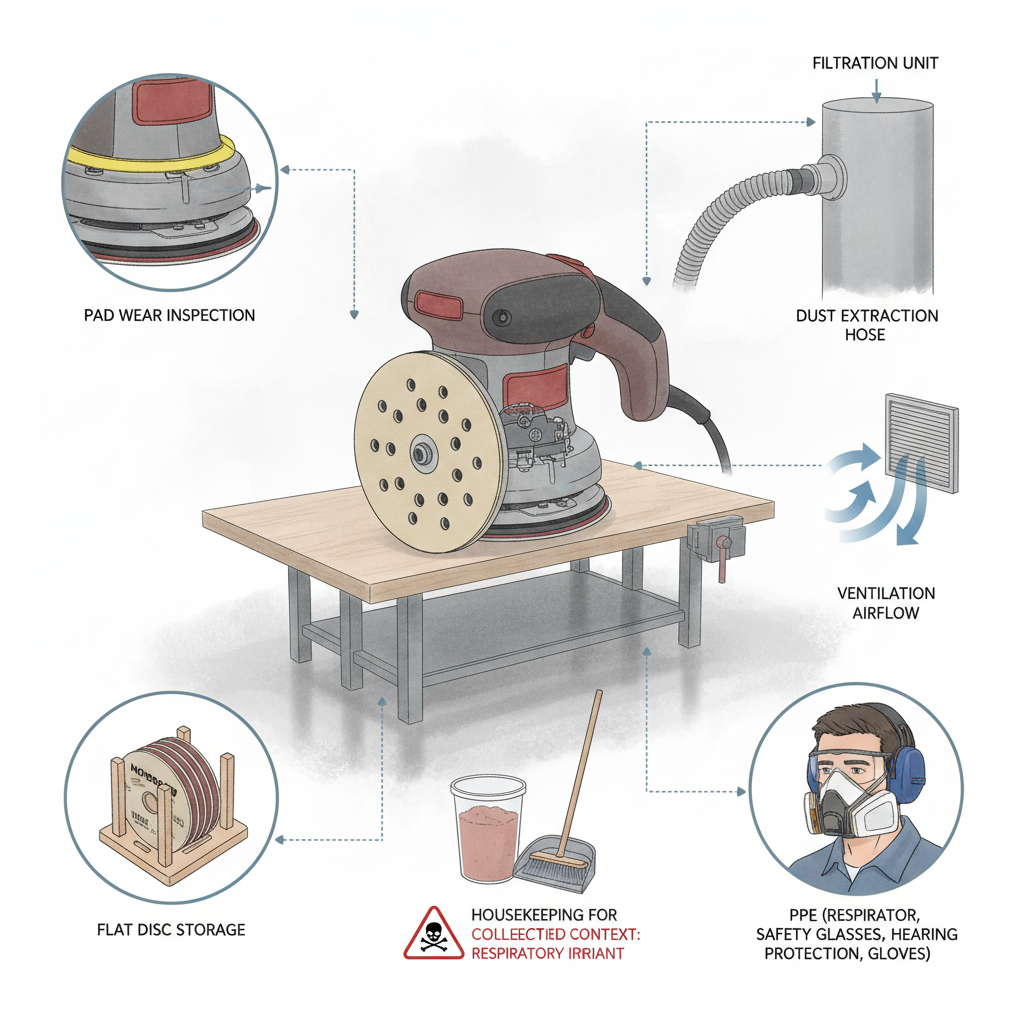
Safety starts before the disc touches the panel. If the hole pattern on a 125 mm or 150 mm paper disc does not match the sander pad and extraction channels, dust stays at the surface, loads the grain, and escapes into the air.
I have seen this most clearly in woodworking and automotive refinishing lines. A furniture plant I supported switched from a mismatched 8-hole disc to the correct multi-hole pattern on a random orbital sander12, and disc life improved by around 20-30%. Dust on benches also dropped noticeably. The abrasive was the same—P180 aluminum oxide on C-weight paper with hook & loop attachment. The process changed.
Pad condition matters just as much. A worn backup pad can wobble, create chatter marks, and tear disc edges early, especially at P240 and finer grits. I always suggest checking pad face flatness, edge damage, and hook wear at the start of each shift. Small damage causes expensive finish defects.
Dust control is a full-system issue, not a disc-only issue. In my experience, sanding wood, primer, body filler, or composites without good extraction increases airborne fine dust, raises cleaning time, and can add combustible dust risk in some plants. Use task-appropriate PPE, local exhaust, and good housekeeping together. That closes the spec sheet gap.
Storage gets ignored too often. Paper-backed discs can curl or turn brittle after humidity swings, direct sunlight, or poor packaging. I suggest storing them flat in original cartons, ideally around 18-22°C and 45-65% relative humidity, then letting them acclimate before use. That simple step helps keep cut quality and attachment consistency stable.
On 125 mm and 150 mm random orbital sanders, a paper disc whose hole pattern does not align with the pad's vacuum channels can reduce extraction enough to increase abrasive loading and shorten usable disc life by roughly 20-30% in dust-heavy work like wood sanding or primer sanding.True
Dust extraction on paper discs depends on airflow through both the disc holes and the pad channels. When those patterns do not match, fine dust stays between the workpiece and abrasive, which clogs the grain, increases heat, and lowers cut consistency. In real production environments, correcting the hole pattern often improves both dust capture and disc life, especially on materials that generate large volumes of sanding dust.
A mismatched hole pattern on a paper sanding disc is mainly a housekeeping issue; as long as the disc diameter matches the 125 mm or 150 mm pad, cut rate and abrasive life are essentially unchanged because extraction does not affect grain loading.False
This is incorrect because extraction is directly tied to sanding performance, not just cleanliness. Poor alignment between the disc holes and pad channels reduces airflow, allowing dust to remain at the interface. That retained dust packs into the abrasive surface, a condition called loading, which slows cutting, raises surface temperature, and can significantly reduce disc life. Diameter match alone does not guarantee proper extraction.
How Should Paper Disc Suppliers Be Qualified?
Paper sanding disc suppliers should be qualified through controlled production trials, not nominal specifications alone. Matching grit, backing weight, grain type, and attachment style do not guarantee equal cut rate, disc life, finish consistency, or dust extraction performance. Critical evaluation should verify batch consistency, coating quality, hole accuracy, conversion quality, and process control using actual substrates, machines, pads, and operating conditions before approval.
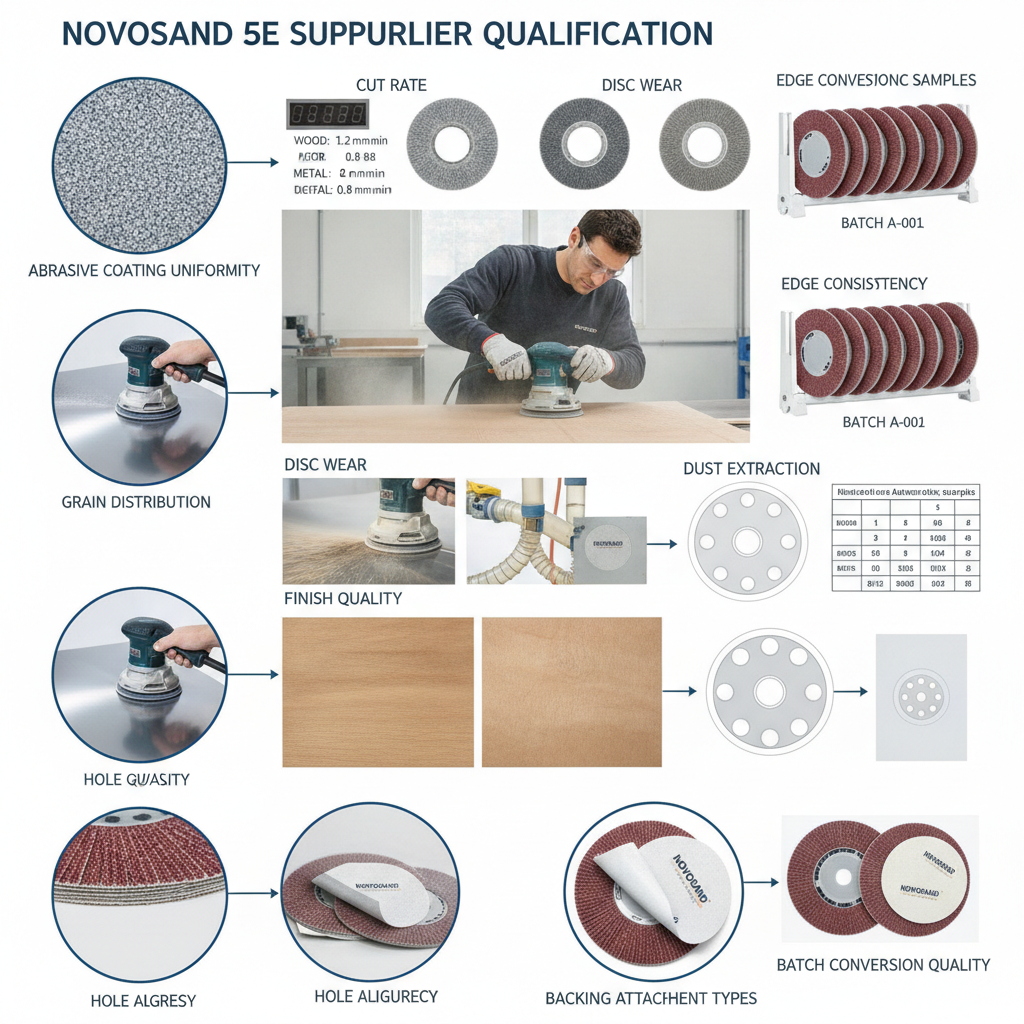
A supplier qualifies only when the disc performs the same way in production, not when the catalog line looks identical. Matching P180, C-weight paper, aluminum oxide, and hook & loop still tells you very little about cut rate, finish, or disc life.
I saw this with a furniture factory in Dongguan running 150 mm, 15-hole paper discs on sealer-sanded oak panels. Two suppliers offered the same nominal spec, but one batch averaged around 28 panels per disc, while the other dropped to 16-18. The weaker batch also left more scratch variation and loaded faster at the pad edge. That difference came from resin system, grain grading accuracy, coating density, and hole punching quality—not the printed grit alone.
For qualification, I always suggest controlled trials on the real line. Use the actual machine, pad hardness, vacuum setting, pressure, and sanding sequence, such as P150 to P240. Measure cut rate, parts per disc, Ra value, defect counts, loading behavior, and operator feedback. In automotive refinishing, I’ve seen nominally equivalent P320 PSA discs give very different primer response because coating uniformity and paper treatment changed the scratch pattern.
Batch consistency matters just as much as first-sample performance. To be honest, this is where many buyers meet the second-batch surprise. Ask for pre-shipment samples from production stock, batch identification, and certificates of conformity where relevant. Then lock approved part numbers and substitution rules into purchasing records.
That step is boring, but it protects yield. I suggest approving suppliers by measured performance per workpiece, not by nominal equivalence or the lowest unit price.
Two 150 mm, 15-hole paper discs with the same listed spec—P180, C-weight paper, aluminum oxide, and hook & loop—can still differ by over 40% in usable life on sealer-sanded oak because coat weight, grain shape, bond hardness, and stearate behavior are not captured by the catalog line.True
Nominal grade and backing tell only part of the story. Real production performance depends on abrasive grain friability, make/size coat chemistry, how heavily the abrasive is applied, and how the loading-resistant topcoat behaves on finishes like sealer. Those hidden construction variables can cause one supplier's disc to cut consistently for roughly 28 panels while another drops to 16-18, even though both look identical on paper. Supplier qualification should therefore be based on line trials and output consistency, not only matched catalog descriptors.
If two paper disc suppliers match on grit, backing weight, abrasive type, and hole pattern, their cut rate and finish will typically stay within 5% of each other, so production trials are mainly unnecessary.False
Matching visible specifications does not guarantee similar performance. FEPA grit designation allows particle-size distribution within a range, and the disc's actual behavior is heavily influenced by resin system, coating density, grain toughness, anti-loading treatment, and backing stiffness under machine pressure. In finishing operations, these differences can produce major gaps in panel count, scratch consistency, heat buildup, and edge wear, so qualification without production testing is unreliable.
We’ve covered the main specifications that define a paper sanding disc, from grain and backing to grit, hole pattern, diameter, and attachment type. Getting these details right is what makes the disc match both the machine and the finish you need.
From my experience, many buyers focus only on grit and price, then run into the spec sheet gap later when dust extraction, edge retention, or backing strength does not fit the job. Before choosing, I suggest checking the workpiece material, sanding stage, and machine setup together.
If you have questions about disc construction or which specification fits your application, feel free to reach out. I’m happy to share what works in real production environments. Every application is different—choose what actually fits your process.
References
-
Systematically explains the cutting characteristics, durability, and suitable woodworking and metalworking applications of aluminum oxide abrasives, helping buyers select the correct abrasive type for paper-backed discs more accurately. ↩
-
Provides an in-depth explanation of silicon carbide’s sharpness, surface finishing performance, and material compatibility differences, suitable for readers comparing fine finish quality and service life. ↩
-
Explains how latex impregnation improves paper flexibility, tear resistance, and heat resistance, and compares its real-world performance in edge sanding and high-pressure applications. ↩
-
Systematically analyzes the structure and function of double-resin bonding layers, explaining how they improve abrasive adhesion, heat resistance, and MDF edge sanding stability. ↩
-
Explains the adhesion mechanism of PSA sanding sheets, compatible backing pads, and adhesive residue risks, helping readers judge whether it is suitable for long-duration single-grit sanding. ↩
-
Covers cut rate, grit durability, wood compatibility, and cost-performance behavior, useful for selecting efficient abrasives in multi-step sanding processes. ↩
-
Explains how open-coat and closed-coat structures influence dust loading, cutting speed, finish quality, and abrasive life across different applications. ↩
-
Explains how hole alignment, airflow, and vacuum system configuration affect dust capture efficiency, clogging, heat buildup, and disc life in real sanding applications. ↩
-
Explains how dimensional stability affects disc flatness, cutting uniformity, and scratch control, and provides comparative performance insights across different backing materials. ↩
-
Explains how bond chemistry affects heat resistance, grain retention, cutting stability, and disc lifespan, helping buyers evaluate real production value differences. ↩
-
Explains how dust extraction systems reduce clogging, airborne particulate levels, and extend abrasive life, useful for improving finishing quality and workshop safety. ↩
-
Explains how orbital sander vacuum channels, hole pattern matching, and airflow design affect surface quality and abrasive life, including practical selection guidance. ↩