What Is a Mesh Sanding Disc? Expert Guide for Buyers
A factory buyer in Foshan once told me, “The disc cuts fine, but the workshop still looks like a dust storm.” That is usually the moment mesh sanding discs enter the conversation—especially for drywall, primer sanding, furniture panels, and automotive filler work.
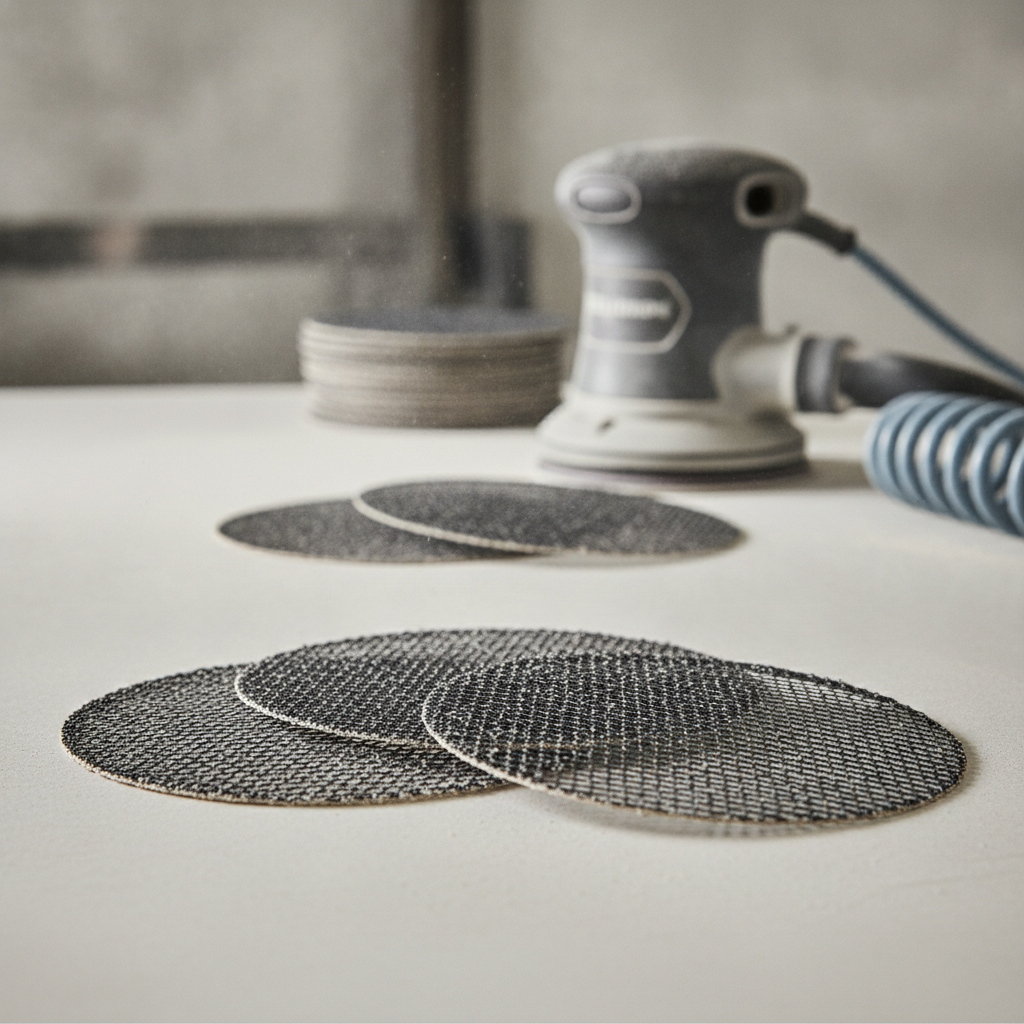
A mesh sanding disc is an abrasive disc built on an open-weave synthetic backing, typically polyamide or nylon, with abrasive grains resin-bonded across the net structure. Unlike paper discs with fixed extraction holes, the entire disc surface remains permeable, allowing dust to pass more evenly into a compatible vacuum system. This design reduces loading, supports more consistent cutting, and improves surface visibility in dust-intensive applications such as automotive refinishing, drywall preparation, woodworking, and floor sanding.
I find mesh
What Is a Mesh Sanding Disc?
A mesh sanding disc is a coated abrasive disc built on an open-weave synthetic mesh backing, usually polyamide or nylon, with abrasive grains resin-bonded across the surface. Unlike paper discs with fixed holes, its uniform mesh allows dust extraction through the entire disc, improving debris removal, reducing loading, and supporting more consistent sanding performance in vacuum-assisted orbital systems.
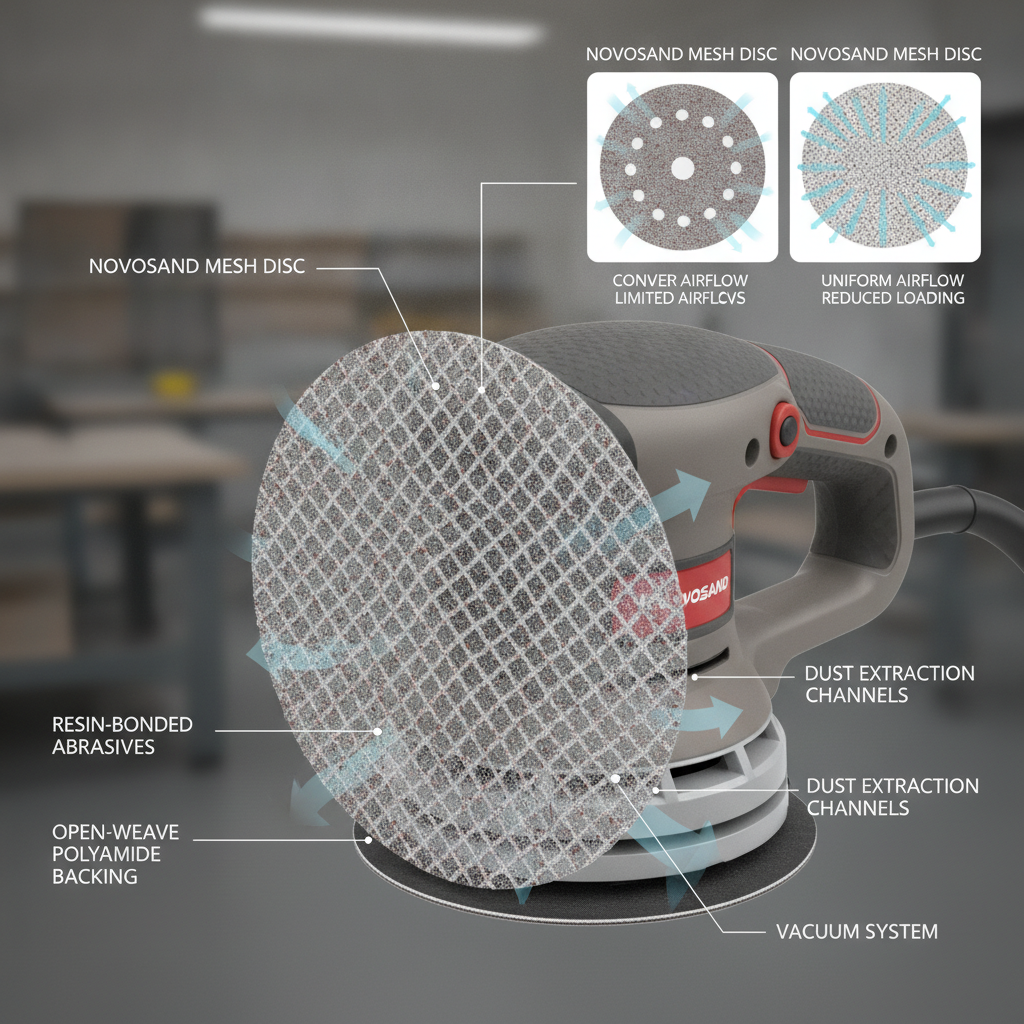
A mesh sanding disc solves a very specific problem: dust has nowhere to go on a conventional disc except through fixed holes. With mesh, the whole face stays open, so dust can pass through almost any point during sanding.
The structure is simple but important. The backing is usually woven polyamide or nylon mesh, and abrasive grains such as aluminum oxide, ceramic, or silicon carbide are resin-bonded across that open lattice. Typical apertures are below 1 mm, small enough to support cutting, but open enough to pull fine debris into a vacuum-assisted orbital system.
I’ve seen this work especially well in automotive refinishing and cabinet sanding. One furniture customer in Guangdong switched part of a line from 125 mm paper discs, P180 and P240, to mesh discs on hook-and-loop pads with central vacuum extraction. Their operators reported around 20-30% less loading on primer and sealer sanding, and disc life improved by roughly a quarter in daily use.
That said, the disc alone does not guarantee clean sanding. The backing pad, interface pad, vacuum airflow, hose diameter, and filter condition all affect dust capture. This is where the spec sheet gap often appears—buyers expect one fixed dust-reduction number, but actual results change with material, pressure, and machine setup.
From my experience, mesh discs make the most sense when dust control and finish consistency matter more than the lowest unit price. I always suggest testing them on your real sander, with your real extractor, in the grit range you use most—often P120 to P320.
Because abrasive is distributed over an open mesh rather than a solid backing, mesh sanding discs typically rely on dust extraction across nearly 100% of the disc face instead of only through 5- to 17-hole patterns, which is why they maintain cut rate better on clog-prone fillers and drywall compounds.True
This is true because the defining feature of a mesh disc is its fully perforated structure: dust can be pulled through almost any point on the abrasive surface. Conventional paper or film discs only evacuate dust where pre-punched holes align with the pad. On soft, powdery materials like drywall mud, primer, and body filler, that broader extraction reduces loading and keeps more abrasive edges exposed, so the disc cuts more consistently.
A mesh sanding disc uses apertures larger than 2 mm so chips can clear freely, which is why mesh discs generally remove stock faster than fiber discs in heavy metal grinding.False
This is false because mesh sanding discs usually have much smaller openings, commonly under 1 mm, so the lattice can still support the abrasive layer while allowing dust passage. They are designed mainly for dust extraction and reduced loading in sanding applications, not for aggressive heavy grinding. Fiber discs for metal grinding use a dense vulcanized backing and far higher grinding pressure, making them a different product category with much higher stock-removal capability.
How Do Mesh Discs Control Dust?
Mesh sanding discs improve dust control because the entire abrasive surface is open, allowing extraction across the full disc rather than through limited holes. When paired with a compatible interface pad and efficient dust extractor, they can significantly reduce airborne dust during sanding of wood, paint, fillers, and joint compound. Actual performance depends on airflow, pad design, grit, substrate, pressure, and system maintenance.
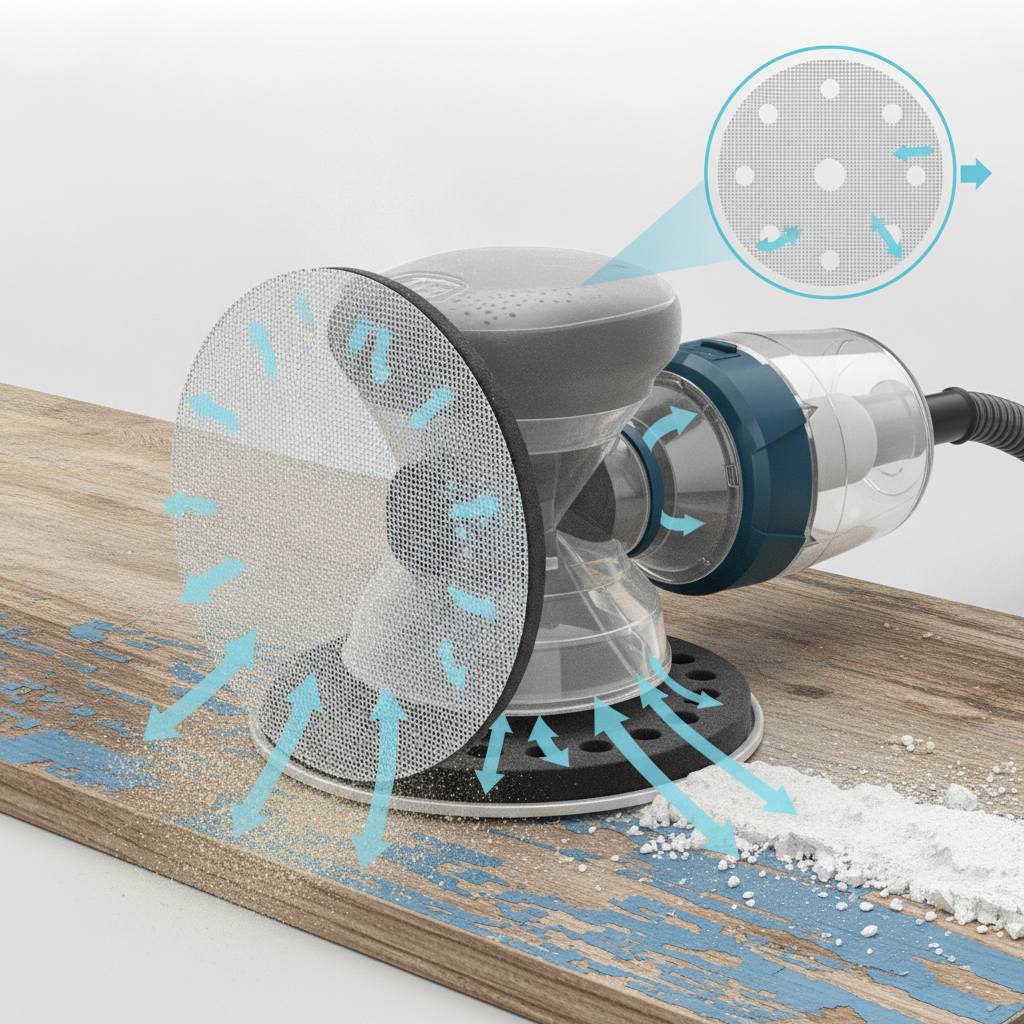
Dust control changes when extraction no longer depends on 6, 8, or 15 punched holes. A mesh disc stays open across nearly the full face, so dust moves through the abrasive surface continuously instead of collecting between blocked holes.
That matters most on fine, airborne dust. In woodworking and drywall finishing, P120 to P240 mesh discs usually pull dust more evenly, especially on 125 mm and 150 mm random orbital sanders with hook & loop attachment. The abrasive grain1 is often aluminum oxide or ceramic, bonded on a polyamide mesh backing, which keeps airflow available even as the disc wears.
I’ve seen this clearly with a furniture components plant sanding MDF panels before primer. They switched from a conventional 150 mm, 17-hole paper disc to a mesh disc with an open-grid interface pad and a properly sealed extractor. Air in the sanding zone looked visibly cleaner, and disc loading dropped by around 20-30% on P180 grit. That gave them more stable cut rate through the shift.
But the disc alone does not solve everything. If the hose diameter is too small, the filter is half clogged, or the interface pad covers too much surface, dust capture drops fast. The spec sheet gap here is airflow—buyers compare grit and price, but ignore extractor performance, pad design, and seal condition.
From my experience, pressure also matters. Push too hard, and fine dust smears into fillers or paint instead of entering the vacuum path. I always suggest testing the full system—sander, pad, mesh disc, and extractor—on the actual substrate. And even with good extraction, respirators and eye protection still belong in the process.
On a 125 mm or 150 mm random orbital sander, a mesh disc can maintain extraction even when the pad-hole pattern does not match the abrasive, because dust passes through thousands of openings across nearly the entire face rather than relying on 6-, 8-, or 15-hole alignmentTrue
This is true because mesh discs are designed as an open net-like structure, so airflow and dust pickup are distributed over most of the abrasive surface. With conventional hole-pattern discs, extraction efficiency depends heavily on whether the punched holes line up with the sander pad. Mesh reduces that dependency and usually gives more even dust removal, especially in fine grits such as P120 to P240 where airborne dust is a bigger issue.
Mesh sanding discs control dust mainly by using larger individual holes than standard 8-hole discs, which increases suction velocity through each opening and makes them especially effective for heavy stock removal below P80False
This is false because mesh discs do not depend on a few larger holes; their advantage comes from having an open structure across almost the full disc face. That broad permeability helps prevent dust from collecting between isolated holes. They are often most noticeable on finer, lighter dust in applications like drywall finishing and woodworking at P120 to P240, not primarily in coarse heavy-removal work below P80.
Which applications suit mesh sanding discs?
Mesh sanding discs are best suited to high-dust, finish-critical, and extended-sanding applications such as automotive bodywork, drywall finishing, wood floor refinishing, furniture manufacturing, and solid-surface sanding. Their open mesh structure improves dust extraction and loading resistance, helping maintain a more consistent cut on paints, putties, and soft woods. They are generally most effective in intermediate and finishing steps rather than heavy stock removal.
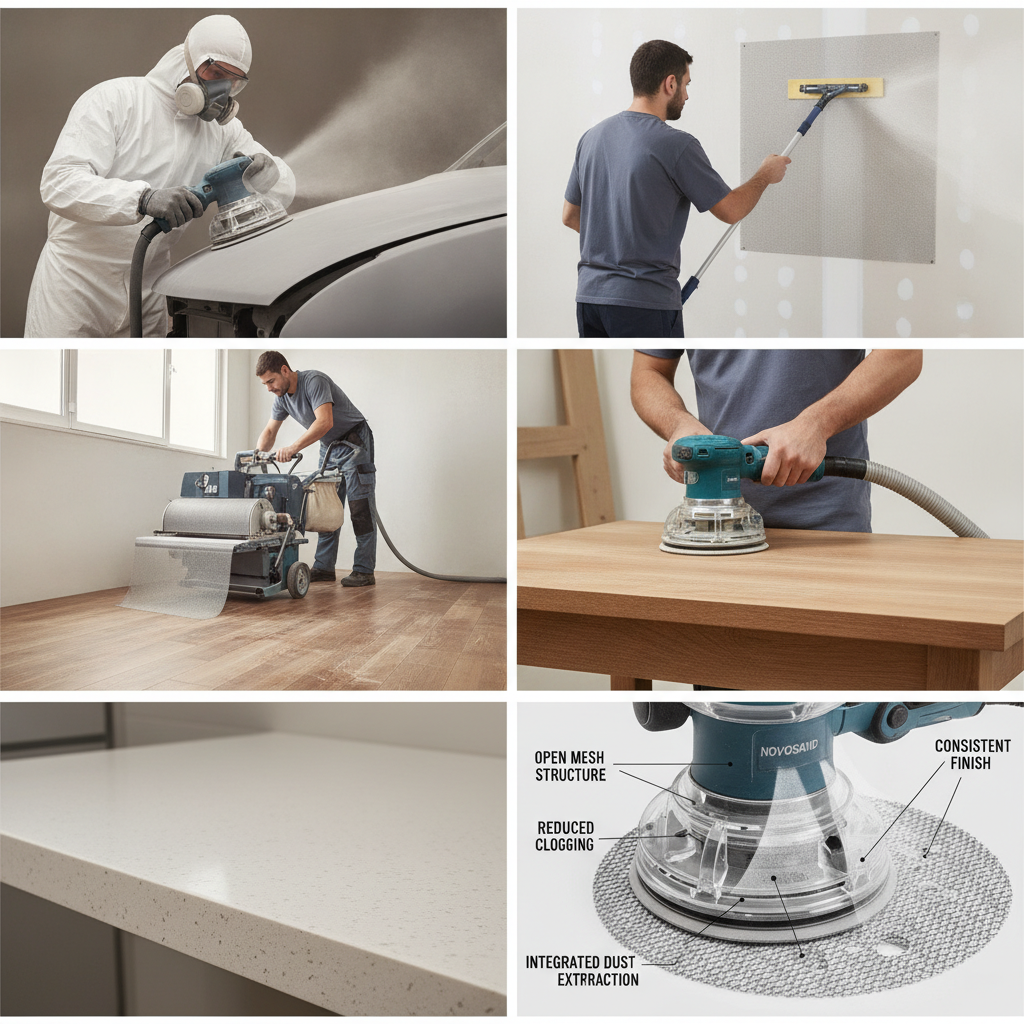
Mesh discs earn their place when dust keeps choking the abrasive before the job is finished. They fit processes where finish consistency matters more than the fastest initial cut. | Application | Why Mesh Fits | Typical Grit Range | Common Disc Size | Main Limitation | |------|------|------|------|------| | Automotive body filler and primer | Resists loading on putty and primer, cleaner sanding | P120-P400 | 150 mm | Slower for heavy leveling | | Drywall and plaster | High dust extraction, less visible dust escape | P180-P320 | 225 mm | Not ideal for aggressive defect removal | | Wood floor screening | Stable cut on finish coats and soft wood dust | P80-P180 | 406 mm screen/disc | Coarse stock removal is slower | | Furniture manufacturing | Better finish uniformity on sealers, MDF, softwood | P150-P320 | 125 mm, 150 mm | Edge pressure can reduce life | | Solid-surface sanding | Cleaner pattern, reduced clogging during long cycles | P120-P600 | 150 mm | Needs good vacuum efficiency | From my experience, automotive refinishing is one of the strongest use cases. A customer in Southeast Asia used 150 mm hook-and-loop mesh discs with aluminum oxide grain for primer sanding at P180 and P240. Disc life improved by around 25-30%, and rework from pigtails dropped noticeably once extraction stayed above 80% efficiency. I’ve seen similar results in furniture plants sanding MDF and sealer coats.
"OnFalse
"Mesh
Mesh sanding discs are best suited for heavy weld leveling on steel because their open structure makes them cut faster than fiber discs at coarse grits such as P24-P36.False
Mesh sanding discs are generally chosen for dust-prone finishing applications, not for maximum metal removal. Their net construction prioritizes extraction and resistance to loading, which is valuable on drywall, plaster, filler, and primer. Heavy weld leveling on steel is typically handled by fiber discs, flap discs, or grinding wheels because those products deliver much higher pressure tolerance and faster stock removal at coarse grits.
How do mesh discs compare to paper?
Mesh sanding discs usually outlast paper-backed discs when clogging is the main failure mode, especially on fillers, primers, paints, drywall compounds, and some woods. Their open structure improves dust evacuation3, reduces loading, and maintains a more consistent cut. However, service life and stock removal depend on substrate, grit, sanding pressure, machine speed, abrasive grain, resin bond, and dust extraction efficiency.
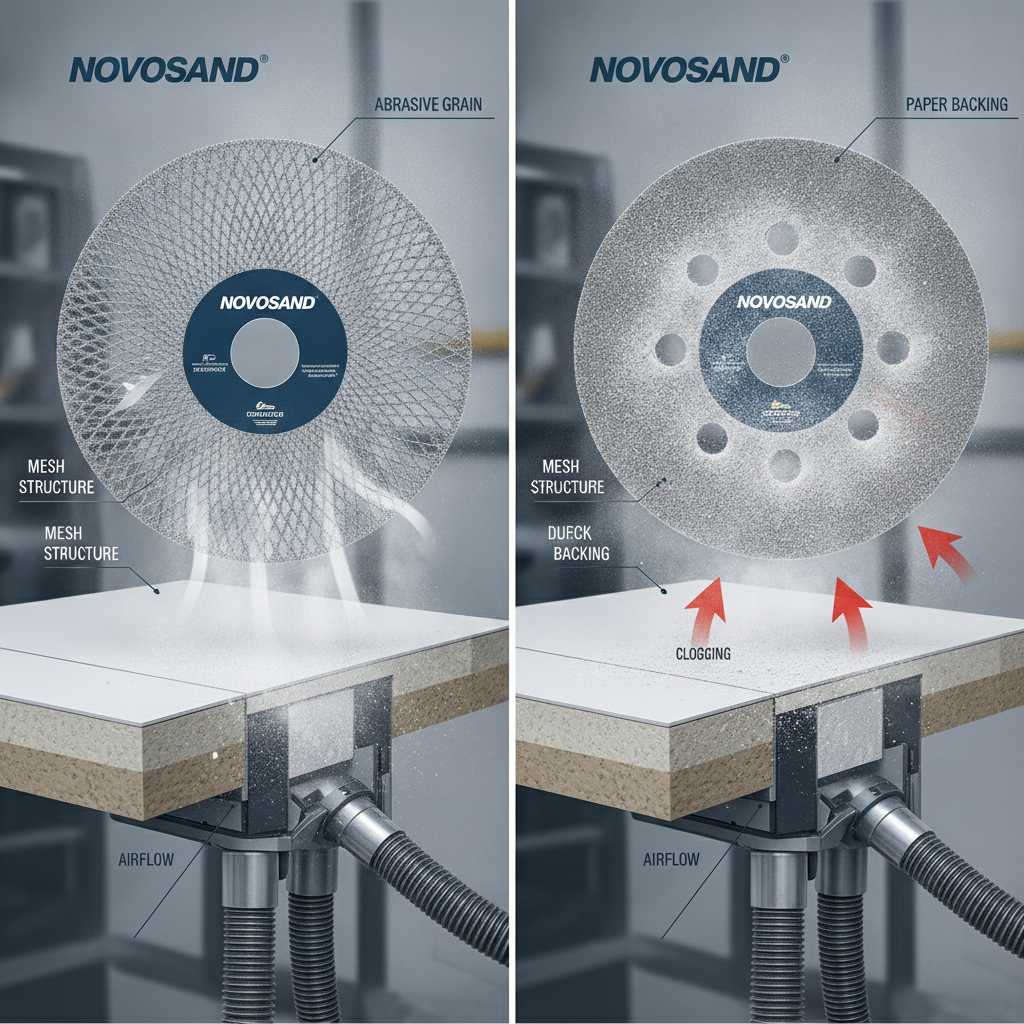
The real comparison starts with failure mode. If a paper disc dies because it loads with dust, a mesh disc usually lasts longer and keeps cutting more evenly.
| Disc type | Strong point | Weak point | Typical use | Relative life |
|---|---|---|---|---|
| Mesh disc | Better dust evacuation, lower loading | Slightly softer feel at same grit | Fillers, primer, paint, drywall, fine wood sanding | Around 1.5–3x in dusty work |
| Paper-backed disc | Higher initial bite, lower unit cost | Loads faster in dusty coatings | Rough wood removal, general stock removal | Standard baseline |
In a furniture plant trial, we compared 150 mm P180 aluminum oxide discs on sealer sanding. The paper-backed version lasted about 18–22 cabinet doors before loading. The mesh version reached around 35–45 doors with the same random orbital sander and central extraction.
That is where the savings came from—not magic, just cleaner abrasive points.
I've seen the same pattern in automotive prep. On primer and body filler, a mesh disc with hook-and-loop backing and resin-over-resin bond kept a more consistent scratch than paper, especially from P120 to P240.
To be honest, the same nominal grit often feels less aggressive on mesh, so some shops move one step coarser to match cut rate. That trade-off is normal.
Paper still wins many roughing jobs.
In dusty applications like drywall compound, primer, or paint sanding, a mesh disc often delivers about 1.5-3x the usable life of a paper-backed disc because its open structure delays loading rather than relying only on a harder abrasive grain.True
The key comparison is failure mode. In many fine-sanding jobs, discs stop working because dust packs the surface and blocks cutting points, not because every abrasive grain is worn out. Mesh discs evacuate dust through the whole face, so they keep cutting more uniformly and typically last much longer in high-loading materials such as fillers, primers, paint, and drywall compounds.
At the same grit size, mesh discs usually cut more aggressively than paper-backed discs because the open mesh creates more pressure per abrasive grain and increases initial bite.False
This is plausible but backwards in typical use. Mesh discs are often described as having a slightly softer feel at the same grit, while paper-backed discs usually offer higher initial bite. The open structure improves dust extraction and reduces loading, but it does not usually make the disc feel more aggressive on first contact than a comparable paper-backed disc.
What Should Buyers Check in Mesh Discs?
Buyers should evaluate mesh backing density, abrasive grain type, grit range, tool attachment, and extraction compatibility when selecting mesh sanding discs. Denser woven backings support finer grits and more uniform finishes, while grain choice affects cutting speed, durability, and cost. Procurement specifications should define substrate, finish target, and expected disc life, then validate performance through side-by-side grit sequence trials against the current process baseline.
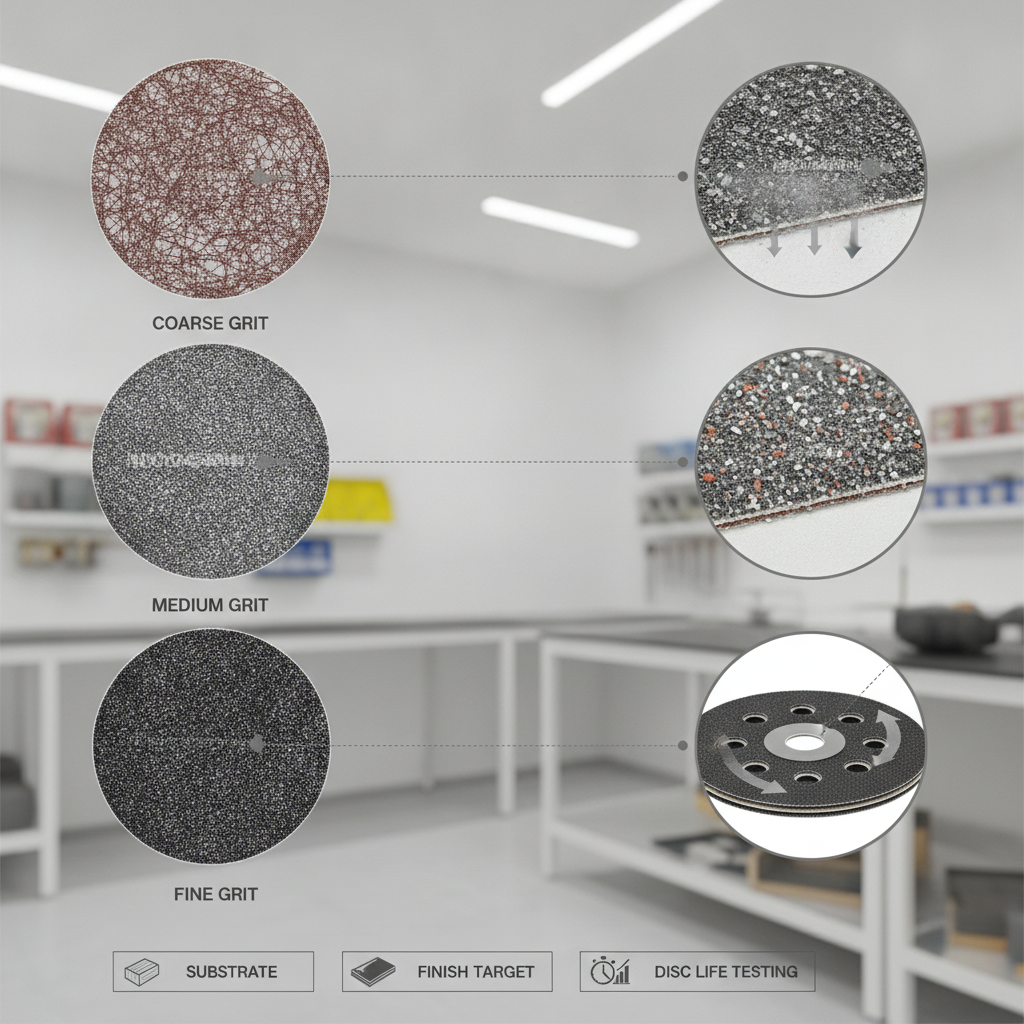
Start with the backing, because mesh density controls both support and airflow. A denser woven net holds finer grits like P240-P400 more evenly, while a more open structure often works better for faster stock removal in P80-P180.
Then check the abrasive grain. Ceramic cuts fast and usually lasts longer on hardwood, metal, or heavy primer sanding, but it costs more. Aluminum oxide is the economical all-round option. Zirconia alumina gives better toughness and self-sharpening behavior than standard aluminum oxide, so I often suggest it for higher-pressure sanding. Silicon carbide is sharper but more brittle, which makes it useful on coatings, plastics, solid surface, and some composites.
I’ve seen the spec sheet gap most clearly in automotive refinishing. One customer tested 150 mm hook-and-loop mesh discs on primer sanding, comparing P180-P240-P320 against their usual paper disc sequence. The ceramic mesh version gave around 20-25% longer disc life, but only after they matched it with a pad that allowed full airflow. Before that, dust packed under the disc and finish quality dropped.
Attachment and extraction compatibility matter just as much as grit. Verify the hook-and-loop engagement, pad hole design, hose diameter, and vacuum airflow. If the pad blocks the mesh pattern, dust extraction falls quickly, and the disc loads early.
From my experience, the best purchase spec includes substrate, target finish, and expected disc life per shift. I always suggest trialing at least two grit sequences against your current baseline, then comparing finish consistency, throughput, and disc consumption before placing a larger order.
On mesh sanding discs, a tighter weave generally supports finer grits such as P240-P400 more consistently because the denser net reduces grain drop-in between openings, while more open mesh layouts in the P80-P180 range improve dust evacuation and maintain cut rate during heavier stock removal.True
Mesh backing is a balance between support and airflow. Fine grits need a more stable surface so the abrasive layer stays even and produces a uniform scratch pattern. Coarser applications generate larger debris, so a more open mesh can clear dust faster and reduce loading, especially in primer or filler sanding. Buyers should evaluate backing density together with grit range rather than treating all mesh discs as interchangeable.
For mesh sanding discs, aluminum oxide always outlasts ceramic on metal because ceramic grains are too brittle to handle the open-net backing and therefore wear out faster in P80-P180 applications.False
Ceramic is commonly chosen for demanding sanding on metal, hardwood, and heavy coatings precisely because it cuts aggressively and usually lasts longer than aluminum oxide. Its microfracturing behavior exposes fresh edges during use, which is beneficial in coarse and medium grits as well. Mesh backing does not inherently make ceramic unsuitable; the real trade-off is higher cost, not reduced durability.
Are Mesh Sanding Discs Universally Compatible?
Mesh sanding discs are not universally compatible in practice, although they are more adaptable than pre-punched paper discs because hole alignment is unnecessary. Compatibility depends on correct disc diameter, hook-and-loop attachment, and backing-pad airflow. On solid or low-opening pads, the disc may still operate, but dust extraction efficiency drops significantly. High-airflow interface pads or multi-hole backing pads are recommended for full performance.
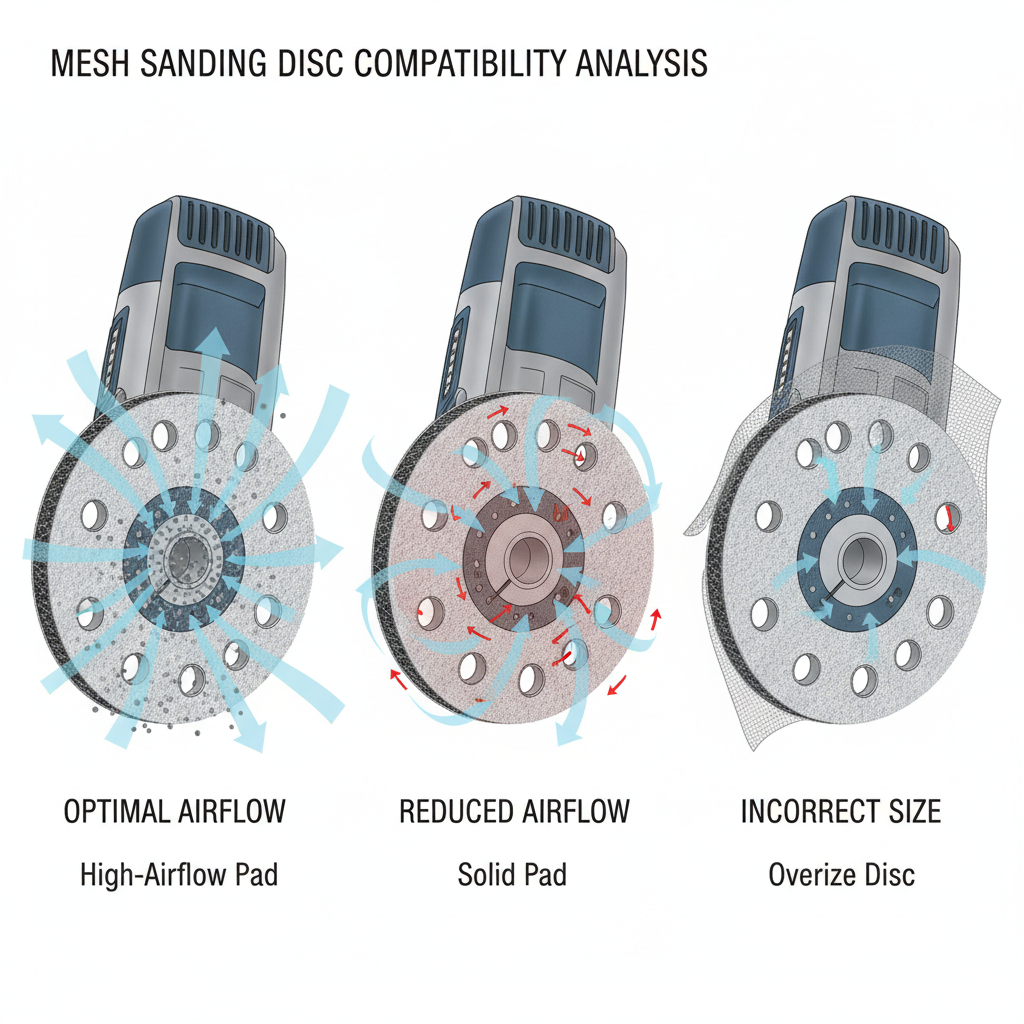
Universal fit sounds simple, but mesh disc compatibility actually has two checkpoints: attachment and airflow. A 150 mm hook-and-loop mesh disc can mount on many random orbital sanders, yet extraction performance depends on what sits underneath.
I’ve seen this issue clearly in a furniture plant running mixed 5-inch and 6-inch machines. They switched from pre-punched P180 paper discs to silicon carbide mesh discs because hole alignment slowed changeovers. The discs fit immediately on most tools. But on older solid pads, dust stayed on the panel and disc loading increased after roughly 20 to 30 doors. Once they changed to multi-hole backing pads with a soft 5 mm interface pad, disc life improved by around 25%, and the finish became more consistent.
That is the practical difference. Mechanical fit means correct diameter, hook-and-loop quality, and stable edge support. Performance fit means the backing pad allows enough vacuum flow through the mesh. If the pad blocks airflow, the disc still cuts, but the dust-control advantage drops sharply. To be honest, this is a common spec sheet gap during tool upgrades.
I always suggest checking three details before a full rollout: disc size, attachment type, and pad ventilation. For automotive refinishing or cabinet sanding, I usually recommend testing P120 to P240 mesh discs on both the current pad and a high-airflow interface pad. The comparison becomes obvious fast. If your shop uses mixed brands or older sanders, budget for pad upgrades as part of the switch.
A 150 mm mesh sanding disc can physically attach to many 6-inch hook-and-loop random orbital sanders without matching any dust-hole pattern, but dust extraction still depends heavily on the backup pad interface because a dense foam interface pad or a pad with limited air channels can reduce vacuum flow even when the mesh itself is fully open.True
Mesh discs differ from pre-punched paper discs because the abrasive surface is open across nearly the entire disc, so hole alignment is no longer the main fit issue. However, extraction air still has to pass through the backup pad and any interface layer underneath. If that stack restricts airflow, dust removal drops, loading increases, and the sanding system may perform worse than expected despite the disc mounting correctly. Compatibility therefore involves both attachment method and airflow path.
Any hook-and-loop mesh sanding disc is universally compatible across both 5-inch and 6-inch random orbital sanders because the open mesh structure automatically compensates for diameter differences and maintains full dust extraction.False
Mesh construction solves hole-pattern alignment problems, not diameter mismatch. A 5-inch tool cannot properly support a 6-inch disc, and a 6-inch tool will overhang a 5-inch disc, affecting balance, edge wear, pad protection, and extraction efficiency. Universal compatibility only applies within the correct disc diameter and attachment style; the airflow benefits of mesh do not eliminate the need for the right pad size and machine format.
How Long Do Mesh Sanding Discs Last?
Mesh sanding discs often outlast comparable paper discs because their open-weave structure4 reduces loading and maintains cutting efficiency longer. Service life improves further when discs are cleaned by tapping, brushing, vacuuming, or washing where applicable, and when excessive pressure, heat buildup, and improper storage are avoided. Product construction also matters: some floor sanding screens are double-sided, while many random orbital mesh discs are single-sided.
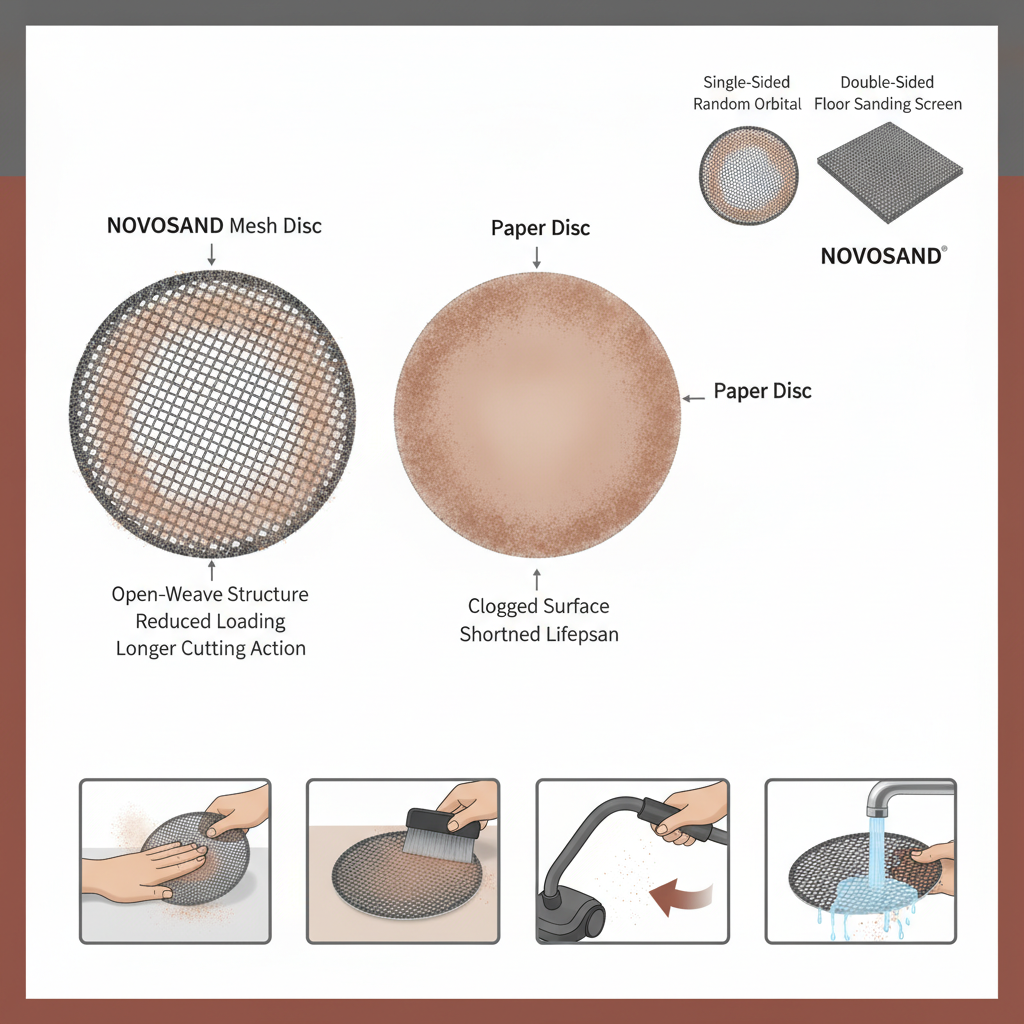
Disc life usually comes down to one simple issue: how fast the surface loads. Because dust passes through the open mesh instead of packing between grains, a mesh disc often keeps cutting 30-50% longer than a comparable paper disc in wood sanding.
I saw this clearly with a furniture parts supplier running 5-inch P180 aluminum oxide mesh discs on random orbital sanders. On rubberwood panels, their paper discs lasted about 18-22 minutes before cut rate dropped hard. The mesh version stayed productive for roughly 28-35 minutes with the same hook-and-loop pad and vacuum extraction. That difference mattered across two shifts.
Construction also changes the answer. Some floor sanding screens use abrasive grain on both sides, so operators can flip them and continue sanding. Many random orbital mesh discs are single-sided, with abrasive on one face and hook-and-loop backing on the other, so buyers should check the product style before comparing lifespan. I always suggest confirming this detail first.
Cleaning extends life more than many users expect. In flooring and solid-surface work, operators often tap out dust, brush the face, or vacuum the disc every few minutes. Some washable mesh products can also be rinsed, dried flat, and reused. From my experience, that routine can add another 20-30% usable life, especially in P120 to P240 grits where fine dust loads quickly.
Pressure is the usual disc killer. Push too hard, and you deform the mesh, overheat the resin bond system, and tear edges on soft wood. I suggest light pressure, flat dry storage, and using mesh for later passes on fragile edges like cedar.
In wood sanding, mesh discs often deliver 30-50% longer usable life than comparable paper discs because the open net structure lets dust pass through the abrasive instead of loading between grains and choking the cutTrue
Disc life is frequently limited by loading, not total grain wear. On woods that generate fine dust, a paper disc can lose cut quickly as debris packs the surface. Mesh construction improves dust extraction across the whole disc face, so more abrasive points stay exposed longer and the cut rate remains stable for a longer portion of the disc's life.
Mesh sanding discs last longer mainly because the mesh backing runs cooler, and on wood sanding they typically double the life of paper discs even when dust extraction is poor or absentFalse
Cooling can help abrasive performance, but the primary reason mesh discs often last longer in wood is reduced loading through better dust evacuation. Their advantage depends heavily on dust actually moving through the mesh, which is strongest with effective extraction. Without adequate vacuum flow, mesh discs do not reliably double paper disc life and may show a much smaller gain.
How Do Mesh Discs Affect Finish?
Mesh sanding discs typically produce smoother, more uniform finishes on paints, fillers, and clear coats because their open structure reduces clogging and maintains a cleaner cutting surface. They often create a more consistent scratch pattern than paper discs of the same nominal grit, although they usually cut less aggressively. Grit selection should be verified against surface roughness, adhesion, visual appearance, and downstream process specifications.
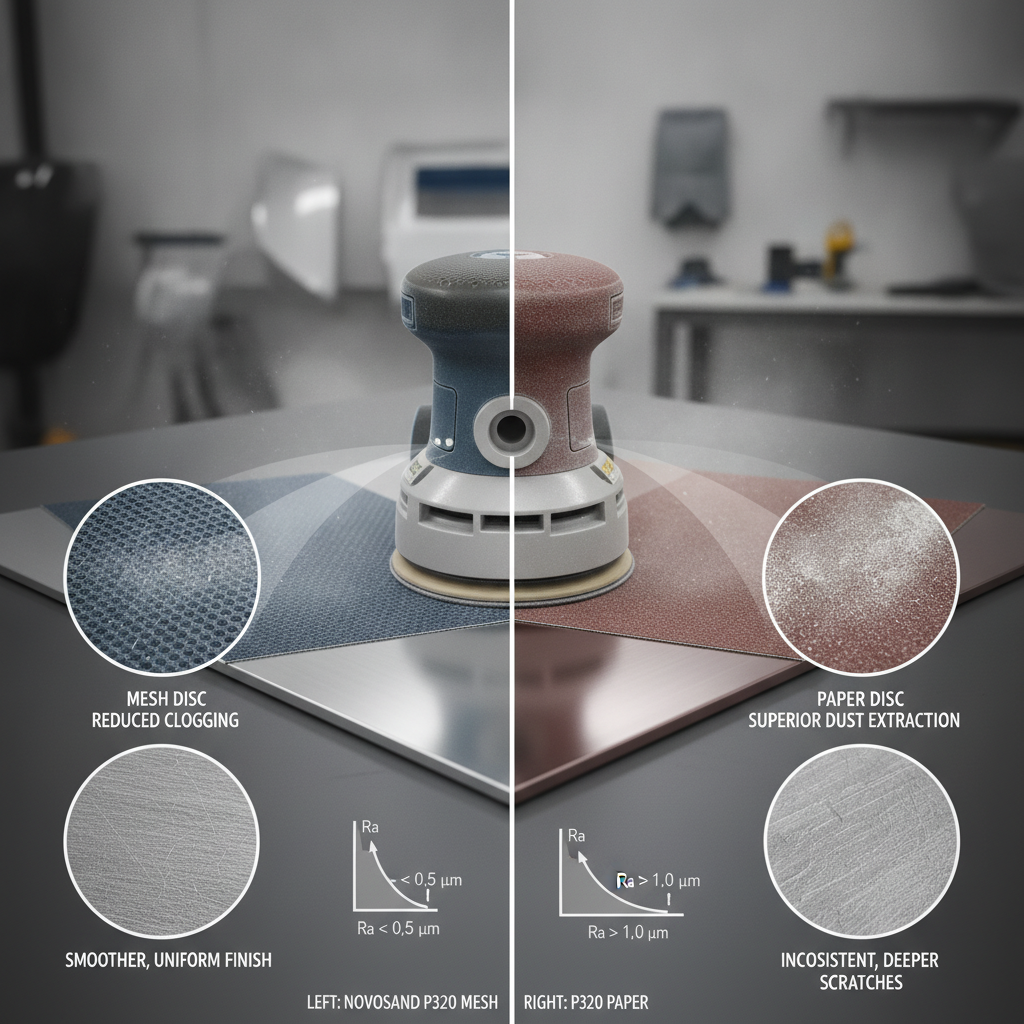
Finish quality changes when the abrasive face stays clean from the first pass to the last. That is why mesh discs often leave a more even scratch pattern on primer, filler, and clear coat than paper discs with the same printed grit.
In practice, the trade-off is cut rate. A P320 mesh disc usually removes material more slowly than a P320 paper disc, even when both use aluminum oxide or ceramic-alumina grain with hook-and-loop backing. From my experience, many operators compensate by moving one step coarser for leveling work, then returning to the target finishing grit. Simple adjustment. Better control.
I saw this clearly with an automotive refinishing customer in Guangdong using 150 mm mesh discs on primer surfacer. They switched from paper P400 to mesh P400 and liked the cleaner panel and lower dust contamination, but sanding time increased by around 15-20% per bumper. We tested P320 mesh followed by P400 mesh instead. The final appearance stayed consistent, and their rework from random deep scratches dropped noticeably over a two-week trial.
The technical reason is straightforward: the open mesh resists loading, so fewer packed particles drag across the coating and create uneven marks. I always suggest checking Ra value, visual gloss holdout, and adhesion after primer or clear coat—not just judging by hand feel. That is where the spec sheet gap appears.
Heat-sensitive surfaces need extra care. On plastics, acrylics, and thin clear coats, I recommend light pressure, moderate machine speed, and shorter sanding cycles to avoid softening or smearing. Test the full grit sequence first, then lock the process once finish quality and downstream bonding stay inside spec.
Because dust can evacuate across the entire abrasive face, a P320 mesh disc often produces a more uniform scratch pattern on primer or clear coat than a P320 paper disc, even though it typically cuts slower at the same applied pressure.True
Mesh discs expose open area across the whole disc instead of relying only on punched holes, so dust has fewer places to pack between the grain and the work surface. That cleaner interface helps maintain a more consistent scratch from the first pass to the last, especially on clog-prone coatings like primer, filler, and clear coat. The trade-off is that less abrasive is in contact with the surface at any moment, so material removal rate is usually lower than an equivalent printed grit paper disc.
A mesh sanding disc always leaves a finer finish than a paper disc because the open net structure makes a P320 mesh disc cut like a P400 paper disc.False
Printed grit on a mesh disc does not automatically convert to the next finer paper grit. Mesh can improve finish uniformity by reducing loading and random deep scratches, but the abrasive grain size still governs the nominal scratch depth. In practice, a P320 mesh disc may look more even than a loaded P320 paper disc, yet it does not universally perform as a P400. Surface hardness, coating type, machine orbit, and pressure all affect the final finish.
Are Ultra-Fine Mesh Discs Available?
Yes, specialized ultra-fine finishing products exist, but they differ from standard open-net mesh sanding discs. Systems such as Micro-Mesh use cushioned flexible backings and micron-graded abrasives5, typically in 1500-12000 grades, for polishing plastics, acrylics, aluminum, coatings, and solid-surface materials. These precision abrasives conform to surface irregularities, reduce deep scratch patterns, and can help achieve near-mirror finishes with fewer buffing steps when used under controlled pressure and clean conditions.
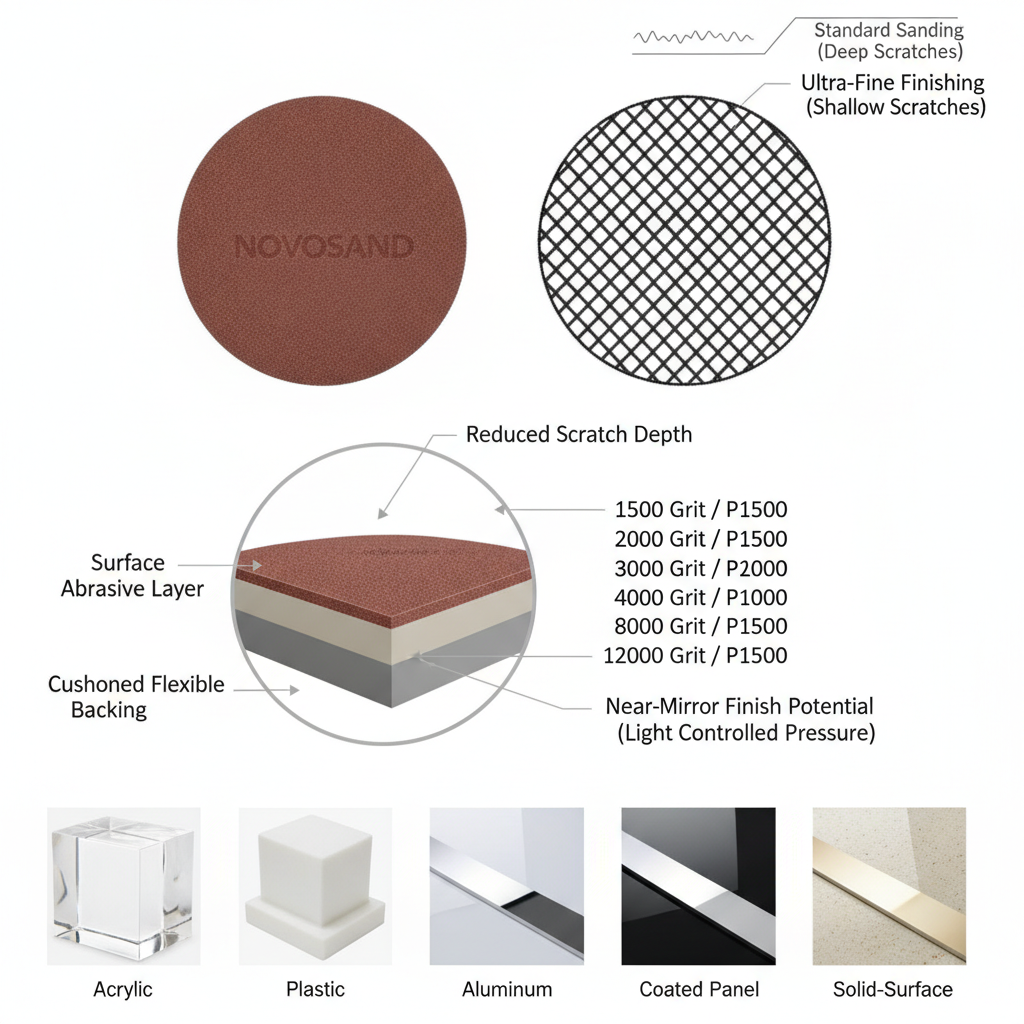
Ultra-fine finishing does exist, but it sits in a different category from standard open-net mesh discs. Once you move into 1500 to 12000 grades, the product usually uses micron-graded abrasive on a cushioned flexible backing, not a typical dust-extraction mesh structure.
That construction matters. The cushioned latex or polymer layer lets the abrasive ride over slight peaks and valleys, so it blends scratches instead of digging fresh ones. On acrylic, soft aluminum, clear coatings, and solid-surface sheets, that means fewer deep random scratches and less risk of haze. From my experience, these products work best with very light pressure and low machine speed. Cleanliness matters even more.
I saw this clearly with a countertop fabricator using 5-inch hook-and-loop discs on solid-surface vanity tops. Their old sequence stopped at P800, then moved to compound buffing. We tested a cushioned precision abrasive progression around 1500, 2400, 3600, and 4000, mostly wet. The finish improved enough that they cut one buffing step on about 60-70% of white and light-color pieces. That saved time each shift.
In automotive trim and instrument-panel polishing, I have also seen these grades reduce holograms on sensitive coated plastics. But there is a trade-off—the cut rate is slow, and one trapped particle can leave a visible contamination scratch. That is the spec sheet gap many buyers miss.
I always suggest treating ultra-fine discs as polishing tools, not general sanding discs. If the target is a near-mirror surface, test them under clean, wet, controlled conditions before placing a full production order.
Ultra-fine finishing products in the 1500-12000 range are usually micron-graded abrasives built on cushioned latex or polymer-backed structures rather than standard open-net mesh discs, because the compliant backing helps refine scratch patterns on clear coats, acrylic, and soft metals instead of cutting aggressively into high spotsTrue
This is true because very fine finishing shifts from the geometry of dust-extraction mesh toward controlled surface conformability. At these grades, the goal is scratch refinement and blending, not heavy stock removal. A cushioned backing lets the abrasive float over minor peaks and valleys, reducing deep random scratches that a stiffer open-net structure could leave on sensitive surfaces like solid surface materials, clear coatings, acrylic, and soft aluminum.
Mesh sanding discs are commonly manufactured all the way to 12000 grit using the same open-net dust-extraction structure as 80-320 grit products, which is why ultra-fine mesh discs are the standard choice for polishing clear coat defectsFalse
This is false because once abrasives move into ultra-fine finishing grades, they are typically no longer made as conventional open-net mesh discs. Instead, manufacturers usually use micron-graded abrasives on flexible cushioned backings designed for scratch refinement. Standard mesh construction is optimized for dust evacuation and cut consistency in conventional sanding ranges, not for the delicate polishing behavior needed at 1500-12000 grades.
We’ve covered what a mesh sanding disc is, how its open structure supports dust extraction, and why performance depends on the full sanding setup. The disc matters, but so do the pad, sander, extractor, and the material you’re working on.
From my experience, buyers get better results when they test the whole system instead of judging the disc alone. I’ve seen the spec sheet gap many times: strong dust-free claims on paper, but weak collection in real sanding because the pad or vacuum setup was not matched well.
Have questions about grit choice, backing options, or compatibility with your current sanding system? Feel free to reach out—I’m happy to share what works in real production environments. Every application is different, so it’s worth choosing based on actual sanding conditions.
References
-
Explains the differences in cutting efficiency, durability, and cost among different abrasive grain types, helping purchasing teams select more accurately by substrate and application. ↩
-
Explains in depth how scratch pattern affects surface appearance, coating adhesion, and rework risk, and shows how different abrasive structures can change the final finishing result. ↩
-
Explains how dust extraction efficiency affects loading, cutting consistency, and service life, while helping users choose a more suitable sanding disc solution based on sanding conditions. ↩
-
Explains in depth how an open mesh structure reduces loading, improves dust evacuation, and extends cutting life, helping buyers assess its real value in woodworking sanding. ↩
-
Explains in depth the grit classification, suitable materials, and surface-finish differences of micron-grade abrasives, helping users choose the right ultra-fine polishing solution and reduce rework. ↩