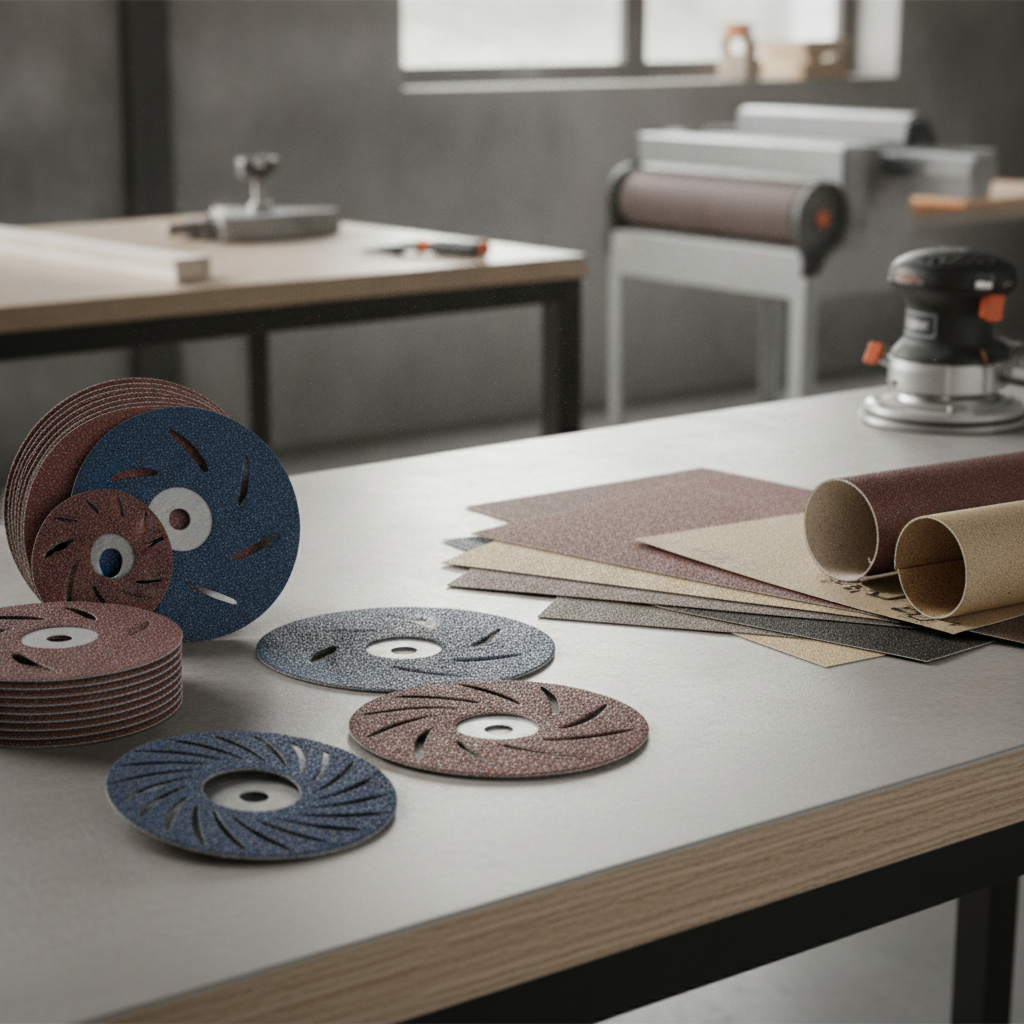
Sanding Disc vs Sandpaper: Key Differences Buyers Miss
A metal fabrication buyer in Suzhou told me something I hear all the time: “A disc is just sandpaper in a round shape, right?” Not quite. That small assumption often leads to slower sanding, more dust, mismatched pads, and higher abrasive cost per part.
Sanding discs and sandpaper sheets use similar abrasive minerals, but they are engineered for different sanding systems and process goals. Discs are built for machine use, with defined diameters, attachment methods such as hook-and-loop1 or PSA, and backing designs that affect heat resistance, dust extraction, and cut stability. Sheets are optimized for hand control, foldability, profile access, and low conversion cost. Backing selection, dust behavior, changeover method, and grit strategy all influence durability, finish consistency, labor
How do sanding discs differ?
Sanding discs are circular coated abrasives engineered for power sanders, with defined diameters, hook-and-loop or PSA attachment, and optional hole patterns or mesh for dust extraction. Sandpaper sheets are flat, flexible abrasives used by hand, on blocks, or cut to shape. Discs emphasize machine productivity, consistency, and lower fatigue, while sheets provide better access, foldability, and control for edges, profiles, corners, and touch-up finishing.
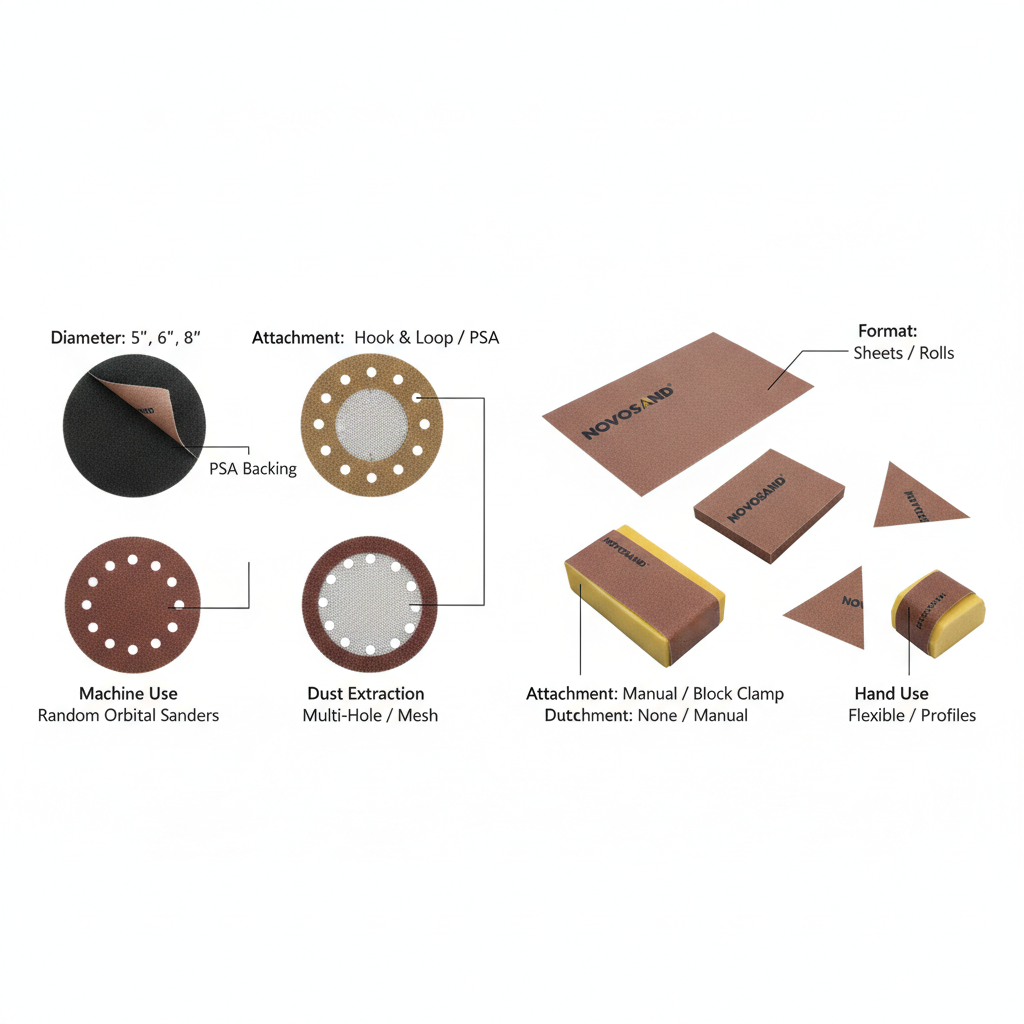
The real difference starts at the interface: sanding discs are built around the machine, while sheets are built around the hand. Diameter, attachment, hole pattern, and backing stiffness all matter because the abrasive has to run stable at speed.
A 125 mm or 150 mm disc on a random orbital sander gives much more repeatable coverage than a folded sheet. Hook-and-loop discs change fast; PSA discs hold flatter for some fine-finishing jobs. I usually see discs in P40 to P320 for stock removal and surface prep, with paper, film, or vulcanized fiber backings selected by cut rate, heat, and edge wear.
Last year, I worked with a furniture factory in East China that sanded oak table tops. They switched from hand-cut sheets to 150 mm, 17-hole aluminum oxide discs for the main flat panels. Output improved by around 20%, and operators used roughly 25-30% fewer abrasive pieces per shift because dust extraction reduced loading.
But sheets still solved the last 10% of the job. The same factory kept P180 and P240 latex-paper sheets for eased edges, inside corners, and small profile corrections before coating. To be honest, this is where many buyers fall into the spec sheet gap—they compare grit only, but ignore machine fit, hole alignment, and backing flexibility.
In automotive refinishing, I’ve seen the same pattern. A film-backed P320 disc handles primer sanding fast and evenly, while a flexible sheet works better around door handles and tight contours. I suggest treating discs and sheets as partners, not substitutes, and testing both on the real workpiece before setting your standard process.
A 150 mm random-orbital sanding disc removes more uniformly than a hand-held sheet partly because its stiffness and full-face attachment keep the abrasive flatter at speed, reducing edge-folding and pressure spikes that commonly create uneven scratch patterns.True
Sanding discs are engineered for machine dynamics, not just abrasive contact. On a random orbital sander, the disc is supported across its full diameter by either hook-and-loop or PSA attachment, which helps maintain a stable sanding plane during rapid orbital motion. A folded sheet used by hand can buckle at the edges and concentrate force in small areas, leading to less repeatable scratch depth and coverage. Disc backing stiffness is therefore a functional design variable, not just a durability feature.
PSA sanding discs always run cooler than hook-and-loop discs because the pressure-sensitive adhesive layer acts as a built-in heat sink between the abrasive and the pad.False
PSA discs can sit flatter on the pad, which may help in some fine-finishing situations, but the adhesive layer is not a heat sink. In practice, disc temperature depends more on abrasive type, loading, dust extraction, contact pressure, machine speed, and hole pattern. Hook-and-loop systems can actually run cooler in many applications because their interface can promote slight airflow and easier disc changes encourage timely replacement before excessive heat builds up.
How Do Backings Affect Disc Durability?
Backing material strongly influences sanding disc and sandpaper durability, flexibility, finish quality, and operating conditions. Film backings2 offer dimensional stability, edge durability, wet-sanding resistance, and consistent scratch patterns. Cloth backings improve tear resistance and flexibility under heavier loads. Paper backings remain economical for lighter dry sanding, while fiber and mesh support edge work, higher pressure, dust extraction, and reduced loading in industrial applications.
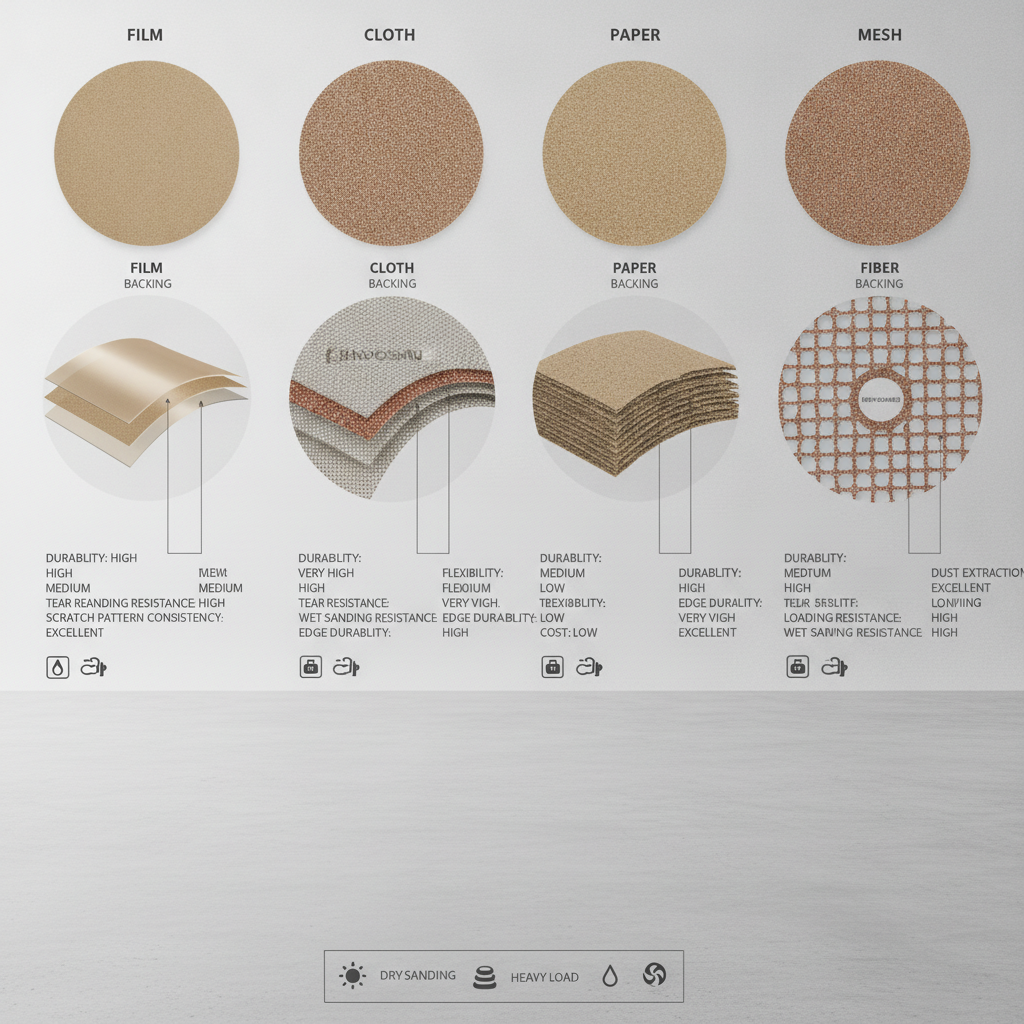
Disc life often fails at the backing before the grain is truly spent. When the backing curls, tears, or softens under heat and moisture, cut rate drops fast and the finish becomes less consistent.
Film backing usually gives the most stable platform for fine finishing. It stays flat, resists edge fray, and keeps a more uniform scratch pattern from about P320 to P2000. I’ve seen this clearly in automotive refinishing lines, where 5-inch film discs used for wet sanding primer lasted around 25-30% longer than comparable paper discs. The abrasive grain and bond system still matter, of course, but the backing controls how well the disc holds its shape under pressure.
Cloth and fiber backings solve a different problem—load and abuse. In a metal fabrication shop, a cloth-backed P80 zirconia disc can survive edge sanding and contour work that would tear a C-weight paper disc quickly. Last year, I worked with a furniture components factory that switched some edge work from paper to X-weight cloth on 150 mm discs. Disc consumption dropped by roughly 20% per shift. That’s real money.
Paper still has a good place. For dry sanding wood sealer, drywall, or primer, a good latex paper backing often gives the lowest cost per piece. But this is where the spec sheet gap appears: buyers compare grit and price, then miss backing weight, flexibility, and moisture resistance.
Mesh is another practical option when dust extraction matters. I always suggest matching the backing to the job first, then testing one grit sequence in real production before scaling up.
For fine grits around P320-P2000, film-backed sanding discs often outlast comparable paper-backed discs by roughly 25-30% in wet automotive primer sanding because the backing stays flatter under moisture and heat, reducing edge fray and preserving a more uniform scratch pattern.True
In fine finishing, backing stability matters as much as abrasive grain. Film backings resist swelling, curling, and tearing better than paper when exposed to water and sanding heat, so the disc maintains better contact with the surface. That stability helps the abrasive cut more evenly and delays failure from backing damage rather than grain wear.
Cloth-backed sanding discs are usually the best choice for P320-P2000 finishing because their thicker backing flexes less than film, producing the most consistent scratch pattern on primers and clear coats.False
Cloth backing is valued more in belts and heavy-duty applications where tear resistance and flexibility are important, not ultra-fine disc finishing. For P320-P2000 work, film backing is typically preferred because it lies flatter and gives a tighter, more consistent scratch pattern. Cloth's texture and thickness can make it less stable for high-uniformity finishing on primers and coatings.
How Do Mesh Discs Control Dust?
Mesh sanding discs use an open lattice backing that allows dust extraction across much of the disc surface, unlike solid paper or film discs that depend on fixed hole patterns. In dust-sensitive sanding, mesh can reduce visible dust and loading when matched with an open backup pad, interface pad, and efficient extractor, although actual results vary with airflow, pad design, pressure, substrate, grit, and overall system compatibility.
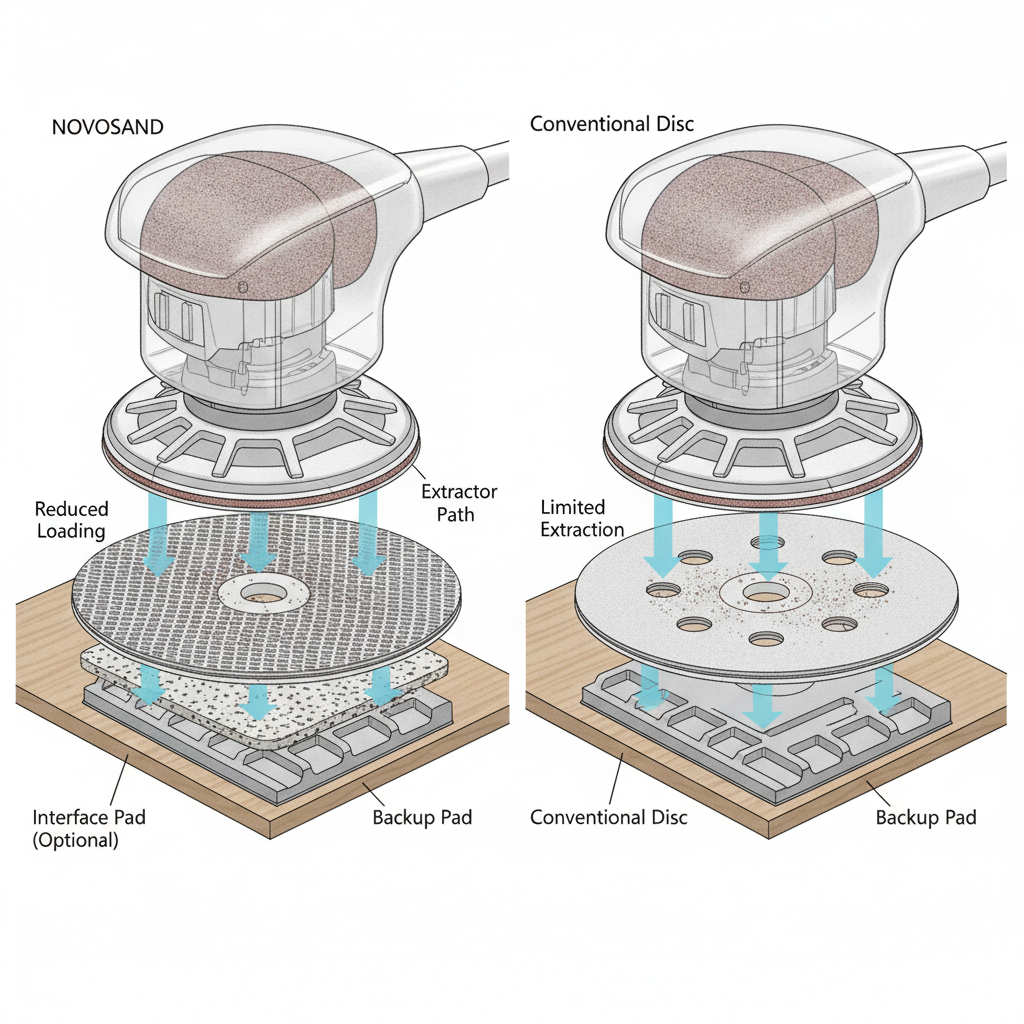
Dust control starts with airflow paths. A mesh disc leaves much of the face open, so extraction can pull dust through the whole working area instead of only through 6, 8, or 15 punched holes.
That matters most on fine dust jobs. In drywall, filler, primer, and topcoat sanding, dust has nowhere to pack as quickly, so loading usually drops. I’ve seen this clearly with 150 mm P180-P320 mesh discs using aluminum oxide or ceramic grain and a resin-over-resin bond system. When the disc ran on an open backup pad with a soft 5 mm interface pad, operators kept the cut more stable across the full disc face.
One customer in automotive refinishing switched part of their primer sanding line from film discs with 15 holes to mesh. They used P240 and P320 on orbital sanders with central vacuum extraction. Visible airborne dust around the booth dropped noticeably, and disc change frequency fell by around 20-25% over a full week. To be honest, the gain did not come from the disc alone. A clean filter, enough airflow, and moderate pressure made the difference.
Mesh is not automatically faster. On coarse stock removal—say P60 or P80 on hardwood filler or heavy sealer build—a solid paper or film disc can feel more aggressive because it has more continuous support behind the grain. From my experience, that is where the spec sheet gap appears: buyers expect dust reduction and maximum cut at the same time.
I always suggest a system test, not a disc-only test. Compare dust, finish consistency, and discs used per finished part before you switch fully.
A 150 mm mesh sanding disc can improve dust extraction on primers, filler, and drywall because suction acts across nearly the entire abrasive face rather than being limited to a 6-, 8-, or 15-hole pattern, which helps reduce loading in the P180-P320 range.True
Mesh discs are built with an open net structure, so dust can pass through many points across the disc surface instead of waiting to reach a few punched holes. On fine-particle sanding tasks such as drywall compound, primer, and topcoat, this broader airflow path reduces dust packing between grains and often lowers loading, especially in finer grits like P180 to P320 where clogging is a common performance limit.
Mesh discs control dust mainly by using thicker resin-over-resin layers that seal the abrasive surface, forcing debris toward the vacuum holes faster than standard punched discs.False
Mesh discs do not improve dust control by sealing the face or by making the resin layers thicker. In fact, their advantage comes from the opposite design principle: a highly open abrasive structure that leaves much of the disc face permeable to airflow. Resin-over-resin bonding can improve grain retention and durability, but it is not the primary mechanism that creates whole-surface dust extraction.
How do disc attachments affect cost?
Attachment method changes both disc cost and changeover time3. Hook-and-loop discs usually cost more per piece but support fast grit changes and temporary removal for inspection. PSA discs are often better for longer single-grit runs because they mount firmly, but removal typically reduces reusability. Total cost depends on labor time, pad compatibility, contamination, heat, and how often grit changes occur during sanding operations.
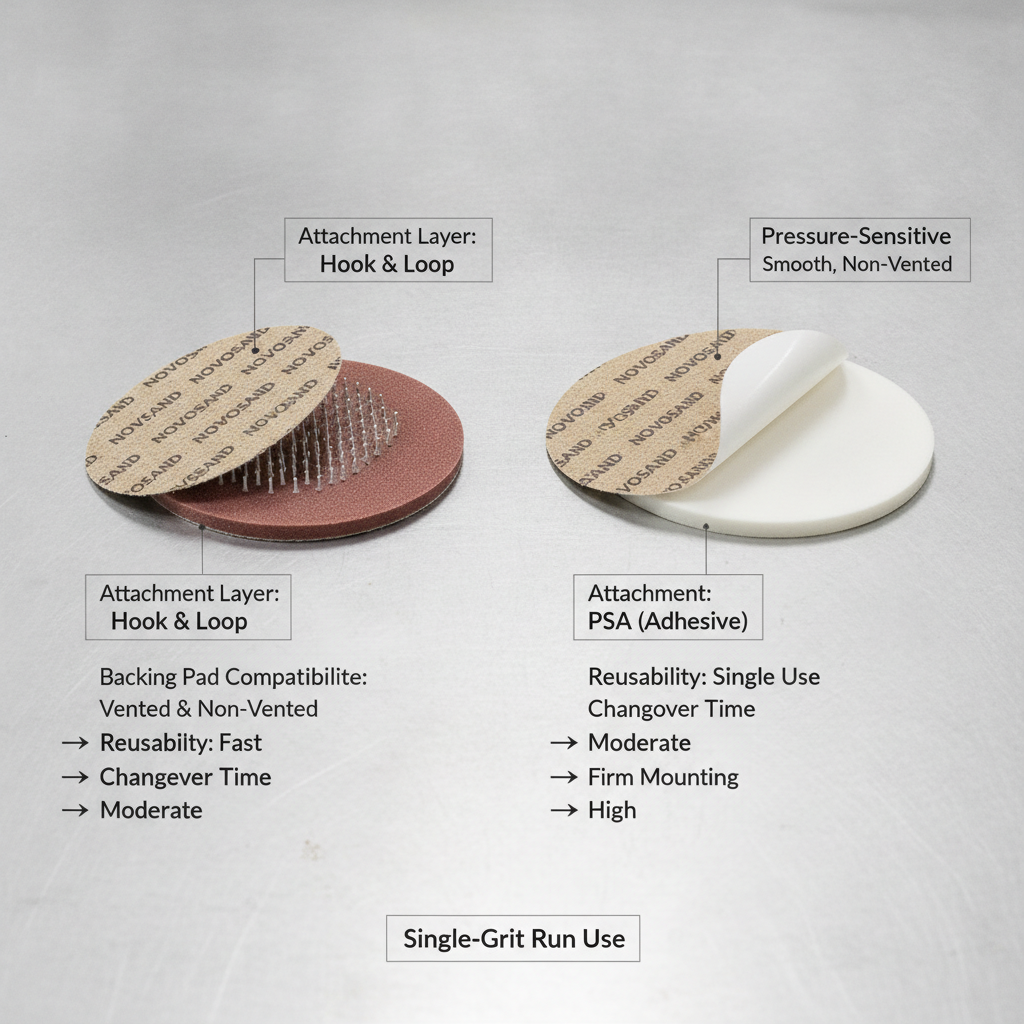
Attachment cost shows up in two places: the disc invoice and the operator’s minutes.
A hook-and-loop disc usually costs more per piece than a PSA disc, but faster grit changes can lower total sanding cost over a shift.
I’ve seen this clearly with a furniture components plant in Dongguan using 150 mm aluminum oxide discs from P120 to P240 on sealer sanding.
Their hook-and-loop discs were around 12–18% higher in unit price, yet each grit change took about 8–10 seconds instead of 25–40 seconds with PSA.
Over two sanding stations and multiple grit changes per batch, that labor difference added up fast.
They also paused often for surface inspection, so temporary disc removal mattered.
The real cost drivers usually include:
- Changeover frequency — more grit changes usually favor hook-and-loop
- Run length per grit — longer single-grit jobs often suit PSA
- Pad compatibility — wrong pad interface creates slippage, vibration, and waste
- Dust and heat — both reduce attachment reliability over time
- Reusability in practice — hook-and-loop can be reattached, but only if the loop and pad stay clean
- Surface requirement — some flat sanding jobs prefer the firmer PSA-mounted feel
In metal fabrication, I often suggest PSA for longer runs with one grit, such as P80 zirconia on flat steel panels.
The adhesive bond feels stable, especially on smooth backup pads.
But once operators remove the disc, tack usually drops.
On multi-step sealer sanding with 150 mm discs, a hook-and-loop attachment that costs 12-18% more per disc can still reduce total cost per shift because grit changes may drop from roughly 25-40 seconds with PSA to 8-10 seconds, cutting non-sanding labor time by more than half.True
Attachment cost is not just the disc price; it also includes operator downtime during changeovers. In workflows that switch frequently between P120, P180, and P240, the labor minutes saved by hook-and-loop can outweigh its higher unit price. This is especially true in furniture finishing lines where many short sanding cycles make changeover time a significant part of total process cost.
PSA sanding discs are always cheaper in total operating cost than hook-and-loop discs because their lower invoice price guarantees lower cost per finished part, regardless of how often grits are changed.False
A lower purchase price does not automatically mean lower total sanding cost. PSA discs often take longer to remove, align, and replace, and adhesive residue or misapplication can add more downtime. When a process involves frequent grit changes or short production runs, the extra labor minutes can offset or even exceed the savings from the lower per-disc price.
How do grit ranges and finishes differ?
Sanding discs and sandpaper both span coarse stock removal to fine finishing, but actual grit availability varies by abrasive grain, backing, and product line. Mesh discs commonly cover coarse-to-fine preparation and excel in dust control, while film-backed discs4 are favored for medium to ultra-fine finishing, consistent scratch patterns, edge durability, and wet-sanding in automotive, coatings, plastics, and precision surface preparation.
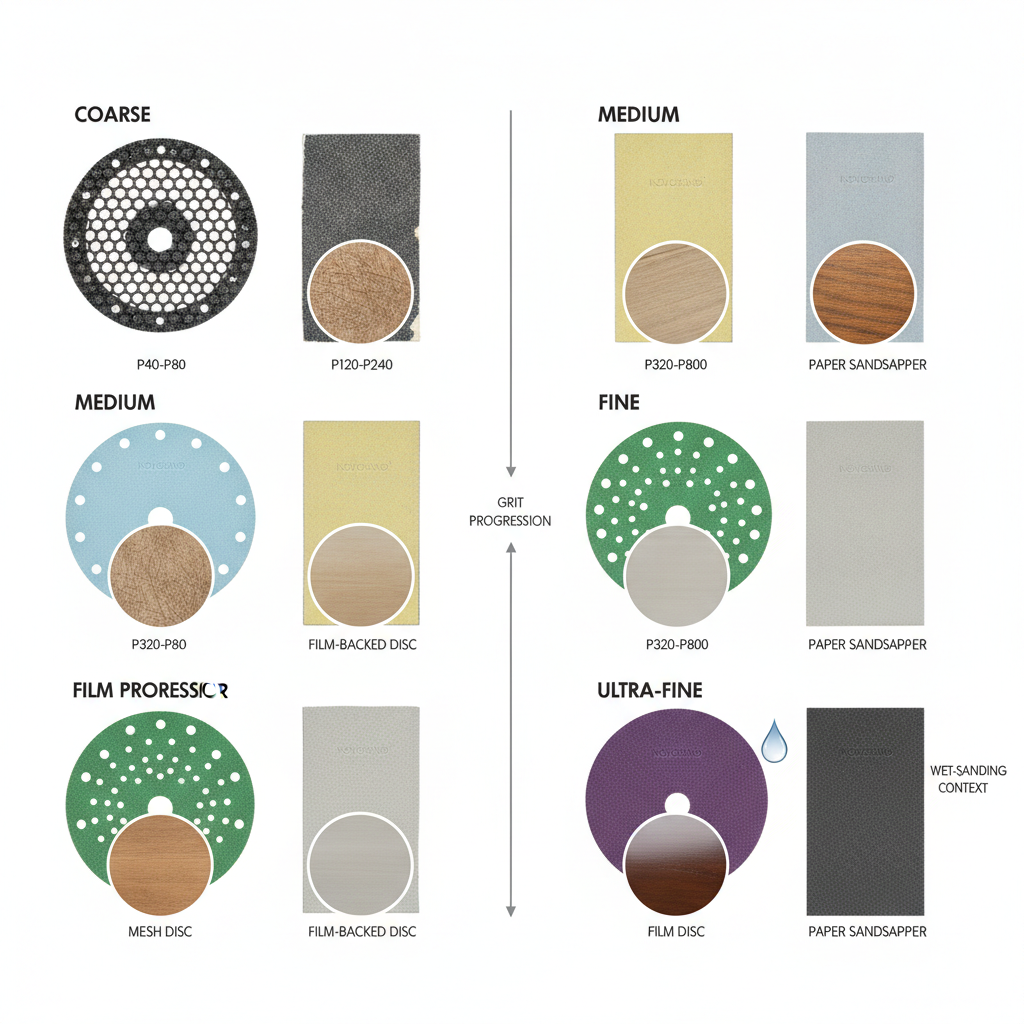
A P80 disc and a P80 sheet do not always leave the same surface. Grit number is only one part of the result; grain type, backing, and bond system change the scratch pattern and finish quality.
In standard production lines, paper-backed discs and sheets usually cover broad ranges from about P40 to P600. Mesh discs also span useful coarse-to-fine grades, often around P80 to P320 in common stock items, with some systems extending finer. Their real strength is dust extraction and loading resistance, especially on filler, primer, paint, drywall, and resinous wood. Film-backed discs usually start where finish requirements become tighter—often P320 up to P2000 or finer for wet sanding.
I saw this clearly with an automotive refinishing customer using 150 mm hook-and-loop discs on primer and clear coat repair. They switched from paper P600/P800 to film-backed P800/P1200. Scratch uniformity improved, and disc edge damage dropped by around 25% during orbital sanding. Wet sanding also became more stable because the film backing stayed flatter than latex paper.
In woodworking, the sequence is different. A furniture factory in Vietnam used 125 mm aluminum oxide paper discs from P80 to P180 for panel leveling, then hand-finished profiles with P220 sheets. I suggested matching the hand-sanding grit closely to the machine step, because that transition area often creates visible marks—the spec sheet gap many buyers miss.
So the right grit range depends on the substrate and the finish target, not just the printed number. I always suggest testing the full grit progression, not one sample disc, before locking a production standard.
A P80 paper-backed sanding disc can leave a finer-looking finish than a P80 sheet if it uses a sharper grain and a harder maker/size bond, because FEPA grit only controls particle size range, not the exact scratch geometry or cut aggressiveness.True
P80 specifies an abrasive size band, but the finished surface also depends on grain shape, coating density, backing stiffness, and resin bond. A sharper grain can cut narrower scratches, while a stiffer disc backing can keep the abrasive more consistent under pressure than a flexible sheet. That is why two products with the same nominal grit can produce noticeably different scratch patterns and finish quality.
Mesh sanding discs are generally stocked in a wider grit range than paper discs, commonly from P40 up to P1200, so they are the standard choice when ultra-fine finishing is required.False
In standard production assortments, paper-backed discs and sheets usually cover the broader everyday grit span, often around P40 to P600. Mesh discs are more commonly stocked in a narrower practical range such as roughly P80 to P320, though some systems do extend finer. Mesh products are primarily valued for dust extraction and resistance to loading, not because they universally offer the widest or finest grit range.
How Do Hole Patterns Affect Sanding?
Hole patterns affect sanding by controlling how well disc openings align with sander dust-extraction ports5. Poor alignment can reduce dust removal, increase loading and heat, and make finishes less consistent. Performance also depends on disc diameter, attachment system, backing, backup pad design, airflow, filter condition, substrate dust, and sanding pressure. Mesh discs are generally more tolerant, but they still require compatible pads and sufficient airflow to perform effectively.
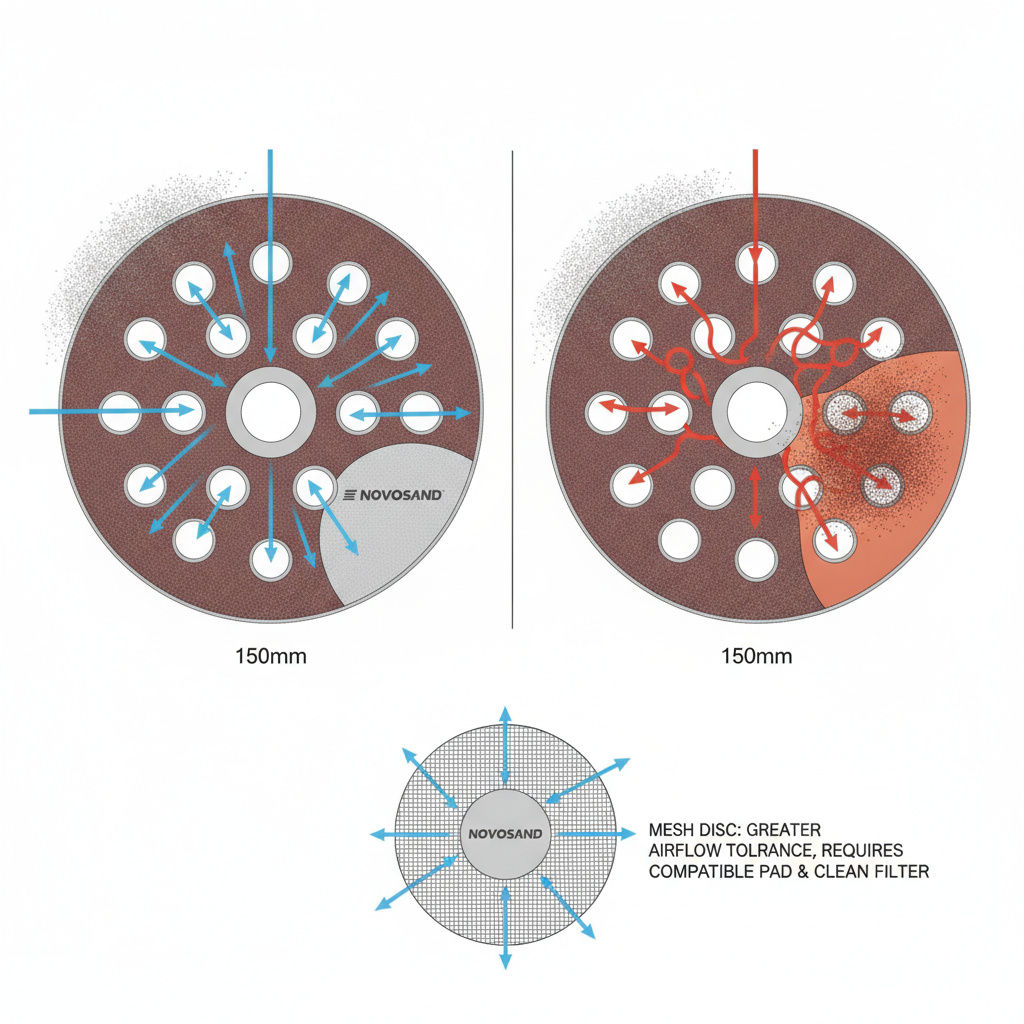
A sanding disc can fit the pad perfectly and still perform poorly if the holes do not match the sander’s extraction ports. When that happens, dust stays at the cutting zone, so the disc loads faster, runs hotter, and leaves a less even scratch pattern.
I saw this clearly with a furniture components plant using 150 mm hook-and-loop paper discs in P180 and P240. They changed from an 8-hole setup to a multi-hole film-backed disc6 because their line had three orbital sander models. The abrasive grain stayed the same—aluminum oxide with resin-over-resin bond—but dust control improved because more openings lined up acceptably across all machines. Disc life increased by around 15-20% on MDF edge sanding. Finish consistency also improved.
From my experience, buyers often miss the backup pad in this discussion. A disc with a smart hole pattern still depends on pad channels, interface pad permeability, and extractor airflow. I have seen mesh discs disappoint in automotive refinishing shops because operators paired them with dense foam interface pads and half-clogged filters. The mesh was not the problem. Airflow was.
Tool compatibility also affects balance and cut feel. A 125 mm ceramic disc with heavy C-weight paper backing may sand aggressively on steel, but if the pad holes only partially align, heat rises quickly during weld blending. I always suggest checking the full stack—disc, pad, interface, and vacuum—before blaming the abrasive.
If a plant runs mixed tools, multi-hole or mesh discs can reduce SKU count. Still, I suggest a short production trial first—check extraction, finish, and pad compatibility on real parts.
On a 150 mm random orbital sander, switching from a mismatched 8-hole disc to a multi-hole disc can improve dust extraction enough to reduce disc loading and heat buildup, even when grit, backing, and diameter stay the same.True
Hole alignment affects whether dust is pulled away from the abrasive/workpiece interface or trapped at the cutting zone. When extraction ports are partially blocked by an incompatible hole pattern, fine dust cakes between grains, increasing friction and temperature. A multi-hole disc does not cut faster because of the holes themselves; it performs better because it maintains cleaner grain exposure and a more uniform scratch pattern across different sander pad layouts.
If a sanding disc matches the pad diameter and uses the same P180 or P240 grit, the hole pattern has no measurable effect on finish quality because vacuum only affects cleanliness, not cutting action.False
This is incorrect because dust extraction directly influences cutting mechanics. Poorly matched holes leave swarf at the interface, which causes the abrasive to load, skate, and generate extra heat. That changes effective cut rate and scratch consistency, often producing a less even surface and shorter disc life. In practice, hole pattern compatibility can matter as much as grit choice when using dust-extracting orbital sanders.
Which abrasives can be wet sanded?
Wet sanding is feasible only with abrasives rated for wet or wet/dry use. Waterproof paper7, film-backed discs, and some cloth-backed products can perform well when the full construction—including backing, resin bond, coating, and attachment system—resists water. Standard dry-only paper discs and sheets may weaken, curl, delaminate, or tear in wet sanding applications such as automotive refinishing, clear coat repair, plastics, and metal finishing.
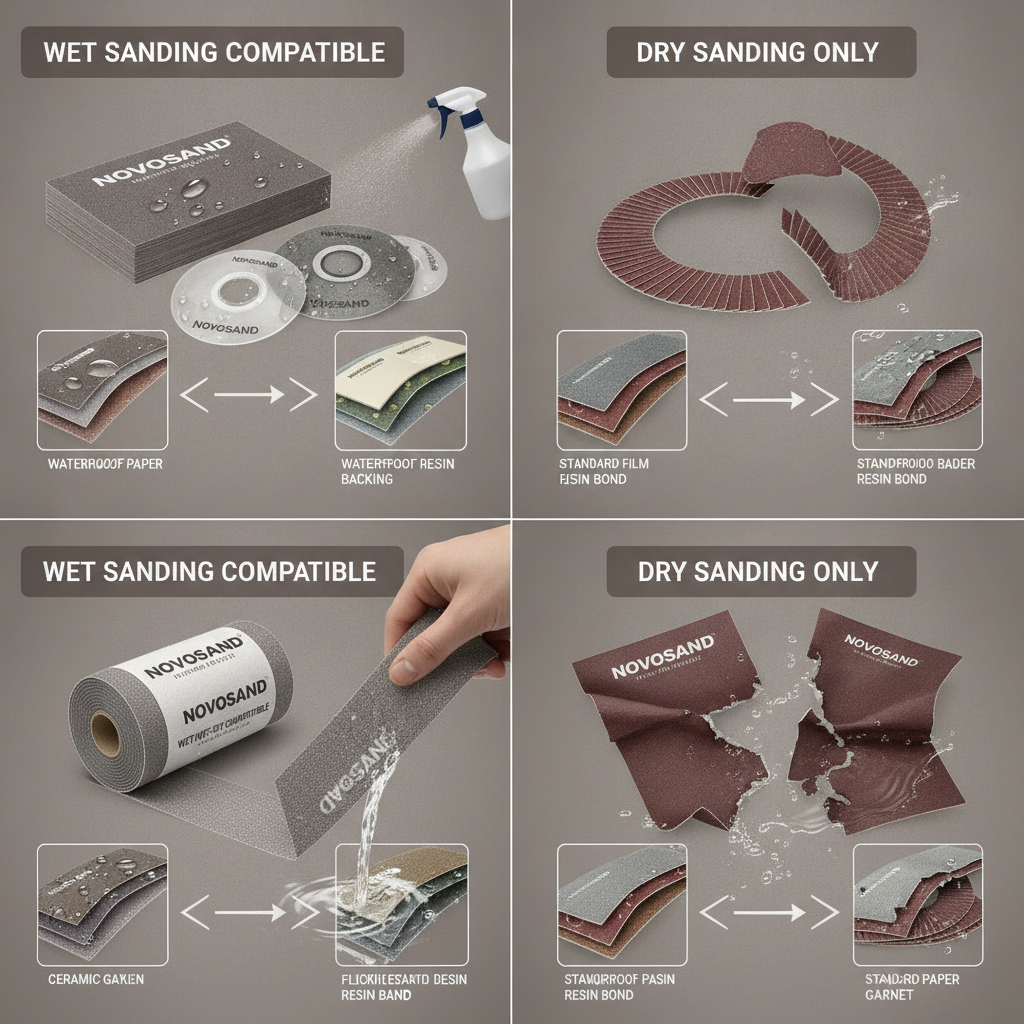
Water changes abrasive performance fast. The key question is not paper or film alone, but whether the full abrasive construction is rated for wet or wet/dry use.
| Abrasive type | Wet sanding suitability | Typical grit range | What matters most | Common risk |
|---|---|---|---|---|
| Standard paper-backed | Usually dry only | P40–P400 | Paper weight and resin bond | Curling, tearing, delamination |
| Waterproof paper | Good for wet sanding | P320–P2500 | Latex paper, waterproof resin, SiC grain | Edge wear if soaked too long |
| Film-backed disc | Very good for wet sanding | P400–P3000 | Polyester film, resin bond, wet-rated PSA or hook & loop | Attachment failure if backing is not wet-rated |
| Cloth-backed abrasive | Depends on construction | P60–P800 | Cloth treatment, bond system, splice or attachment | Stiffness or bond softening |
In automotive refinishing, wet sanding usually starts around P800 to P2000 for primer, clear coat denibbing, or polish prep.
I’ve seen repair shops switch from dry-only paper sheets to waterproof silicon carbide paper and cut disc consumption by around 20–30% on rework jobs.
Why? Less loading, lower heat, and fewer torn sheets.
The finish also stays more uniform.
Film-backed discs perform especially well on high-gloss coatings and plastics because the backing stays flat and dimensionally stable.
Last year, I supported a furniture coating customer using 5-inch P1000 and P1500 film discs on polyester clear coat.
A sanding disc or sheet can only be wet sanded if the entire abrasive construction is rated for wet or wet/dry use; a waterproof-looking backing alone is not enough because the resin bond and attachment layer must also resist water, especially in fine grits such as roughly P320-P2500.True
Wet sanding suitability depends on the full build of the abrasive, not just whether it is paper or film. Waterproof paper products typically use latex-saturated backing and water-resistant resin systems so the backing stays flexible and the abrasive bond does not soften or fail. This is why many wet-sanding products are concentrated in finer grits like P320-P2500, where controlled finishing with water is common.
Any film-backed sanding disc is automatically better for wet sanding than waterproof paper because polyester film cannot absorb water, so manufacturers do not need to use waterproof resin bonds or wet-rated adhesives.False
Film backing is moisture resistant, but wet sanding performance still depends on the full abrasive construction. If the make coat, size coat, resin bond, stearate, or hook-and-loop/PSA attachment is not designed for water exposure, the disc can still lose adhesion, load improperly, or fail prematurely. Wet suitability must be confirmed by the product's wet or wet/dry rating, not assumed from film backing alone.
How Do Industry Norms Guide Selection?
Industry norms provide a practical starting point for selecting sanding discs or sandpaper by application, substrate, and process step. Woodworking often favors paper or film discs for flat surfaces, drywall commonly uses mesh for dust control, and automotive or metal finishing may require film, cloth, fiber, or mesh products depending on shaping, finishing, wet sanding, and surface specifications.
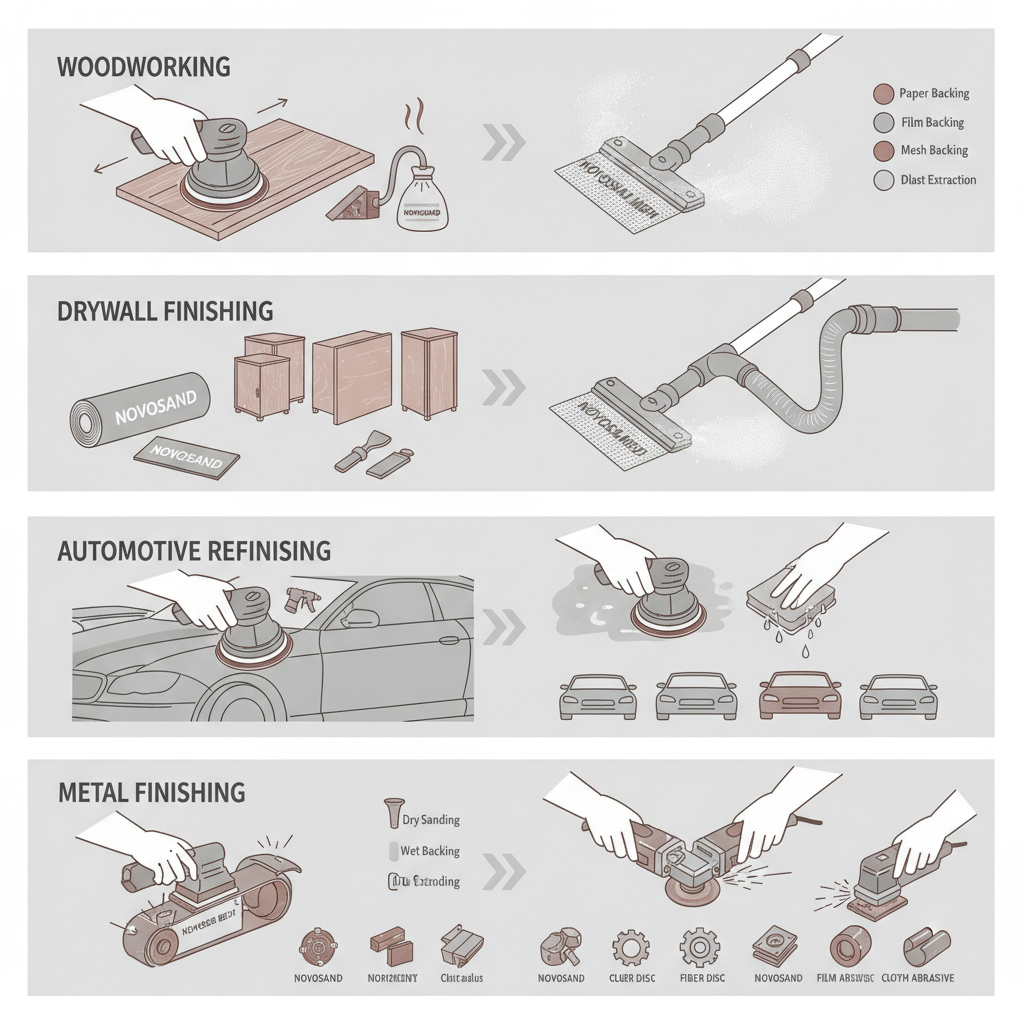
Selection usually starts with the process step, not the catalog. A P80 disc for sealer sanding and a P80 disc for weld blending may share grit size, but they need very different backing, grain, and bond systems.
In woodworking, shops often begin with paper or film discs on 5-inch or 6-inch random orbital sanders8 for flat panels and doors. For example, a furniture plant I supported used P120, P180, and P240 aluminum oxide paper discs on MDF primer sanding, then switched to film-backed discs at P320 for a more stable scratch pattern. Disc life improved by around 20%, and rework on topcoat defects dropped noticeably. For edges and profiles, they still kept sheets and hand pads. That is normal.
Drywall follows a different logic. Dust control drives the choice. I’ve seen contractors using mesh discs in P120 to P220 because open structure helps vacuum extraction and reduces loading. Indoors, that matters more than headline cut rate. If extraction is weak, even a good mesh product can underperform—this is the spec sheet gap many buyers miss.
Automotive refinishing and metal fabrication need a wider mix. A repair shop may use film-backed discs for primer sanding and wet sanding at P600 to P2000, while a metal shop may move from P36 resin fiber discs for weld removal to P80 or P120 cloth-backed discs for blending. From my experience, common practice is a useful shortcut, but only a shortcut.
I always suggest a controlled line trial before standardizing. Compare cycle time, disc usage, surface roughness, dust capture, and operator feedback before making the final call.
Industry norms guide sanding disc selection by process step rather than grit alone: a P80 disc used for sealer sanding on wood commonly uses stearated aluminum oxide on paper or film to reduce loading, while a P80 disc for weld blending is more likely to use ceramic or zirconia grain on vulcanized fiber or cloth-backed construction to withstand higher pressure and heat.True
This is true because grit size only describes particle size, not how the abrasive behaves in a specific operation. Sealer sanding generates fine, gummy dust that loads abrasives, so anti-loading topcoats and flexible backings are favored. Weld blending involves metal removal, heat, and edge wear, so tougher grains, stronger backings, and more heat-resistant bond systems are the norm even at the same P80 grade.
Industry practice treats sanding discs and sandpaper as interchangeable whenever the grit number matches, so a P180 sheet and a P180 random orbital disc should deliver essentially the same finish regardless of backing, hole pattern, or abrasive grain type.False
This is false because identical grit numbers do not guarantee identical scratch pattern, cut rate, or finish quality. Backing stiffness affects surface conformity, hole patterns influence dust extraction and loading, and grain type changes how aggressively the abrasive fractures and cuts. In production environments, these factors are often more important than grit number alone when choosing between a sanding disc and general sandpaper.
How should sanding cost be compared?
Sanding cost should be compared by cost per square meter finished or cost per completed part, not by disc or sheet price alone. A valid comparison includes abrasive purchase cost, usable life, sanding time, changeover time, rework, defect rate, dust-cleanup labor, pad maintenance, and downstream finishing performance at the required surface quality.
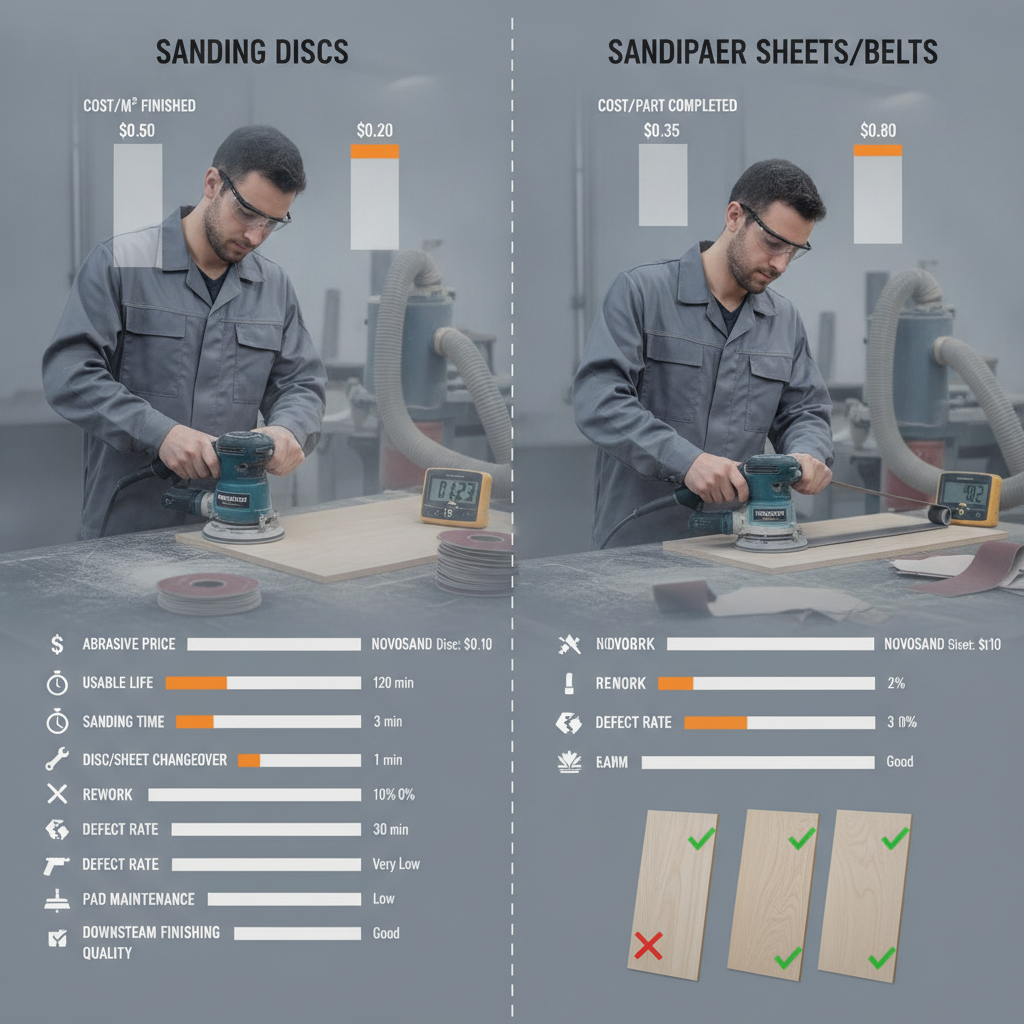
A low disc price can still produce a high sanding cost if operators change abrasives too often, rework scratches, or spend extra time cleaning dust.
The useful metric is cost per finished square meter or cost per completed part at the required surface quality.
| Cost factor | Sheet sanding | Disc sanding |
|---|---|---|
| Unit purchase cost | Usually lower per piece | Usually higher per piece |
| Productivity | Better for detail and hand work | Better for machine sanding |
| Changeover time | Often longer in repeated work | Usually faster with hook & loop |
| Dust control | More manual cleanup | Better with holes or mesh plus extraction |
| Best cost metric | Cost per repaired area or part | Cost per square meter or part |
In one furniture plant trial, the team compared P180 paper sheets with 150 mm P180 film-backed discs on orbital sanders.
The disc cost more per piece, but it finished around 22 cabinet doors per abrasive, versus about 9 doors with sheets used in mixed hand and machine work.
Sanding time per door dropped by roughly 20%, and dust-cleanup labor also fell because extraction worked better.
That changed the economics fast.
From my experience, this is where buyers hit the spec sheet gap.
They compare box price, but ignore cut rate, loading resistance, pad wear, and downstream finishing results like primer holdout and scratch visibility.
A sanding disc that costs 30-50% more per piece can still deliver a lower sanding cost per finished square meter if it lasts about 2× longer and reduces rework from loading or scratch inconsistencyTrue
Comparing abrasives by unit price alone misses labor, downtime, and quality losses. In machine sanding, disc changes, dust cleanup, and correcting scratch defects often cost more than the abrasive itself. If a higher-priced disc maintains cut rate longer and produces a more consistent finish, the total cost per accepted part or per finished square meter can be lower even when the purchase price per disc is higher.
Because sheet sandpaper usually has a lower purchase price per piece, it almost always has the lowest sanding cost per completed part, regardless of machine type or surface quality targetFalse
Lower unit price does not guarantee lower process cost. Disc sanding is typically more productive in machine applications, and faster stock removal, fewer abrasive changes, and less rework can outweigh the higher per-piece disc cost. The correct comparison is cost per finished area or per completed part at the required finish quality, not price per sheet or disc alone.
We’ve covered where sanding discs and sandpaper sheets differ in speed, control, access, and finish quality. The main point is simple: discs improve consistency on broad machine-sanded areas, while sheets still matter for edges, profiles, and final touch-up.
From my experience, buyers get better results when they build the process around the workpiece, not around one abrasive format. I’ve seen the spec sheet gap here too—fast removal looks good on paper, but awkward corners and finish correction still need hand sanding.
If you’re comparing options for woodworking, metal, or finishing lines, feel free to reach out. I’m happy to help you think through grit sequence, backing choice, and where each format fits best in real production. Every application is different—choose what actually works on your floor.
References
-
Explains the hook-and-loop sanding disc fastening mechanism, compatible machine types, and differences in changeover efficiency, and compares its trade-offs with PSA in terms of fine-finishing stability and cost. ↩
-
Explains the dimensional stability of film backings, wet sanding performance, and scratch consistency, and uses fine finishing scenarios to show why it extends service life. ↩
-
Explains how changeover time impacts productivity, labor cost, and per-part cost, and compares efficiency differences and optimization strategies across sanding workflows. ↩
-
Explains in depth the advantages of film-backed discs in ultra-fine sanding, wet sanding, scratch uniformity, and edge durability, especially for automotive filler, coatings, and precision surface finishing. ↩
-
Explains port alignment, airflow, and dust removal mechanics, with practical guidance on reducing loading, heat buildup, and uneven surface defects. ↩
-
Explains in detail the water resistance of film-backed discs in wet sanding, surface consistency, common grit ranges, and PSA or hook-and-loop failure risks for proper selection. ↩
-
Explains how waterproof sandpaper’s substrate, resin system, and silicon carbide abrasive work together for wet applications, including suitable grit ranges and common failure modes. ↩
-
Systematically explains how random orbital sanders affect disc size, backing type, surface finish quality, and sanding efficiency, suitable for procurement and process engineers. ↩