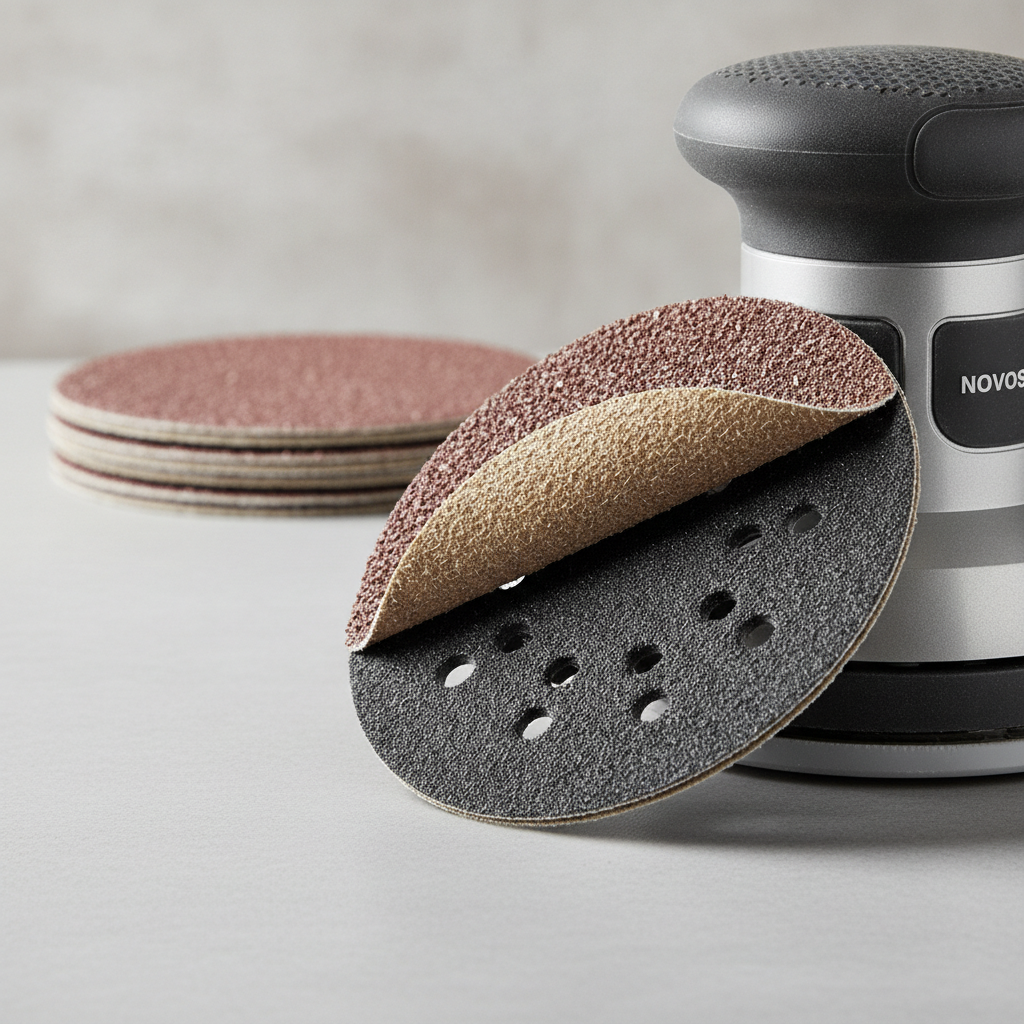
What Is a Hook and Loop Sanding Disc? Expert Guide
Yesterday, a buyer for an automotive refinishing1 shop asked me why their 6-inch discs changed so fast but still left dust everywhere. The issue was not only grit choice. They were mixing the wrong hole pattern with a worn hook pad, which happens more often than many teams expect.
A hook and loop sanding disc is a round abrasive disc that attaches mechanically to a hook-style backup pad2d](https://www.danpoort.com/products/hook-and-loop-sanding-discs/)[^8] through a laminated loop backing. It may use aluminum oxide, ceramic alumina, zirconia alumina, or silicon carbide on paper, film, cloth, or mesh backings. Common sizes include 5 in and 6 in, with larger industrial diameters also available. Performance depends on disc size, hole-pattern alignment, abrasive selection, pad condition, dust extraction efficiency,
What Is a Hook and Loop Sanding Disc?
A hook and loop sanding disc is a round coated abrasive disc with a loop-backed rear surface that attaches mechanically to a hook-style backup pad on a sander. It typically carries aluminum oxide, ceramic, zirconia, or silicon carbide grain on paper, film, cloth, or mesh backing. Many versions include vacuum holes that must match the pad for effective dust extraction and stable sanding performance.
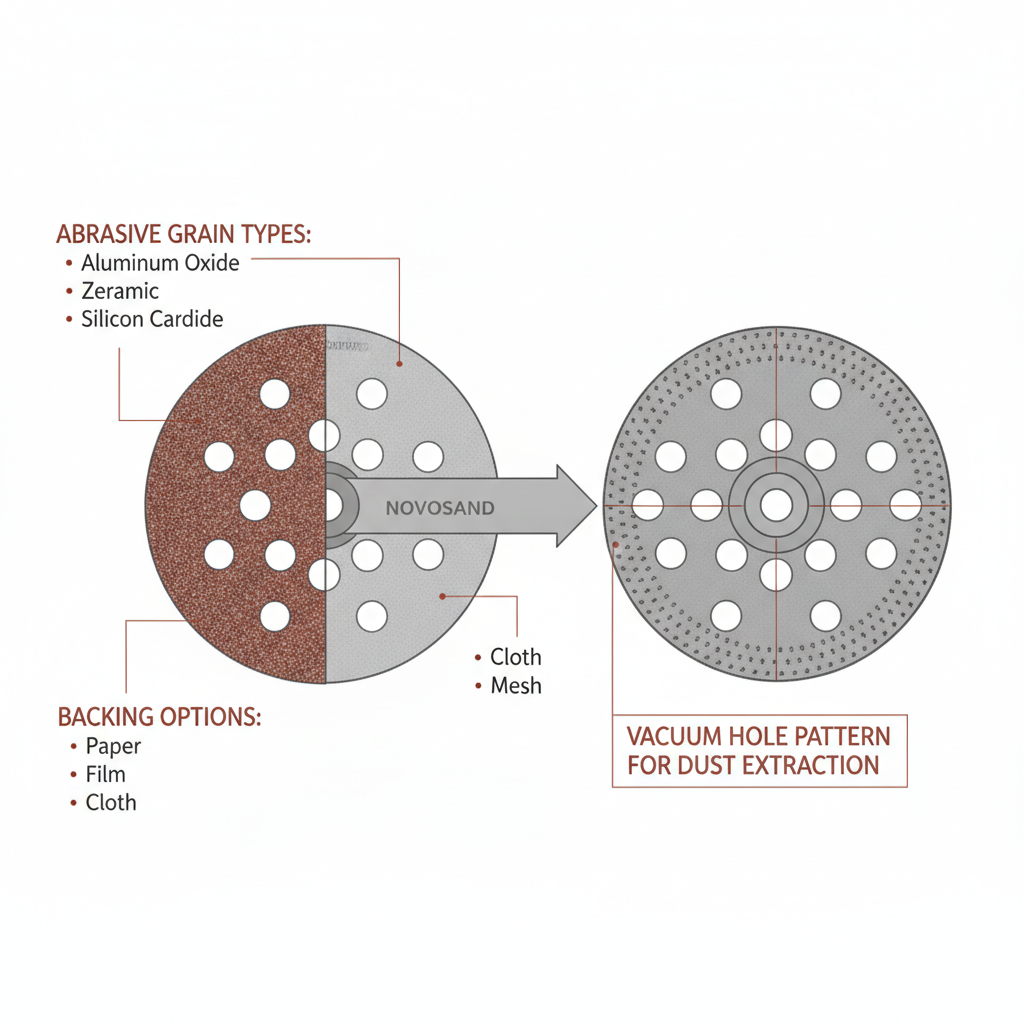
A hook and loop sanding disc is defined by its attachment system, not by the abrasive alone. The front side does the cutting, while the back side uses loop fabric to lock onto a hook-style backup pad quickly and cleanly.
That construction sounds simple, but the details matter. The disc may carry aluminum oxide for general woodworking, ceramic grain for aggressive stock removal, zirconia for tougher metalwork, or silicon carbide for finer finishing. I often see these grains coated on C-weight paper, polyester film, cloth, or open mesh, depending on flexibility, edge wear, and dust extraction needs.
In a furniture factory I supported in East China, operators used 5 in and 6 in hook and loop discs on orbital sanders for primer and sealer sanding. Their grit sequence ran from P120 to P320. After switching from PSA discs, they cut grit-change time from around 25 seconds to under 10 seconds per change, which saved noticeable labor over two shifts. Small change. Real impact.
Hole pattern alignment is another key point. If an 8-hole or multi-hole disc does not match the pad, dust stays on the surface, the disc loads faster, and cut rate drops. I have seen film-backed P240 discs last around 20-30% longer than paper-backed versions in fine sanding because they resisted edge cracking better.
To be honest, many buyers focus only on the attachment style. That is the spec sheet gap. I suggest checking disc diameter, hole pattern, grain type, backing, and pad condition together before placing a full production order.
A hook and loop sanding disc is identified by its loop-fabric backing rather than its abrasive mineral, so the same attachment format can be made with aluminum oxide, zirconia, ceramic, or silicon carbide on paper, film, or cloth-backed constructionsTrue
Hook and loop describes the fastening interface on the back of the disc, not the cutting grain on the front. Manufacturers use this attachment system across many abrasive types and backing weights because it allows fast disc changes while keeping the abrasive specification independent of the mounting method.
Hook and loop sanding discs only work with aluminum oxide abrasives because ceramic and zirconia grains are too heavy for loop-backed attachment systemsFalse
The hook and loop attachment system is not limited by abrasive type in that way. Ceramic and zirconia hook and loop discs are widely used for aggressive sanding and metalworking, and their performance depends on the backing, resin bond, and pad support rather than any supposed incompatibility between heavier grains and loop fabric.
How Do Hook and Loop Discs Compare?
Hook and loop sanding discs attach mechanically to a hook pad, while PSA discs use a pressure-sensitive adhesive backing3. Hook and loop usually costs more per disc but enables faster grit changes and cleaner pad maintenance. PSA can be more economical for long single-grit runs, so the best choice depends on total process cost, changeover frequency, pad condition, surface quality requirements, and operator workflow.
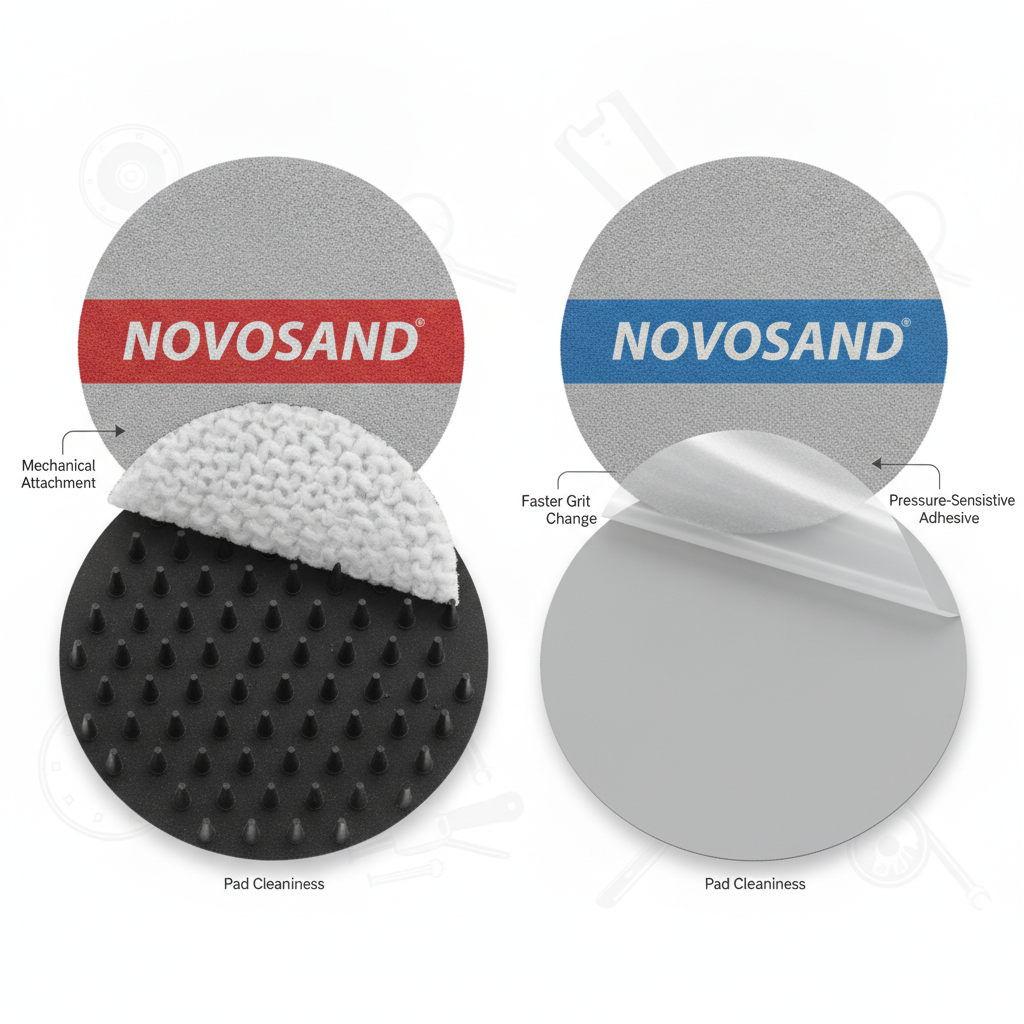
When operators change from P80 to P120 to P180 several times per shift, attachment method starts affecting real production cost. That is where hook and loop and PSA separate quickly.
| Attachment type | Main advantage | Main limitation | Best-fit workflow | Typical issue to watch |
|---|---|---|---|---|
| Hook and loop | Fast disc changes, clean pad swaps | Higher disc cost | Multi-grit sanding and rework-heavy lines | Worn hooks reduce holding power |
| PSA | Lower unit cost, firm bond | Slower changeover, adhesive residue | Long single-grit production runs | Heat or dust can weaken adhesion |
From my experience, hook and loop works better in furniture sanding, automotive prep, and stainless finishing where operators switch grits often.
I worked with a furniture factory in Guangdong using 5-inch P120 and P180 aluminum oxide paper-backed discs on orbital sanders.
After changing from PSA to hook and loop, disc price went up around 12–18%, but pad cleaning time dropped by roughly 20 minutes per shift across one line.
That saved more labor than the disc premium.
PSA still makes sense in steady runs.
I have seen metal shops run one grit for several hours on flat panels, where a PSA disc with a C-weight paper backing stayed stable and kept unit cost lower.
But if the pad gets dirty or overheats, the adhesive can soften and leave residue.
Then the problem is not only disc waste—it also affects surface consistency.
On lines that step through P80, P120, and P180 multiple times per shift, hook and loop discs can reduce total sanding cost even when each disc costs more, because swap time and pad cleaning usually drop enough to outweigh the higher unit price.True
The attachment method affects labor time, machine uptime, and scrap risk, not just disc price. Hook and loop systems are designed for fast grit changes and easy pad swaps, which makes them a better fit for multi-grit workflows and rework-heavy operations. In those environments, the time saved during repeated disc changes can offset a higher per-disc purchase cost.
Hook and loop sanding discs always provide a firmer, more vibration-free attachment than PSA discs because the hook field locks the disc more rigidly to the backup pad.False
This is incorrect because hook and loop trades some rigidity for speed and removability. PSA systems are typically valued for a firmer, flatter bond to the pad, while hook and loop systems are preferred for rapid disc changes. A worn hook surface can also reduce holding power and increase movement, which is specifically a known issue to watch with hook and loop setups.
Why Do Disc Size and Holes Matter?
Disc size and hole pattern affect sanding balance, dust extraction, cut consistency, heat buildup, and finish quality. Common 5-inch and 6-inch discs fit random orbital sanders, while 7-inch to 12-inch sizes serve floor and industrial machines. Matching 5-hole, 6-hole, 7-hole, 8-hole, multi-hole, or net patterns to pad vacuum ports improves dust removal, reduces loading, and supports longer abrasive life.
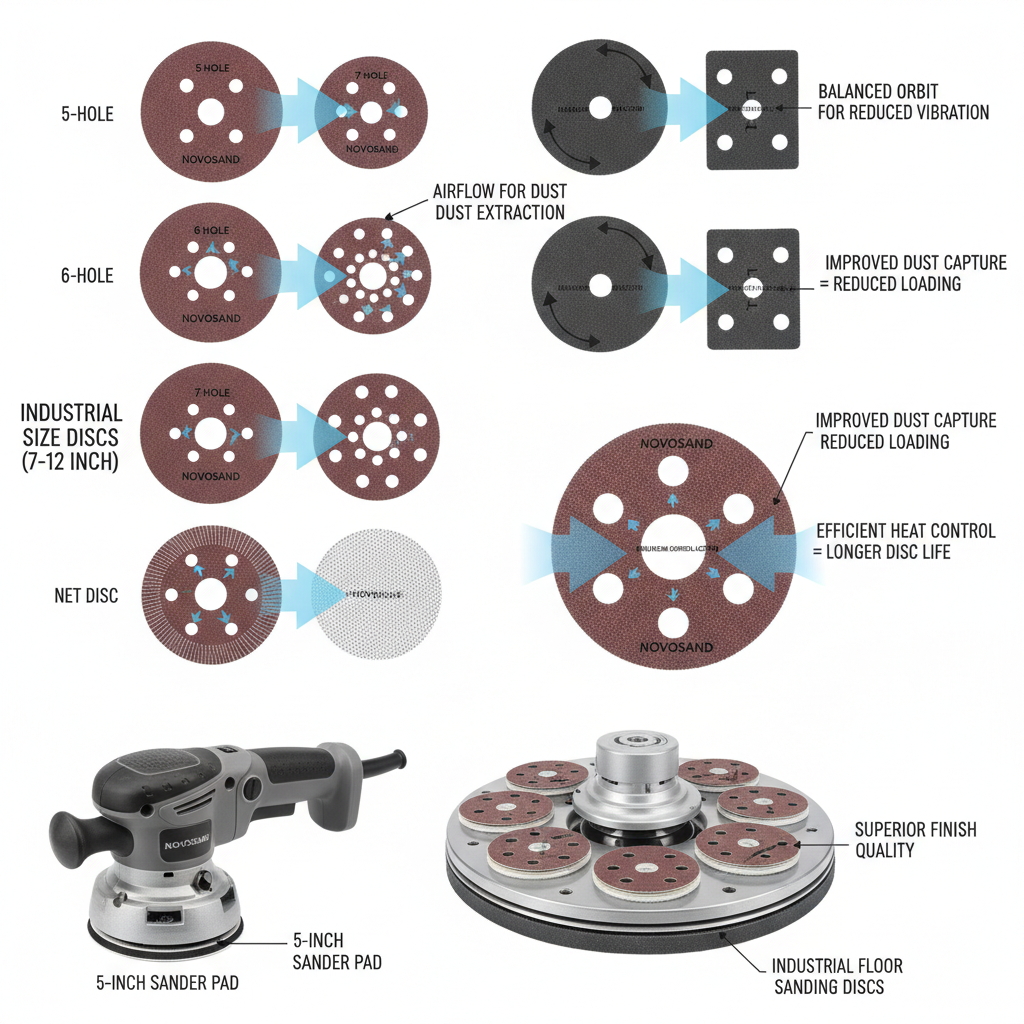
A 5-inch disc on a 6-inch pad will still spin, but it will not sand correctly. Hole pattern mismatch causes a similar problem—less vacuum flow, more dust on the surface, and faster loading.
In random orbital sanding, size affects balance first. A 5-inch or 6-inch hook and loop disc suits most pneumatic and electric sanders, while 7-inch to 12-inch discs go on floor machines or stationary units. If the diameter is wrong, the pad overhang or uncovered edge changes pressure distribution. I’ve seen automotive refinishing shops blame the abrasive, when the real issue was poor pad matching.
Hole layout matters just as much. A 6-hole disc on an 8-port pad can still cut, but dust extraction usually drops noticeably. In a wood furniture plant I supported, they switched from a standard 8-hole aluminum oxide disc to a multi-hole film-backed disc4 in P180 and P240. Disc life improved by around 20-30%, and operators reported cleaner scratch patterns on sealer sanding. Less dust stayed between the grain and the workpiece. That helped finish consistency.
From my experience, this is a common spec sheet gap. Buyers compare grit and price, but they skip vacuum-port alignment. On hardwood flooring and primer sanding, that detail affects heat buildup, clogging, and visibility during the pass.
I always suggest checking three points before standardizing a SKU: pad diameter, hole configuration, and backing type. A short machine trial tells you more than a catalog page. If extraction improves, disc life and finish quality usually improve with it.
On a random orbital sander, using a 5-inch hook and loop disc on a 6-inch backup pad can increase edge pressure enough to leave uneven scratch patterns, because the uncovered outer portion of the pad changes the tool's balance and support across the orbit.True
Disc diameter is not just about coverage; it directly affects how pressure is distributed through the backup pad during orbital motion. When the disc is smaller than the pad, the unsupported outer ring of the pad can alter contact stability, especially near edges and contours. This can lead to inconsistent cut rate, swirl-prone scratch patterns, and reduced finish quality even though the disc still attaches and spins normally.
If the hook and loop attachment is secure, hole pattern mismatch has little effect on sanding performance because dust extraction is controlled mainly by the sander's motor power rather than by hole alignment.False
Hole alignment is critical to dust evacuation. On vacuum-assisted random orbital sanders, the pad, disc, and extraction holes work as a system. If the holes do not line up, airflow drops at the abrasive surface, leaving more dust between the grit and the workpiece. That increases loading, heat, and pigtailing risk, and usually reduces abrasive life regardless of how strong the motor is.
How to select abrasive, grit, backing?
Hook and loop disc selection depends on matching abrasive grain, grit range, backing type, coating, and hole pattern to the substrate and sanding load. Aluminum oxide suits general-purpose sanding, zirconia and ceramic5 handle tougher removal, and silicon carbide fits brittle finishing applications. Paper, film, cloth, and mesh backings affect flexibility, tear resistance, finish consistency, and dust extraction, while grit progression controls removal rate and final surface quality.
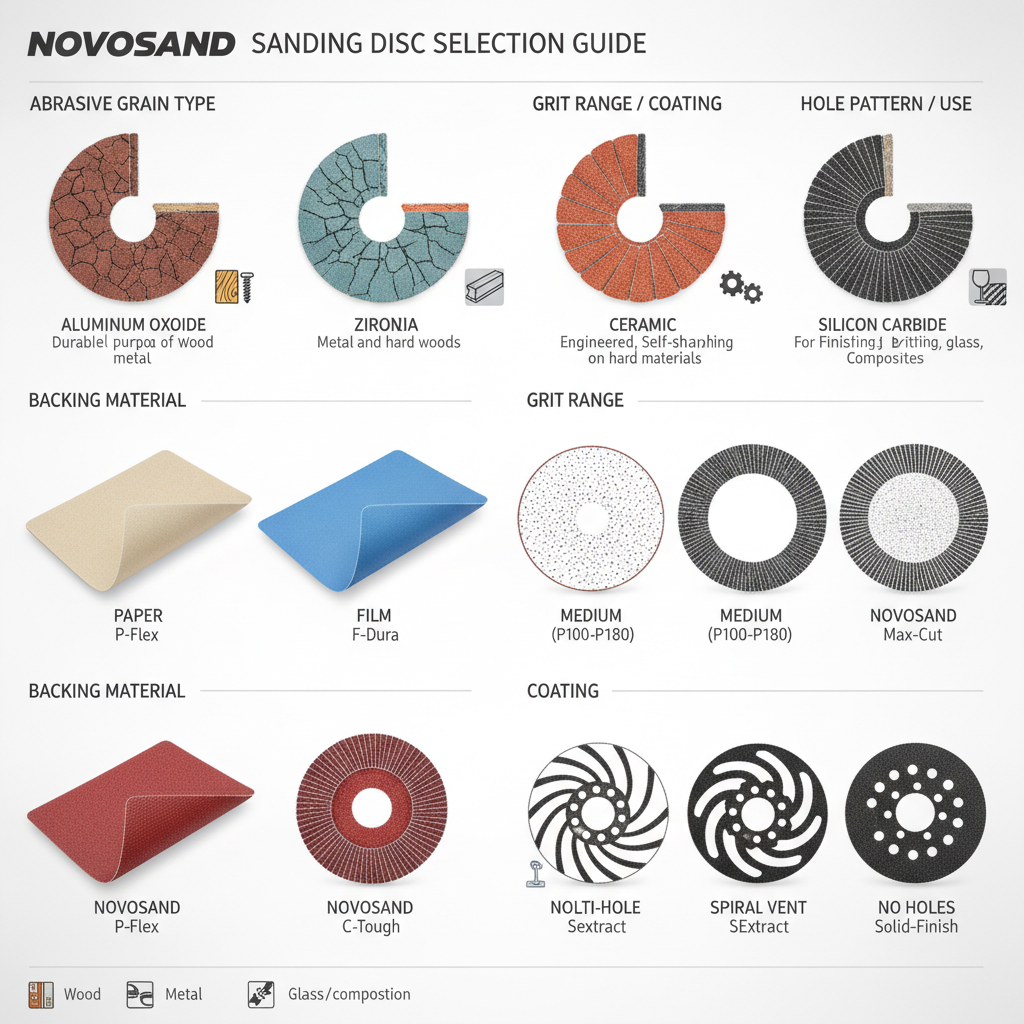
Disc selection usually fails at the same point: the grain cuts well, but the backing or grit sequence does not fit the sanding load. That is why I match five things together—abrasive type, grit, backing, coating, and hole pattern.
For general woodworking and primer sanding, aluminum oxide still gives the best cost balance. For stainless steel, carbon steel, or aggressive stock removal, zirconia and ceramic hold the edge much longer under pressure. Silicon carbide cuts very sharp but fractures faster, so I suggest it for clear coat, fiberglass, plastics, and stone where finish quality matters more than disc life.
Backing changes behavior more than many buyers expect. Light paper works well for hand sanding and lower-pressure machine sanding, while heavy paper or cloth resists edge wear on orbital machines. In one furniture project, a factory in Vietnam changed from a C-weight paper P150 disc to a film-backed P180 disc6 for sealer sanding. Disc life increased by around 25%, and the scratch pattern became more uniform. Less rework.
Grit progression also needs discipline. I usually recommend P40-P80 for stripping or rough leveling, P100-P240 for blending and prep, and P320-P800 for finish refinement. Jumping from P80 directly to P240 often leaves deep scratch carryover. I've seen this create the classic "spec sheet gap"—good sample panels, slow production correction later.
If loading is the problem, choose open-coat or stearate-coated discs, especially on softwood, filler, and primer. For dusty sanding lines, mesh or multi-hole discs improve extraction and keep cut rate stable. I always suggest testing one standardized disc system by application before expanding plant-wide.
A hook and loop sanding disc for primer or wood often performs better when aluminum oxide grain is paired with an open-coat stearated surface in the P180-P320 range, because the anti-loading coating can matter more to finish consistency than switching to a harder grain like zirconia.True
In primer and wood sanding, clogging is a major failure mode. Aluminum oxide remains cost-effective and cuts predictably, while open-coat and stearate treatments reduce dust buildup and premature loading. Zirconia is tougher under high pressure, but on softer materials and coatings it may not improve finish quality if the disc loads before the grain is fully used. Matching grain, coating, and grit range to the sanding load is often more important than choosing the hardest abrasive.
For hook and loop sanding discs on stainless steel, switching from aluminum oxide P80 to silicon carbide P80 always increases disc life by at least 50% because silicon carbide is the hardest common abrasive grain.False
Silicon carbide is very sharp, but it is also more brittle and fractures faster under heavy pressure. On stainless steel and other demanding metals, zirconia and ceramic typically outlast both aluminum oxide and silicon carbide because they maintain cutting edges better during aggressive stock removal. Hardness alone does not determine service life; grain toughness, fracture pattern, heat resistance, and the sanding load are all critical.
What Affects Hook and Loop Compatibility?
Hook and loop sanding disc performance depends on compatibility between the sander pad’s hook field and the disc’s loop backing. Hook density, height, shape, material, loop construction, pad wear, diameter, hole pattern, and rated speed all influence holding power. Worn, contaminated, mismatched, or heat-damaged pads can cause disc slippage, poor dust extraction, uneven wear, vibration, or disc detachment, especially in high-speed industrial sanding.
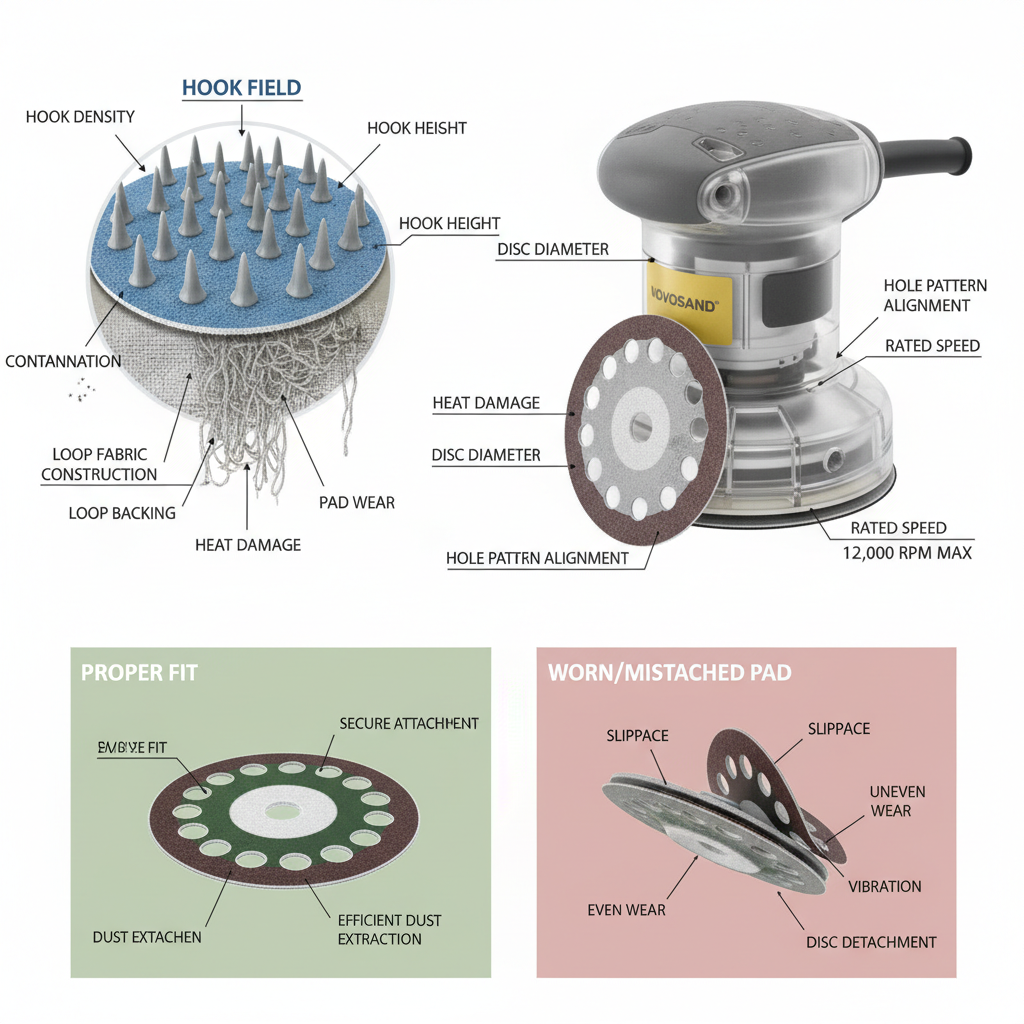
Holding power starts with a simple match: the pad’s hook field has to engage the disc’s loop backing evenly. If hook density, hook height, or loop construction differ too much, the disc may stick at first but fail under heat, pressure, or high RPM.
I’ve seen this issue in a furniture plant running 150 mm P120 aluminum oxide discs on orbital sanders for sealer sanding. Their discs lasted only 20-25 panels before edge lift started. The abrasive was not the real problem. The backup pad hooks had flattened, and dust had packed between the hooks, so only part of the loop backing could grip.
In metal fabrication7, the risk is higher. A coarse P40 ceramic disc cuts aggressively, creates more heat, and pulls harder against the pad, especially on stainless edges or weld seams. From my experience, standard consumer-grade pads can lose holding power 30-40% faster in those conditions than industrial-grade pads with stronger nylon hooks and better heat resistance.
Diameter and hole pattern matter too. An undersized 125 mm disc on a worn pad, or a mismatched dust-extraction pattern, often creates vibration and weakens edge support. I always suggest checking rated speed as well. If the disc and pad do not share compatible maximum RPM, detachment becomes a real safety issue.
The spec sheet gap often sits here—buyers compare grit and price, but ignore hook type and pad condition. To be honest, replacing a tired backup pad at the right time often saves more than changing disc suppliers. I suggest running a small production trial with your actual machine, pressure, and sanding cycle before locking in bulk orders.
A hook-and-loop disc can feel secure during hand inspection yet still release early in use if the backup pad's hooks are too short or partially worn, because high-RPM sanding concentrates peel forces at the disc edge where incomplete hook engagement fails first.True
Compatibility is not just about diameter or pattern; it depends on how completely the hook field meshes with the loop backing across the whole face. If hook height is reduced by wear, loading, or heat damage, the disc may initially attach but develop weak edge retention under orbital motion, heat, and pressure. Edge lift is often an attachment-interface problem rather than an abrasive grain problem.
As long as a sanding disc and backup pad share the same diameter, hook density differences do not affect holding power because orbital sander vacuum holes carry most of the retention load.False
Diameter matching alone does not ensure compatibility. Holding power primarily comes from mechanical engagement between the pad's hooks and the disc's loop backing, not from the dust-extraction holes. If hook density, hook shape, or loop construction are mismatched, the disc may attach unevenly, lose shear strength, and peel under heat or high RPM even when the hole pattern and diameter are correct.
How to maintain hook and loop discs?
Hook and loop sanding disc life is extended through routine pad inspection, proper cleaning, controlled sanding conditions, and correct storage. Pads should be replaced based on hook wear, flatness, heat damage, vibration, and disc retention rather than fixed intervals. Disc longevity also improves with dust extraction, moderate pressure, periodic debris removal, and flat storage in dry, temperature-stable conditions away from heat, sunlight, and contamination.
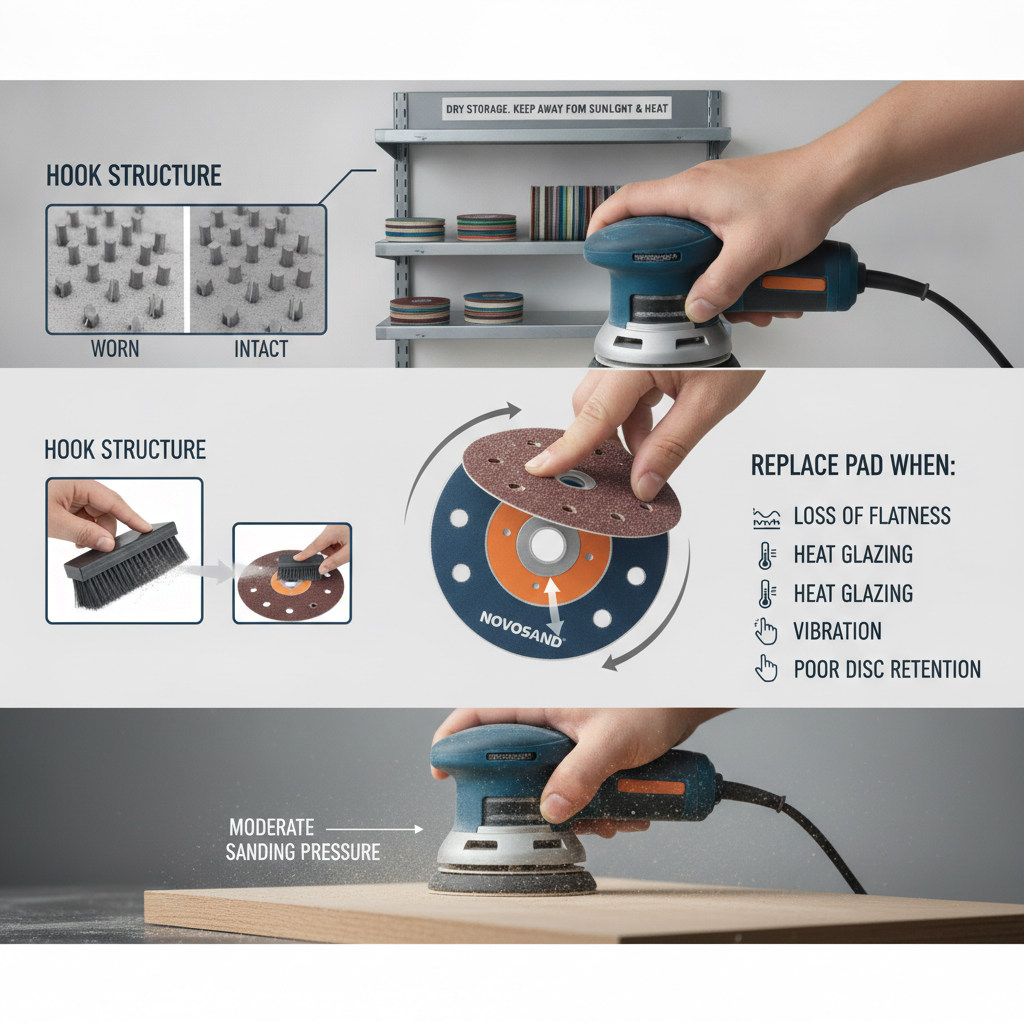
Most hook and loop disc failures start before the abrasive grain wears out. The weak point is usually the interface—flattened hooks, heat-hardened foam, blocked dust holes, or loop contamination that reduces holding power.
Pads deserve regular inspection. In daily furniture sanding, I’ve seen 5-inch pads on random orbital sanders lose grip after 6 to 10 weeks of heavy use, while lightly used pads stayed serviceable for several months. Check hook height, pad flatness, foam rebound, vibration, and whether a P120 or P180 disc still locks on firmly across the full face.
Cleaning helps more than many shops expect. I always suggest blowing off the pad with clean compressed air and brushing resin or dust with a nylon brush at each shift change. If the tool maker allows it, use only approved cleaners—strong solvents can damage the hook field, rubber edge, or adhesive layers under the pad.
During sanding, heat and loading shorten life fast. A cabinet door plant I supported reduced disc consumption by around 20% after adding better dust extraction and training operators to use moderate pressure instead of leaning on 150 mm aluminum oxide discs. The cut stayed steadier, and discs released less dust-packed debris at the edges.
Storage also matters. Keep discs flat, dry, and away from sunlight, heaters, and oil mist, especially film-backed or fine-grit finishing discs above P320, where curl and loop damage show up quickly. From my experience, plants get better consistency when they track reuse count, finish quality, and disc slippage together. I suggest adding pad inspection to preventive maintenance, not waiting for disc throw-off.
A hook and loop sanding disc can start slipping long before the abrasive grain is worn out because blocked dust holes, compressed pad foam, and flattened hooks reduce real contact area and holding power at the interfaceTrue
Disc retention depends on mechanical engagement between the disc's loop fabric and the pad's hooks, not just on the abrasive layer. Fine dust packed into extraction holes or loop fabric prevents full hook penetration, while heat and pressure can harden the backup pad foam so the disc no longer seats evenly. In production sanding, this often causes premature disc throw-off or edge flutter even when usable grain remains.
The best way to restore grip on a worn hook and loop pad is to heat it with a heat gun, because warming the hooks makes them spring back to their original height and extends pad life by several weeksFalse
Thermoplastic hooks do not reliably recover their original geometry once they have been mechanically flattened or heat-damaged. Additional heat usually accelerates degradation by further softening the hook stems, hardening nearby foam, or weakening the adhesive layers in the pad. If hook height, pad flatness, or foam rebound has deteriorated, replacement is the correct maintenance step rather than reheating.
Where Do Hook and Loop Discs Excel?
Hook and loop sanding discs excel in applications requiring frequent grit changes, multi-step finishing, and consistent surface quality. They are especially effective in woodworking, furniture production, automotive refinishing, metal fabrication, and some flooring tasks, where fast disc replacement, clean attachment, controlled scratch patterns, and reduced rework improve process efficiency. They are less suited to heavy weld grinding or maximum stock removal.
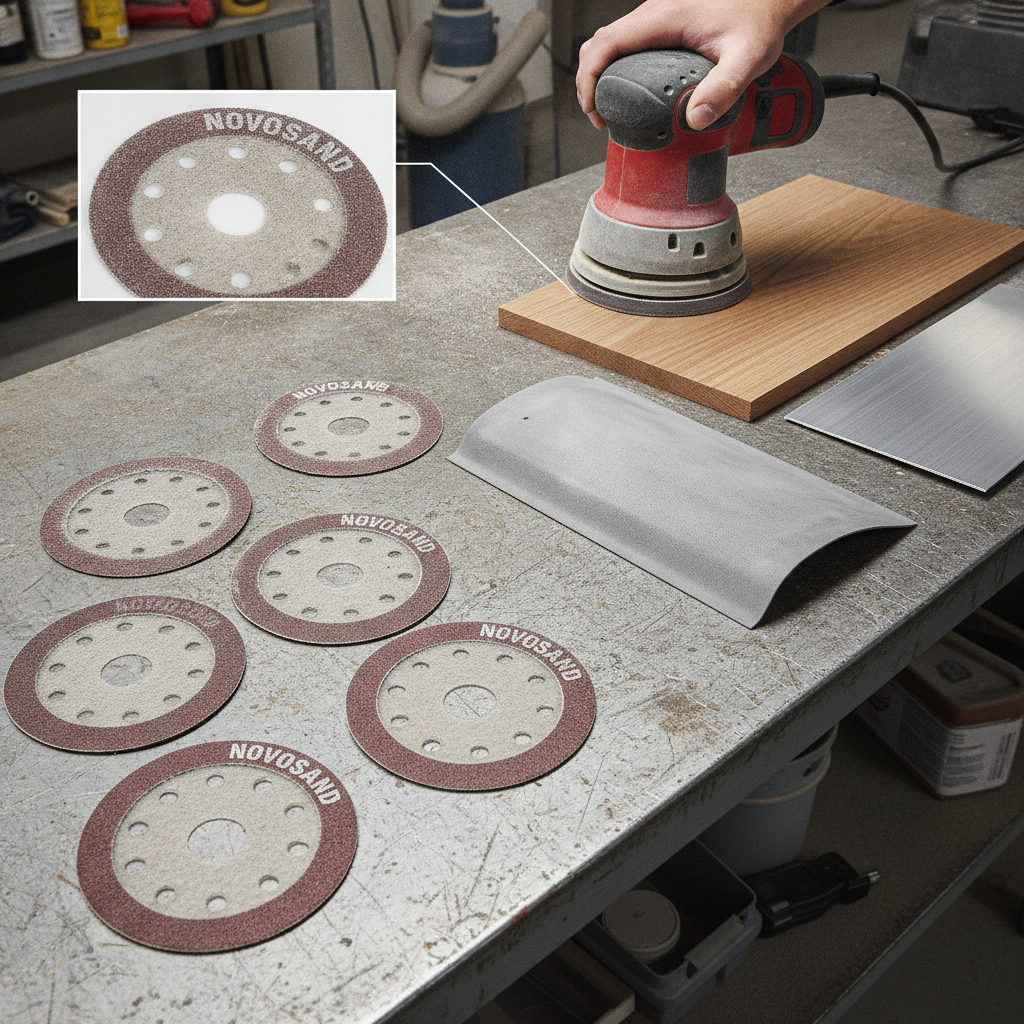
Frequent grit changes decide this category. When a process moves from shaping to scratch refinement in the same shift, hook and loop discs usually save more time than they cost.
Common applications where they perform especially well include:
- Woodworking and furniture production — Operators may run P80, P120, P180, then P240 on the same panel or profile. Hook and loop speeds each change and keeps the pad face clean.
- Automotive refinishing — Technicians often switch between P120 for filler shaping, P240-P320 for primer work, and P800 or finer for paint prep. I’ve seen this workflow cut changeover time by around 20-30% in busy repair shops.
- Metal fabrication — These discs work well for deburring, blending, and surface prep on stainless steel, aluminum, and painted sheet parts. A film-backed aluminum oxide or ceramic disc gives a more controlled scratch pattern than a coarse grinding product.
- Selected flooring jobs — On edge sanders and some orbital floor machines, larger hook and loop discs make grit progression faster. But I would not rank them above belt or drum systems for heavy floor leveling.
From my experience, furniture plants benefit the most. One cabinet factory in eastern China used 5-inch, 8-hole P120 and P180 film-backed discs on orbital sanders for lacquer prep. After switching from PSA discs, they reduced disc-change interruptions by roughly 25% and cut rework on edge burn-through.
The limit is clear too. For heavy weld grinding or aggressive stock removal, I always suggest fiber discs, flap discs, or cloth-backed belts instead. Test hook and loop where finish quality, dust extraction, and speed between grits drive the real sanding cost.
Hook and loop discs excel when a workflow requires three or more grit changes on the same part—such as moving from P80 to P120 to P180 to P240 in woodworking or refinishing—because the quick-change attachment typically reduces swap time enough to outweigh their higher unit cost.True
The main advantage of hook and loop is process efficiency, not maximum retention strength. In operations where operators step through multiple grits in one shift, each fast disc change saves handling time and reduces downtime. That time savings often offsets the higher disc cost compared with slower-change attachment systems, especially in panel sanding, profile work, and automotive repair where grit progression is frequent.
Hook and loop discs perform best in single-grit, high-pressure stock-removal jobs because the fabric hook backing is designed to transfer more torque than fiber or PSA systems and becomes more secure as heat builds.False
Hook and loop systems are usually chosen for convenience and frequent grit changes, not for the highest torque transfer in aggressive, single-step grinding. Under heavy pressure and heat, hook and loop attachment can lose holding performance faster than systems intended for severe-duty stock removal. For constant single-grit use, the quick-change benefit is minimal, so other attachment styles are often more suitable.
How Do Hook and Loop Discs Reduce Cost?
Hook and loop sanding discs can lower total sanding cost when faster changeovers, cleaner disc removal, lower pad maintenance, reduced rework, and reusable partially worn discs offset a higher unit price. Cost effectiveness depends on measured production results, including discs per job, parts per disc, changeover time, defect rate, downtime, and finish consistency. Stearate-coated and open-coat versions may further improve performance on loading-prone substrates.
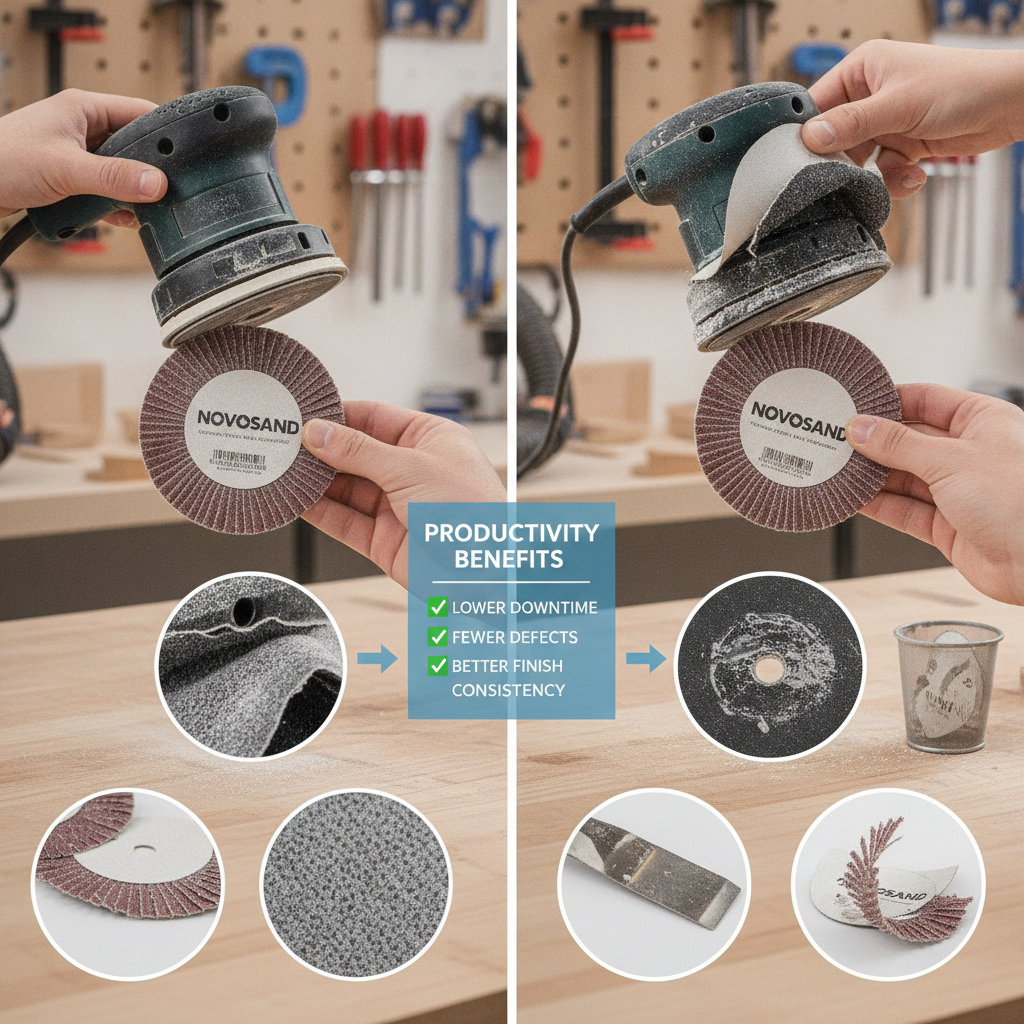
The price tag alone rarely tells the real sanding cost. Hook and loop discs often cost more per piece, but they can still reduce cost per part when operators change discs quickly, remove them cleanly, and avoid damaging the backup pad.
In one furniture plant I supported, operators switched 150 mm P120 aluminum oxide discs around 40 times per shift. With PSA discs, each change took roughly 25-30 seconds because they had to peel carefully and clean adhesive residue. Hook and loop cut that to about 8-10 seconds. That saved close to 15 minutes of labor per operator each shift. Small number, real money.
I’ve also seen pad life improve in woodworking and primer sanding lines. PSA removal can tear pad faces or leave glue contamination, especially when shops rush disc changes. One cabinet factory in Guangdong reduced pad replacement from about every 3 weeks to around every 5 weeks after changing to hook and loop film-backed discs for P180 to P320 finishing. Less maintenance. Less downtime.
Another cost point is disc reuse. If an operator uses only half of a P240 disc on profile edges, hook and loop lets them remove it and reinstall it later. PSA usually gets wasted once peeled. To be honest, this matters most in mixed production, not long single-run jobs.
Loading resistance also affects total cost. On primers, fillers, and resinous softwood, I often suggest open-coat or stearate-coated discs because they reduce loading and keep cut rate more stable. My advice is simple: track discs per job, changeover time, pad replacements, and rework before and after a trial. That data shows the real ROI.
In high-changeover sanding operations, a hook and loop disc that cuts change time from about 25-30 seconds to around 8-10 seconds can recover 10-15 minutes of labor per operator per shift, which often outweighs a higher per-disc purchase price.True
Total sanding cost includes labor and downtime, not just disc price. If an operator changes discs roughly 40 times per shift, saving even 15-20 seconds per change returns about 10-13 minutes of productive time. Hook and loop systems also reduce time spent scraping PSA adhesive residue, so the real savings can show up as lower cost per part rather than lower cost per disc.
Hook and loop discs reduce cost primarily because their cloth backing makes them inherently 30-50% more abrasive-efficient than PSA discs of the same grit and mineral.False
Hook and loop versus PSA describes the attachment system, not the abrasive cutting chemistry. Cut rate and life are driven mainly by abrasive mineral, grit size, coating density, backing weight, and resin system. While some hook and loop discs use stronger backings, the attachment method alone does not make a disc intrinsically 30-50% more efficient at material removal.
We’ve covered what hook and loop sanding discs are, how they attach, and which factors actually affect sanding performance in real use. The attachment system mainly helps with fast disc changes, clean removal, and possible reuse.
From my experience, buyers get better results when they look beyond attachment style and check abrasive grain, backing strength, hole alignment, disc size, and pad condition together. That’s where the spec sheet gap often shows up.
Have questions about matching disc type, hole pattern, or backing pad to your application? I’ve worked with customers in woodworking, metalworking, and automotive refinishing, and I’m happy to share what works in real production settings. Feel free to reach out.
References
-
Details sanding workflows in automotive refinishing, including grit progression, primer sanding, and paint preparation processes, helping optimize efficiency and achieve more stable surface quality. ↩
-
Explains pad construction, compatibility, and attachment mechanics, helping buyers prevent poor fit, disc failure, and inefficient sanding. ↩
-
Explains the adhesion principle of PSA backings, their heat and dust resistance performance, and adhesive residue risks, helping procurement and process engineers decide whether they are suitable for long-duration single-grit operations. ↩
-
Provides a detailed explanation of perforated film-backed abrasive discs, including dust extraction, anti-loading performance, scratch uniformity, and extended service life advantages, useful for comparing abrasive structures. ↩
-
Systematically compares zirconia alumina and ceramic abrasives in terms of cutting efficiency, heat resistance, and durability, helping users select the right option based on metal type and working pressure. ↩
-
Explains in depth the durability, scratch consistency, and surface quality advantages of P180 film-backed discs in sealed primer sanding, combined with real application scenarios. ↩
-
Explains key grinding considerations in metal fabrication such as deburring, blending, and surface preparation, and compares scratch control and material suitability differences. ↩